

Everyone wants a bargain. Even if you don’t need that extra shirt or pair of sneakers, getting a bargain heightens the senses. Why wouldn’t you jump on it? When it comes to fantasy basketball, the same logic applies. Anytime you can find yourself a deal, jump on it. Both feet, all in. As long as it fits and makes sense, go for it. In fantasy basketball terms, that means we’re talking about sleepers.
Now, if you happen to be a New York Knicks fan, don’t buy a Boston Celtics jersey just because it’s on sale. And don’t be greedy, either. Any discount you find is a plus. The worst thing you can do is come home to a closet full of shirts with no shorts or pants. Likewise, don’t sit at your fantasy basketball draft and grab a slew of guards because they were sleepers and then realize you don’t have any forwards or rebounds.
What?! Your fantasy basketball league wasn’t hosted on Fantrax? Inconceivable! Check out all the features of Fantrax Fantasy Basketball Commissioner, and we’re pretty sure you’ll come around to our way of thinking.
It’s still all about balance. Of course, while finding value with each draft choice. Now, let’s take a look at players being drafted outside the first six rounds, about 75 picks, that represent value. Here are my top 10 sleepers for the 2025-2026 fantasy basketball season.
Top 10 Sleepers for 2025-26 Fantasy Basketball
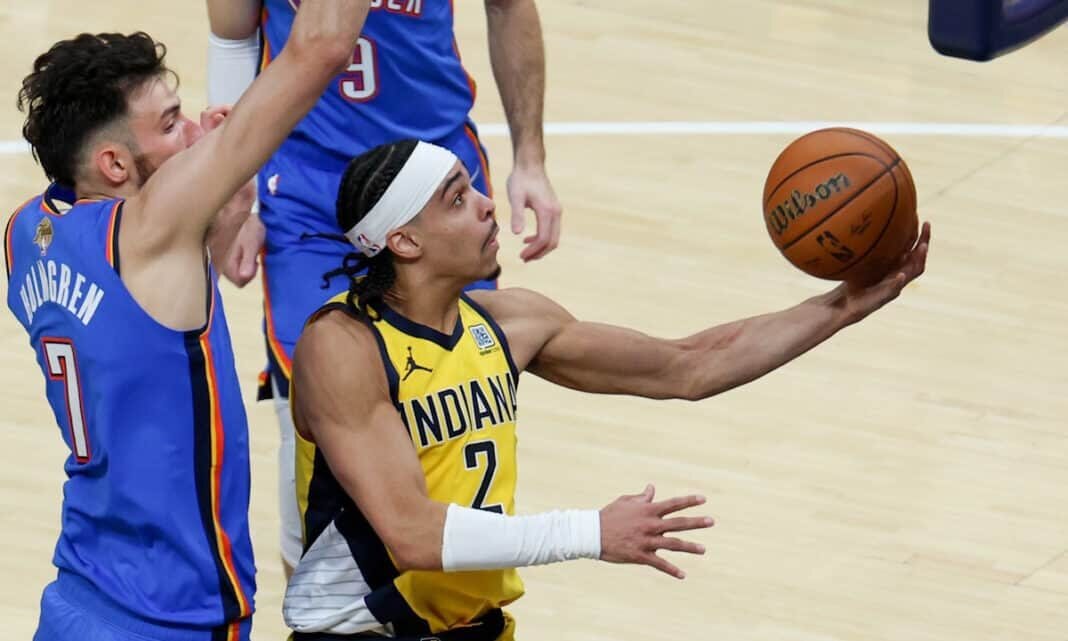
1. Andrew Nembhard, G, Indiana Pacers
It’s all about usage. With Tyrese Haliburton sidelined for the season, Andrew Nembhard’s usage is set to increase this season. The point guard and his 16.4% usage rate move into the starting lineup after Haliburton had a 22% usage rate last season.
With Haliburton in the fold last season, Nembhard averaged 10 points and five assists last season to go along with about a steal and three-pointer per game. In the playoffs, that went up to 12.5 points per game with 1.7 three-pointers and 4.7 assists.
Nembhard’s ascension is two-fold: an expected increase of about five percent, along with five to seven more minutes per game. While he might not light up the scoreboard, he should jump up a few points and add a few more assists per game as well. The point guard will add a few rebounds while knocking down two or three shots from long distance.
2. Michael Porter, F, Brooklyn Nets
Someone has to score for the Brooklyn Nets. They’re likely going to be playing from behind, in blowouts, for the majority of the season. To say that there are limited veteran players, or those who can score, is an understatement.
Across all facets of the game, there’s limited competition for Michael Porter. He goes from being the third or fourth option on a championship team in Denver to sharing the number one duties with Cam Thomas.
The big thing for Porter is that he has been healthy, playing in 81 and 77 games the last two seasons. Last year, he averaged a strong 18.2 points and seven rebounds per game. The one concern, though, is whether he can maintain his 50.4% field goal percentage due to the downgrade in offense and playmakers.
Among forwards, Porter is an asset, with 2.5 three-pointers per game in 2024-2025. This year, it wouldn’t surprise me to see him surpass his career best of three per game.
3. Anfernee Simons, G, Boston Celtics
After spending the first seven years of his career, things are quite different for Anfernee Simons this season. The guard now calls Boston home, and it’s a very different Celtics team than we were previously accustomed to.
Jayson Tatum is out for the season. Jrue Holiday and Kristaps Porzingis both play for other teams. That means someone has to make up for that missing offense. Simons is going to play a large part of that as he steps into a major backcourt role.
Over the past three seasons, Simons averaged between 19.1 and 22.6 points per game. The guard doesn’t contribute much in the way of steals, and I’m not sure we’ll see more than four or five assists per game. However, he will make about three shots per game from long distance, as well as shooting around 90% from the foul line.
4. Paul George, F, Philadelphia 76ers
Yes, Paul George is 35 years old. The forward has also battled his share of injuries, and can we really trust him? Once he gets going at the beginning of the season, George will enter 2025-2026 healthy.
At this point in the draft, around the 10th or 11th round, it’s really time to take a chance. And with George, we truly get two extremes. In the last five years, George was a top-10 player twice, and two other times he was out of the top-150. The fact that George is still dealing with the remnants of an off-season injury likely depresses his draft value.
However, even last year, when George was on the court, the results were strong. The veteran averaged 16.2 points, 5.2 rebounds, and 4.3 assists per game to go along with 1.8 steals. Even if he doesn’t play this preseason, I’m taking a shot on George at this point in the draft.
5. Jaden Ivey, G, Detroit Pistons
After a strong finish to the 2024-2025 season and a tough playoff series, the Detroit Pistons are on their way up. While Jaden Ivey wasn’t a part of their late-season run, that changes for this year as he’s healed from a broken leg.
Ivey returns right to the starting lineup and should pick up right where he left off. And that was within a breakout season. Through 30 games, Ivey averaged 17.6 points, four assists, and 4.1 rebounds per game in just 30 minutes of action. Assuming he goes back to his 26% usage, Ivey represents value heading into the 2025-2026 season.
6. Kyle Filipowski, C, Utah Jazz
The Utah Jazz are a team not going anywhere in the 2025-26 season, and that’s perfectly fine from a fantasy standpoint. And it works out perfectly for Kyle Filipowski. When searching for sleepers, when that option happens to be eligible at center, it’s even better.
Filipowski is looking to build on what was a strong conclusion to his rookie season. The center averaged a strong 14 points and 8.7 rebounds per game over 27 minutes in his last 16 games. He then continued that momentum this summer with 23.2 points and 9.5 rebounds per game.
As a center, his proficiency at three-pointers is an asset. We aren’t going to be blocked shots here, and he can improve from the free-throw line, but based on expected volume, Filipowski is a strong sleeper.
7. Reed Sheppard, G, Houston Rockets
Last year, in his rookie season, it was so slow start to Reed Sheppard’s career. He averaged just 13 minutes a game while scoring 4.4 points and 1.4 assists. Heading into this season, Sheppard’s ADP is all over the place, but on average, you can grab him around the 11th or 12th round.
That represents good value as Sheppard will likely be starting this season for the Rockets. With the addition of Kevin Durant, Houston should be an exciting offense. Sheppard is in a great position to capitalize on that. Last season, he averaged about one steal and one three-pointer per game. As his playing time increases, that production should follow.
8. Mitchell Robinson, C, New York Knicks
Let’s get it out of the way; the free-throw percentage is going to be terrible. But if you can get past that, Mitchell Robinson represents solid sleeper value.
Entering the season, it appears that Robinson will be starting for the Knicks alongside Karl-Anthony Towns. That means plenty of rebounds for Robinson after he averaged 5.1 points and 5.9 rebounds per game in 17 minutes last year. With extended playing time, a double-double is quite feasible for Robinson, along with a steal and block or two a game. With his limited range, you’ll also get the benefit of his 66.1% field goal percentage from last year.
9. Jonathan Kuminga, F, Golden State Warriors
I want more. He’s capable of more. But will we see out of Jonathan Kuminga this season?
Once again, we can expect the forward to likely play around 25 to 28 minutes a game, and he’ll continue to be a solid option with upside. After the Warriors committed two more years to Kuminga, there’s no reason for him not to carve out a legitimate role. And at age 23, there’s still a good amount of upside present.
That’s not to say that Kuminga will have a breakout season, but in the 13th round, he represents solid sleeper value. Last year, Kuminga averaged 15.3 points and 4.6 rebounds per game. His fantasy production does have a cap, and that includes his 66.8% free-throw shooting, but he can do more.
10. Kyle Kuzma, F, Milwaukee Bucks
With Kyle Kuzma, this is a volume play. The forward will be starting for the Milwaukee Bucks on a nightly basis, and that means regular playing time. That also means Kuzma will be in position to rack up some fantasy production.
Last year was a down season for Kuzma, and he averaged just 14.8 points per game. In the last two year,s though, Kuzma averaged 21.2 and 22.2 points per game. He should also kick in six or seven rebounds and a few assists while knocking down about two three-pointers per game. When you get down to around pick 160, it’s hard to argue with that.
Fantrax is one of the fastest-growing fantasy sites in the fantasy sports industry, and we’re not stopping anytime soon. We are the most customizable, easy-to-use, and feature-rich platform in the industry, offering the greatest fantasy experience for your dynasty, keeper, redraft, and best ball leagues. Fantasy sports doesn’t sleep, and neither does Fantrax, with seasons running 365 days a year. Take your fantasy leagues to the next level now at Fantrax.com!