

Well, I was bang on with last week’s buy-low and sell-high candidates. And while I would love to spend the next thousand words congratulating myself, there is a more pressing matter at hand. We have trades to make, managers to manipulate (respectfully, of course), and a fantasy season to win.
The Art of Playing the Long Game
The temptation at this point is to become a prisoner of the moment. A player strings together three outstanding performances and suddenly he is untouchable. Another struggles for a fortnight and his manager starts wondering whether the waiver wire might offer a better return.
This is precisely where we want to operate.
Fantasy basketball is a long game. And although winning November is lovely, nobody is handing out championship trophies because your roster looked impressive after three weeks.
The objective is to identify where perception has drifted from reality, find managers willing to act on that perception, and make transactions that leave us better positioned for the months ahead.
So, let’s see if we can run it back.
NBA Fantasy Buy Low
Jalen Brunson | New York Knicks
Maybe the lights of New York have finally shone a little too brightly on the NBA Finals MVP and last year’s NBA champions. Between Saturday Night Live appearances, Law & Order cameos and the endless media obligations accompanying basketball stardom in the Big Apple, one could argue the Brunson publicity machine has been operating in overdrive.
His basketball game, however, has not.
Nor have the Knicks, for that matter.
Through six games, Brunson is averaging 25.5 points, 5.2 assists, 2.8 rebounds, and a steal per 35.2 minutes. Respectable numbers on the surface. Yet beneath those counting stats is a shooting profile that has dragged a player drafted for Top 30 production outside the Top 100 in category leagues.
The culprit is his 39.5% shooting from the field. Throw in 32.5% from beyond the arc, and an uncharacteristic 76% from the charity stripe, and suddenly the percentages are doing considerably more damage than the counting stats can repair.
The free throws are particularly important. One of Brunson’s greatest fantasy assets has always been his ability to generate significant volume at the line while converting at an excellent rate. When that advantage becomes a liability, even temporarily, the impact on his category ranking can be substantial.
But nothing in Brunson’s opportunity suggests some dramatic erosion of his fantasy relevance. He is still playing heavy minutes, commanding the offence and getting the opportunities that made him such a desirable asset.
The shots simply aren’t falling.
And sometimes the simplest explanation is the correct one. A proven offensive player experiencing a cold shooting stretch is not necessarily declining. More often, his fantasy ranking is temporarily disconnected from his actual value.
We don’t need Brunson to become a better basketball player. We just need him to return to being the one we already know.
If his manager is frustrated with the lack of returns on a premium draft investment, I would be making enquiries. Particularly if I could package players currently outperforming expectations.
Buy the frustration. Then enjoy the inevitable shooting correction (but don’t expect near .500 numbers).
Austin Reaves | Los Angeles Lakers
Austin Reaves is a peculiar buy-low candidate because, in many respects, he is playing outstanding basketball.
Across eight games, Reaves is averaging 23.6 points, 5.1 assists, and 3.3 rebounds while shooting an outrageous 53.9% from the field, 44.4% from three and 86.5% from the line.
Those are percentages that usually have fantasy basketball managers sitting rather smugly atop their league standings.
Yet Reaves is outside the Top 60 in category leagues.
The culprit? Turnovers. A whopping 4.6 per game, alongside a mere 0.9 steals.
Now, I am not pretending Reaves will maintain his current shooting percentages. That would be an optimistic exercise in statistical gymnastics. However, we shouldn’t assume his turnover rate remains this destructive either.
And therein lies the opportunity.
The Lakers are putting together an impressive run led by Luka Dončić, while the feel-good Walker Kessler vibes are strong. With the spotlight gravitating towards those two, some shine has been removed from a player targeted towards the end of the second round or beginning of the third in competitive drafts.
Reaves is still producing offensively, and the path towards a significant ranking improvement doesn’t require an extraordinary increase in scoring.
It requires him to stop giving the basketball to the opposition quite so frequently.
There is a caveat. His responsibilities as a creator mean turnovers won’t disappear. But even a modest reduction, coupled with slightly better defensive production, could make his current ranking look rather misleading.
I still see legitimate Top 25 upside here.
The challenge is finding a manager prepared to sell. Rather than offering a conventional points-for-points trade, I would look for an inverse relationship. Perhaps a player offering rebounds, defensive statistics, and lower turnovers. Somebody who addresses the weaknesses Reaves currently presents.
Remember, a successful trade isn’t necessarily about offering the most talented player.
It’s about offering the player your opposing manager believes they need.
LaMelo Ball | Minnesota Timberwolves
The quickest player in NBA history to reach 1,000 made three-pointers.
Quite the achievement.
A fantasy ranking hovering around 100? Considerably less impressive.
LaMelo Ball’s arrival in Minnesota generated significant intrigue. With Anthony Edwards absent, there was an expectation that Ball might seize the opportunity to deliver the fantasy production that has made him such an enticing, albeit frustrating, asset.
Regrettably, that hasn’t happened. At least not yet.
Through eight games, Ball is averaging 16.9 points, 5.9 assists, 3.6 rebounds and 1.8 steals in just 26.1 minutes. His 42.7% shooting from the field is hardly disastrous, while 36.6% from beyond the arc is respectable.
But limited playing time, modest scoring, and 3.6 turnovers have left his production well below draft-day expectations.
There are encouraging signs, though.
The 1.8 steals provide an excellent foundation for category production, while the assists remain useful. Even in reduced minutes, Ball is demonstrating the statistical versatility that has historically made him valuable.
More importantly, the minutes provide an obvious pathway towards improvement.
At 26.1 minutes per game, Ball simply isn’t spending enough time on the court to consistently deliver the counting statistics associated with his ceiling. An increase in playing time would naturally lift his scoring, assists, and three-point production.
Now, I’m not suggesting Minnesota will hand him 35 minutes tomorrow. Nor should we ignore the possibility that his current role reflects genuine limitations within the rotation.
But the gap between his current ranking and established upside is substantial enough to warrant attention.
He has already climbed inside the Top 75 over the past week, suggesting the correction may be beginning.
And that’s the problem with buying low. Wait until everybody is comfortable again, and the discount has usually disappeared.
The window is now.
Buy-Low Honourable Mentions
Nickeil Alexander-Walker | Atlanta Hawks: I discussed NAW last week, and I’m not abandoning ship because the market hasn’t immediately agreed with me. The role and defensive production are there, and I still believe Top 50 value is waiting to emerge. Keep knocking.
Lauri Markkanen | Utah Jazz: Markkanen’s combination of scoring, threes and rebounds deserves attention whenever his market value slips. There are availability considerations, but if somebody is discounting the talent because of a frustrating stretch, I’m listening.
Desmond Bane | Orlando Magic: Bane is a perennial buy-low candidate. So much so that I’ve circled December 1 on my calendar with the reminder, “Send offers for Desmond Bane.” That’s a week before my father’s birthday on December 6. Make it your annual reminder. Some families have Christmas traditions. Fantasy managers have Desmond Bane trade offers.
NBA Fantasy Sell High
WARRIORSSSSSSS! | Yaxel Lendeborg & Stephen Curry
Last week, I discussed the merits of selling high on Yaxel Lendeborg.
And this week? Well, we’re reheating the leftovers.
Only the oven temperature has increased; the Yaxel hype has escalated, and the potential return may be even more appetising.
The argument remains straightforward. Lendeborg is an enormously intriguing young player whose opportunity within Golden State’s unusual season presents legitimate upside. However, when somebody is already delivering fringe Top 40 value, how much upside remains? And how much more are opposing managers prepared to pay for the possibility of something greater?
I love Yaxel, too. I just might love the established Top 30 player somebody is prepared to give me a little more for him.
And speaking of optimism, let’s discuss Stephen Curry.
The greatest shooter in NBA history is currently inside the Top 5 in nine-category leagues. Across six games, Curry is averaging 30 points, 4.5 assists, 4.2 rebounds and 1.3 steals while shooting 46.8% from the field, 42.9% from three and his usually elite free-throw percentage (98.1%).
And while watching a rejuvenated Curry rain down three-pointers like it’s 2016 is wonderful, how much of this can we reasonably expect to continue?
Maintaining 30 points per game across an entire season is also a different proposition from doing so across six appearances.
Then there’s the elephant in the Chase Center.
Golden State’s longer-term direction.
Steve Kerr has discussed managing Curry’s workload, and the Warriors’ circumstances raise questions about how aggressively they will pursue wins should the season head south.
This isn’t a declaration that Curry is about to be shut down. It is recognising that a veteran superstar producing Top 5 value on a team with potential incentives to manage his workload carries a different risk profile from a younger superstar chasing postseason success.
Fantasy basketball is about more than per-game rankings. It’s about availability, games played and accumulating value across six months rather than six games.
If Curry can be moved for a younger, more dependable first- or early-second-round asset, I would explore that enthusiastically.
You’re not selling because Steph is bad.
You’re selling because the market currently believes he is almost impossibly good and the Warriors might be on the brink of a push with Yaxel going off and the potential to make trades to buoy a play-in/play-off push.
And those are two very different things.
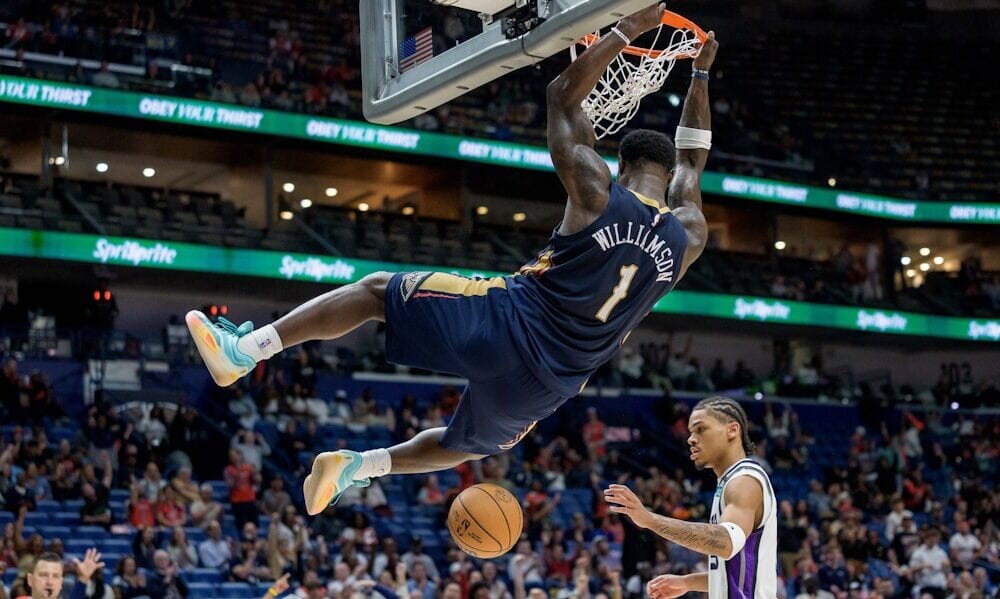
Zion Williamson | New Orleans Pelicans
Zion Williamson is very good at basketball.
When healthy, Williamson is an extraordinary offensive force. His combination of power, touch, and explosiveness remains almost unparalleled.
But there’s a difference between being very good at basketball and being a Top 25 fantasy player in nine-category leagues.
Right now, Zion is doing both.
Across seven games, Williamson is averaging 21.3 points, 5.3 rebounds, 2.7 assists, and an astonishing 2.7 steals while shooting 63.6% from the field, 42.9% from three and 73.9% from the line.
There’s plenty to unpack.
The field-goal percentage is exceptional, even by Zion’s standards. The three-point percentage is well above expectations, and the free throws have been far less damaging than in the past.
But the real fantasy goldmine is those 2.7 steals.
Two-point-seven!
That’s the sort of defensive production that can dramatically reshape a player’s category ranking, particularly alongside elite field-goal efficiency.
It’s also the statistic I would be most reluctant to project across an entire season.
Could Zion have taken a genuine step forward defensively? Absolutely. But projecting a player to maintain a defensive statistic this far above his established norms is dangerous business.
We also cannot dismiss the availability concerns that have followed Williamson throughout his career.
Before the Zion faithful sharpen their pitchforks, I’m not saying he will get injured. I’m saying that when a player with a substantial injury history is producing significantly above his established category baseline, there is an opportunity to convert uncertainty into something dependable.
Points leagues are a different conversation. But in category leagues?
I’d be sniffing around.
And here’s how I would approach the trade.
I wouldn’t openly shop Zion. That signals I’m trying to get rid of him, inviting suspicion and reducing leverage.
Instead, I’d identify a consistent Top 30 or Top 40 player and enquire about their availability. When the inevitable question comes back “Who would you be willing to give up?”… I’d dance around Williamson initially.
Maybe discuss another player. Perhaps suggest a package.
Then, with just the right amount of theatrical reluctance, I’d bend the knee.
“Look, I really don’t want to move Zion, but if that’s what it takes…”
Suddenly, the opposing manager feels they’ve negotiated a tremendous victory. They’ve secured the exciting player currently dominating the rankings.
Meanwhile, you’ve quietly acquired the player you wanted all along.
Everybody leaves happy.
One manager just happens to be a little happier in March.
Jabari Smith Jr. | Houston Rockets
Could this finally be the season Jabari Smith Jr. takes the leap we’ve been waiting for?
Absolutely.
Is that leap a sustained Top 20 ranking in category leagues?
Now we’re getting carried away.
Smith has been excellent through eight games, averaging 18.4 points, 6.4 rebounds, 2.4 assists, 0.9 steals and 0.8 blocks across 34.5 minutes.
He’s also shooting 49% from the field, 48.1% from three and 88% from the free-throw line.
Tremendous numbers for a player whose fantasy appeal rests on combining perimeter shooting with rebounding and defensive contributions.
And there are legitimate reasons to believe some improvement is sustainable.
The minutes are excellent, his offensive role appears secure, and the Rockets are playing basketball that creates opportunities for multiple players to thrive.
But we need to separate genuine development from an early-season hot streak.
Shooting 48.1% from beyond the arc is doing considerable heavy lifting in Smith’s valuation. Regression towards conventional shooting numbers would meaningfully affect his scoring and efficiency, even if his opportunities remain stable.
Then there’s the broader Houston picture.
Alperen Şengün is producing Top 10 value, while Kevin Durant and Amen Thompson sit outside the Top 35 and Top 75, respectively.
Think about that.
Houston’s established offensive superstar and one of its most exciting young talents are delivering fantasy returns below Smith’s.
Now, rankings aren’t a direct measure of basketball hierarchy, and teammates can certainly produce excellent category value simultaneously.
But the disparity should encourage us to question whether Smith’s current position represents his new normal.
I’d suggest it doesn’t.
Smith could establish himself as a consistently valuable fantasy asset this season, perhaps comfortably outperforming his draft position.
But a player can improve substantially and still be a sell-high candidate.
That’s the distinction managers often struggle to make.
You’re not betting against Jabari Smith Jr.’s development. You’re betting against the assumption his current Top 20 production is where that development will settle.
If another manager is prepared to pay a second-round price, I’d happily entertain the conversation.
Enjoy the breakout.
Just consider whether somebody else might pay you for the rest of it in advance.
Sell-High Honourable Mentions
Duncan Robinson | Detroit Pistons: I just want to be clear that I never thought I would be writing this. So I won’t. Just do it. Sell now. We can discuss how we got here after the transaction clears.
Ty Jerome | Memphis Grizzlies: I love Jerome. Genuinely. But if somebody believes they’re acquiring a sustainable Top 20 fantasy player, you have my permission to punch his ticket on the hype-train express. First class, preferably. With a proven asset coming back.
Michael Porter Jr. | Brooklyn Nets: The Nets are going nowhere quickly, which means it might be high time Porter Jr. found his way onto another fantasy roster just as quickly. The opportunity is attractive, but team direction, availability concerns and inflated expectations make this an excellent time to explore the market.
The Final Word
As we are three weeks into an NBA season, the temptation is to treat the current rankings as though they’ve already revealed the truth.
They haven’t.
They’ve revealed three weeks of basketball.
Some of what we’re witnessing is genuine development. Some is opportunity. And some is statistical noise wearing a very convincing disguise.
The best fantasy managers learn to distinguish between them.
More importantly, they recognise that the trade market isn’t governed exclusively by numbers. It’s governed by emotion, frustration, optimism, impatience, and our wonderful tendency to believe whatever happened recently will continue indefinitely.
Our job is to exploit those tendencies without becoming victims ourselves.
So send the offers. Start the conversations. Be prepared to move players you genuinely like if the return makes sense.
Because the objective isn’t to win the argument about who was better in Week 3.
It’s to be the manager holding the trophy when everybody else has forgotten what happened in November.
Fantrax is one of the fastest-growing fantasy sites in the fantasy sports industry, and we’re not stopping anytime soon. We are the most customizable, easy-to-use, and feature-rich platform in the industry, offering the greatest fantasy experience for your dynasty, keeper, redraft, and best ball leagues. Fantasy sports doesn’t sleep, and neither does Fantrax, with seasons running 365 days a year. Take your fantasy leagues to the next level now at Fantrax.com!