

Usually, this piece is dedicated to evaluating an underrated asset for fantasy baseball managers. But this week, I decided to take a bit of a different approach to the “Under the Radar” moniker and talk about a statistic that is rarely talked about but has extremely high predictive power when it comes to the annual Cy Young Award.
More great Fantasy Baseball Analysis: Fantasy Baseball Waiver Wire | Weekly SP Rankings | Pitching Streamers | Two-Start Pitchers | Hitting Planner | Lineup Analysis | MLB Injury Report | Risers and Fallers | Prospect Report | Advanced Stats | Under the Radar | Overvalued & Undervalued
What is RE24?
For pitchers, RE24 measures the total Run Expectancy the batting team loses while said pitcher is on the mound. Run Expectancy is calculated based on the 24 base-out states (thus the “RE24” moniker), which represent all possible combinations of runners and outs. Ben Clemens wrote an excellent article at Fangraphs earlier this season on the 2025 Run Expectancy Matrix, which shows the number of runs a team can be expected to score that inning based on a given base-out state.
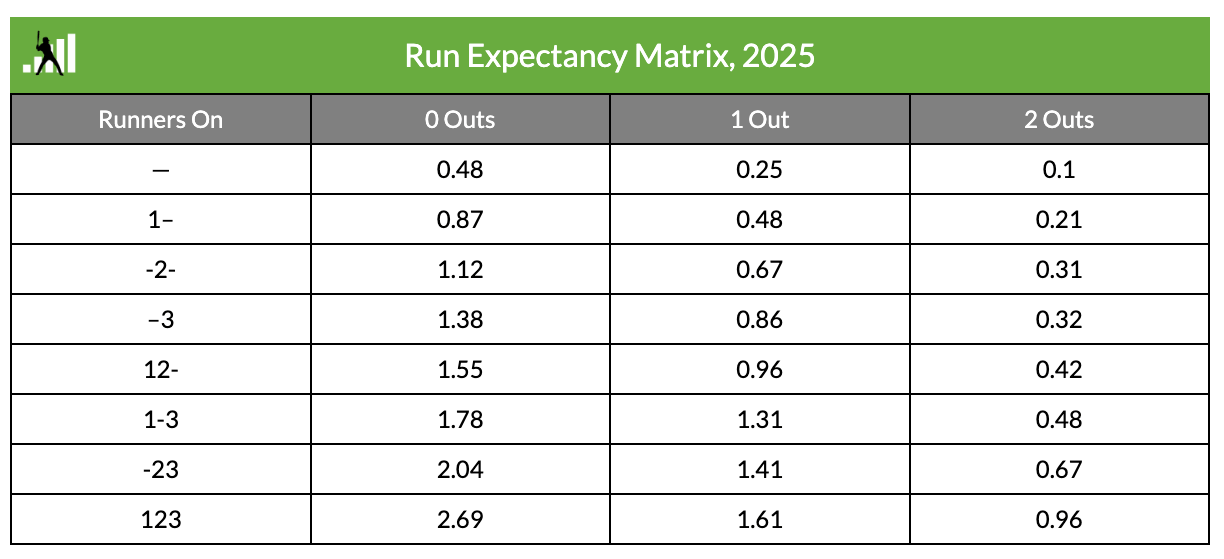
Courtesy of Ben Clemens (Fangraphs)
Let’s use a moment from the 2025 All-Star game to see RE24 in action. After consecutive singles from Shohei Ohtani and Ronald Acuna Jr., Tarik Skubal was pitching to Ketel Marte with runners on first and second and no outs. At that instant, the NL All-Stars’ run expectancy for the inning sat at 1.55 runs. After Marte shot a 2-RBI double down the right-field line, he stood at second with no outs and had tacked on two more runs to the NL’s tally. His team’s run expectancy had increased from 1.55 to 3.12 runs: Ohtani and Acuna Jr. had crossed the plate already, and the runner on second with no outs represented another 1.12 expected runs. That meant Skubal’s RE24 fell by 1.57 runs, and Marte’s increased by the same amount.
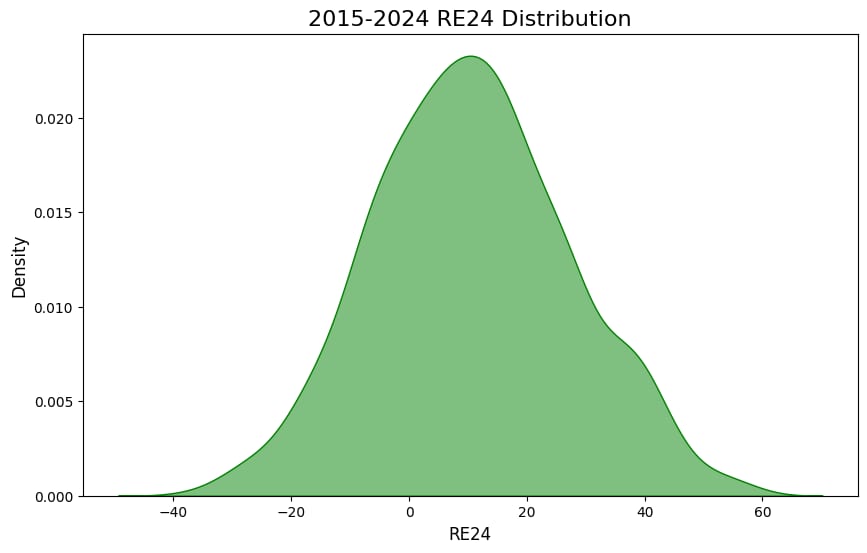
When totaled up over a full season, a qualified starter’s RE24 typically falls around 10 runs. The best pitchers reach the 40-run mark, and historic seasons might break the 50-run plateau. Since 2015, only five pitchers have accumulated 50 RE24 in a season. 27 pitchers have reached 40 runs. The plot below shows the distribution of RE24 among qualified pitchers in the last decade (excluding 2020):
Given we don’t hear about it nearly as often as mainstream statistics like ERA, one could be forgiven for wondering why RE24 is worthy of consideration as a useful metric. As it turns out, this run-of-the-mill statistic is extremely good at predicting a very prestigious award.
RE24’s Correlation with Cy Young Success
Over the last decade of baseball history, 16 pitchers have won a Cy Young Award. Of that group, 75% led their league in RE24. However, just 60% of them led their league in ERA. That means RE24 has a significant advantage when it comes to predicting the Cy Young Award. What’s more, the last six Cy Young Award winners (since 2022) all led their league in RE24. Since 2015, just 35% of Cy Young recipients led their league in strikeouts. Only six charted the most innings pitched.
To test how predictive RE24 is compared to other statistics, I created a simple Random Forest machine learning model (named CYRUS, for Cy Young Random Forest Utilization System) in Python to project Cy Young Award winners. CYRUS was trained on data from 2000-2018 and had access to every qualified pitcher’s ranking (excluding some rare cases) in RE24, strikeouts, innings pitched, and ERA within each season and league.
CYRUS then predicted the Cy Young Award winners for the last five full seasons (2019-2024, excluding the shortened 2020 season) and nailed nearly all of them. The only incorrect classification came in 2021, when the model predicted Los Angeles’ Walker Buehler to beat out Milwaukee ace Corbin Burnes for the National League award.
In order to understand how CYRUS made such accurate predictions, we can take a look at the model’s SHAP (SHapley Additive exPlanations) summary plot. The plot lists the features in order from most to least impactful along the left-hand axis, and each colored dot represents a specific prediction. The impact on the model’s output is found on the x-axis, showing how much a given feature nudged CYRUS in the positive direction (Cy Young winner) or the negative direction (non-Cy Young winner). Blue dots for a given feature mean the pitcher ranked more favorably in said category, and red dots mean the opposite.
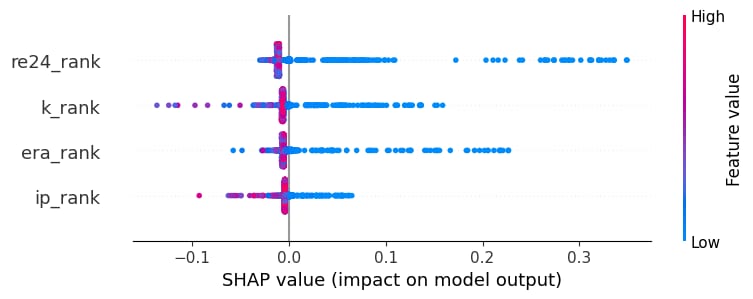
Based on the plot, RE24 had the most significant impact on the model’s predictions. The blue dots further towards the right on the RE24 line indicate that pitchers with a highly-ranked RE24 saw their chances of being predicted the winner significantly boosted.
That’s all great, but what does this data tell us about how the voters evaluate pitchers?
For one thing, it tells us that voters are using an increasingly holistic process to determine the best pitcher in the league. Encompassing both quality and quantity is RE24’s main strength. ERA struggles to capture a pitcher’s full body of work, and innings pitched has a limited capacity to describe effectiveness. Total run expectancy measures both quality and quantity of a pitcher’s production, which is critical for voters.
What’s more, the increase in expected statistics in the baseball industry has largely impacted run prevention evaluation indirectly. Metrics like xBA, xwOBA, and xSLG tend to measure the means but not the ends. RE24 successfully integrates expected outcomes with run prevention, which makes it a more direct measure of pitcher success.
Given its ability to capture quality and quantity – and its ease of understanding – it’s no wonder that RE24 tends to mirror the opinions of BBWAA voters. So what does that mean for this year’s Cy Young Award hopefuls?
2025 Cy Young Candidates and RE24
Perhaps it should come as no surprise that Pirates ace Paul Skenes paces the National League in RE24. Even as Philadelphia’s Zack Wheeler continues pushing for his first Cy Young Award, Skenes leads the league in ERA, Batting Average Against, and WAR.
But in the American League, Red Sox ace Garrett Crochet – who has roughly 1-in-4 implied odds to win the Cy Young Award – has a slight RE24 lead over the aforementioned favorite Skubal. Of the eight RE24 league leaders – and Cy Young Award winners – in the last four years, only three of them led their league in RE24 on July 29th.
Of the two, Skenes seems most likely to maintain his lead. He has been simply dominant all season long and has posted an ERA under 2.23 in every full month of the season. Wheeler, on the other hand, had a fantastic month of June but has been less consistent. Wheeler does lead Skenes in strikeouts by a significant margin, but – as we’ve learned from RE24 and historical voting results – getting outs is more important to voters than racking up punchouts.
In the American League, it seems unlikely Crochet will hold onto his RE24 lead for much longer. After a five-inning, four-run clunker against the Dodgers on Opening Day, Skubal has been completely lights out for the last four months. He also leads the American League in ERA, K/BB, WAR, and a myriad of other statistics.
Based on current metrics, CYRUS predicts Skenes to win the NL Cy Young Award and forecasts Crochet will take home the American League hardware. This isn’t a shock, given the model’s reliance on RE24. If Crochet sustains his RE24 lead for the rest of the season, it will be fascinating to see if the metric’s four-year prediction streak holds up – especially against Skubal, who will likely finish with a lower ERA and more strikeouts.
Regardless of who wins the Cy Young Award this season, RE24 deserves more love as a statistic that measures the quality and quantity of a pitcher’s performance. It allows us to measure expected run prevention on a direct basis while also valuing different pitching styles, and gives us a window into the minds of the people responsible for crowning the best pitcher in baseball.
Fantrax is one of the fastest-growing fantasy sites in the fantasy sports industry, and we’re not stopping anytime soon. We are the most customizable, easy-to-use, and feature-rich platform in the industry, offering the greatest fantasy experience for your dynasty, keeper, redraft, and best ball leagues. Fantasy sports doesn’t sleep, and neither does Fantrax, with seasons running 365 days a year. Take your fantasy leagues to the next level now at Fantrax.com!