

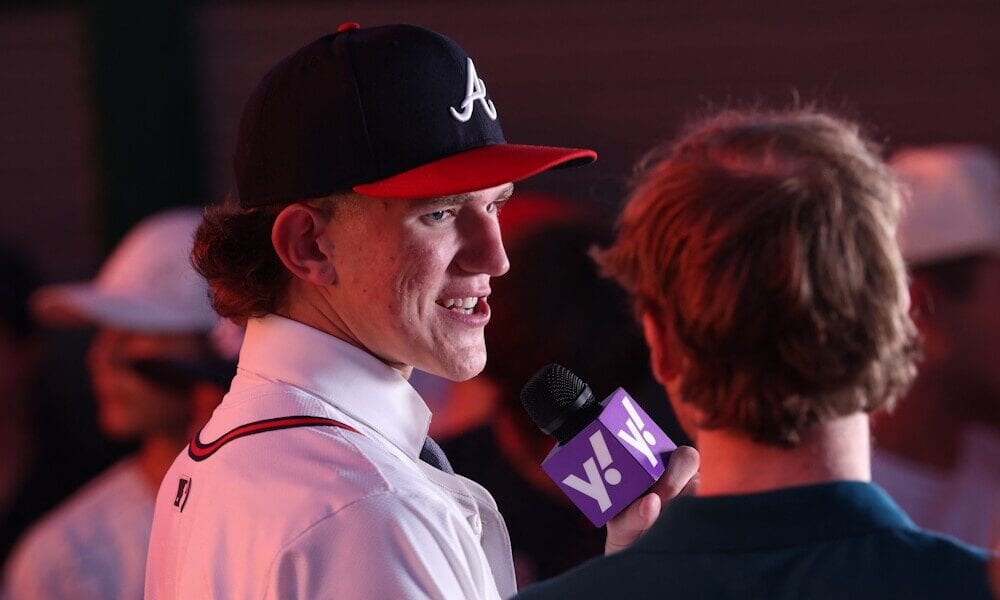
The Atlanta Braves have spent much of the past decade demonstrating how quickly a strong player-development operation can turn young talent into major-league contributors. Under President of Baseball Operations and General Manager Alex Anthopoulos, Atlanta has built an organization that combines aggressive major-league roster construction with a continued willingness to trust players developed from within. Anthopoulos oversees all aspects of baseball operations and has led the organization since November 2017.
DYNASTY BASEBALL: 2026 Atlanta Braves Top 20 Fantasy Baseball Prospects
For dynasty fantasy managers, that developmental track record matters.
Atlanta’s farm system has not always ranked among baseball’s deepest in recent seasons, in part because so much of the organization’s best young talent has graduated to the major leagues. Michael Harris II, Spencer Strider, Spencer Schwellenbach, Drake Baldwin, Hurston Waldrep and Didier Fuentes are examples of players the Braves have identified and developed into meaningful big-league pieces. That ability to convert prospects into major-league production has become one of the defining characteristics of the organization.
Pitching has traditionally been one of the system’s greatest strengths. Atlanta has repeatedly invested draft capital in arms and has shown an ability to develop pitchers with the stuff necessary to miss bats at the highest level. But the organization has recently begun creating greater balance. The 2025 draft brought an influx of position-player talent, including Tate Southisene, Alex Lodise and Conor Essenburg, while the emergence of 2024 selections Cam Caminiti and Eric Hartman has helped give the system considerably more upside and depth than it possessed only a few years ago.
That momentum continued in 2026. Armed with five Day 1 selections, Atlanta had an opportunity to accelerate the rebuilding of its prospect inventory and used its first-round selections on college outfielders, including ninth-overall pick AJ Gracia. The recent draft classes have transformed a system that had been considered one of baseball’s thinner farms into one featuring an increasingly interesting combination of pitching, athleticism, and offensive upside, as you’ll see in the Braves’ Top 20 fantasy baseball prospects profiled ahead.
Anthopoulos also provides an important piece of context when evaluating Braves prospects. Atlanta remains a win-now organization, and the front office has consistently used every avenue available—free agency, trades, extensions, the draft, and internal development—to maintain a competitive major-league roster. At the 2026 trade deadline, however, Anthopoulos added major-league help while retaining the organization’s top prospects, illustrating that the Braves do not automatically have to sacrifice their farm system to address immediate needs.
For dynasty managers, that creates an interesting environment. Opportunity in Atlanta must often be earned rather than handed to a prospect simply because he reaches the upper minors. But when the Braves identify a player they believe can help the major-league club, their developmental history gives that player additional credibility. The organization has already demonstrated that prospects can move from relatively modest industry expectations to significant major-league roles.
That makes the Braves a system worth studying beyond the names at the very top of prospect rankings. Atlanta’s recent drafts have replenished the pipeline, its pitching development remains an organizational strength, and the emergence of increasingly intriguing position players has created a more balanced farm system.
For dynasty managers, the lesson is straightforward: pay attention when the Braves identify, invest in, and begin accelerating a young player. Under Alex Anthopoulos, Atlanta has repeatedly shown that organizational conviction can be an important signal—and the next significant dynasty asset may emerge before the broader prospect market fully recognizes what the Braves have found.
So, let’s begin with our countdown of the Braves’ top 20 prospects.
#20 — Starlyn De La Cruz | OF (ETA 2030)
De La Cruz is exactly the kind of deep-league lottery ticket worth remembering. The 17-year-old left-handed hitter erupted for a .360/.500/.560 line with two homers and nine steals in only 16 DSL games before an injury cut his season short.
Atlanta signed De La Cruz out of the Dominican Republic for $1.2 million during the 2026 international period. His quick bat, speed, and center-field athleticism give him an intriguing fantasy foundation, although his small frame creates questions about how much home-run power eventually develops.
For dynasty managers, this is a patience play with significant volatility. If the hit tool survives the climb and he develops even average power, the speed could make him considerably more valuable than this ranking suggests.
#19 — Diego Tornes | OF (ETA 2030)
Tornes remains an enticing athlete despite a difficult 2026 season in the Florida Complex League. The switch-hitting Cuban outfielder hit just .196 without a homer, but his 32 steals through his first 234 professional at-bats show why speed remains central to his fantasy appeal.
The Braves landed Tornes during the 2025 international signing period, adding one of the more prominent players in their class. His combination of athleticism, switch-hitting ability, and projection created considerable excitement before his stateside struggles.
Dynasty managers shouldn’t completely abandon an 18-year-old because of one rough season. Tornes needs his bat to rebound and significantly more game power, but there is still enough age-adjusted upside here to remain interesting in very deep formats.
#18 — Owen Carey | OF (ETA 2029)
Carey is another late-round Braves find who has steadily forced his way onto the prospect radar. The left-handed outfielder finished 2026 at .244 with 10 homers and seven steals, giving him a useful blend of skills even though none currently screams fantasy star.
Atlanta selected Carey out of Londonderry High School in New Hampshire in the 15th round of the 2024 Draft. His athletic background and ability to handle center field give him a legitimate route toward the majors despite his modest draft pedigree.
Carey’s dynasty ceiling depends on the bat becoming more impactful. He’s presently more of a deep-league stash than a priority prospect, but another jump in power could quickly change that calculation.
#17 — Jack Brenner | C (ETA 2030)
Brenner is one of the more speculative names on this countdown because his professional résumé has barely begun. The appeal comes from betting on a young catcher with enough offensive potential to become much more interesting once we have actual pro data.
The Braves selected Brenner from Fond du Lac High School in Wisconsin in the seventh round, 202nd overall, of the 2026 Draft. He signed and joined the Florida Complex League roster, though he has yet to accumulate official professional statistics.
Catchers develop slowly and carry substantial fantasy risk, so patience is mandatory. In leagues where catching prospects are valuable, however, Brenner is the kind of inexpensive early stash who could appreciate considerably with a strong full-season debut.
#16 — Isaiah Drake | OF (ETA 2029)
Few players in this system can match Drake’s raw fantasy ingredients. His elite speed has always been the headline, but a 2026 season featuring a .264 average, 12 homers and 19 steals offered encouraging evidence that his offensive game is becoming more complete.
Atlanta drafted the hometown product from North Atlanta High School in the fifth round of the 2023 Draft, then went well over slot to sign him for $747,500. His athleticism and left-handed power/speed potential made him an upside bet from day one.
The fantasy ceiling remains much higher than the floor because Drake’s career offensive production has been inconsistent. If the 2026 improvements stick, his speed alone gives him a path toward becoming a useful category contributor.
#15 — Luis Guanipa | OF (ETA 2029)
Guanipa quietly put himself back on the dynasty map in 2026. He hit .303/.365/.452 with 11 homers and 37 steals and earned Carolina League postseason All-Star recognition, showing the power-speed combination fantasy managers have been waiting to see.
The Braves signed Guanipa out of Venezuela during the 2023 international period for $2.5 million, making a substantial investment in his athleticism and offensive upside. He was ranked No. 34 in MLB’s international class at the time.
His dynasty stock is moving upward again. Guanipa still needs to prove himself against advanced pitching, but a young outfielder capable of reaching double-digit homers while stealing 30-plus bases deserves renewed attention.
#14 — Herick Hernandez | LHP (ETA 2027)
Hernandez offers something fantasy managers should always notice: strikeouts. The compact left-hander punched out 96 hitters over 74 2/3 innings in 2026 and has amassed 235 strikeouts through 184 2/3 professional innings, though a 1.49 WHIP this season highlights the command risk.
Atlanta selected Hernandez from Miami in the fourth round, 129th overall, of the 2024 Draft. His fastball characteristics and developing breaking stuff have allowed him to miss bats consistently as a professional.
The fantasy question is whether he throws enough quality strikes to remain a starter. Triple-A proximity and strikeout ability make Hernandez useful in deeper pitching formats even if the eventual role carries some uncertainty.
#13 — Luke Sinnard | RHP (ETA 2027)
Sinnard’s gigantic 6-foot-7 frame is accompanied by genuine bat-missing ability. He posted a 2.94 ERA, 1.17 WHIP, and 61 strikeouts over 52 innings in 2026, bringing his professional total to 147 strikeouts in 124 1/3 innings.
The Braves drafted Sinnard from Indiana in the third round, 99th overall, in 2024 after elbow surgery had clouded his amateur outlook. Atlanta essentially bought low on a huge right-hander with strike-throwing ability and multiple usable pitches.
For dynasty purposes, he’s an appealing pitching sleeper because he’s now reached Double-A and has consistently generated strikeouts. Health and workload remain worth monitoring, but the ingredients for a mid-rotation fantasy starter are present.
#12 — Kaiden McCarthy | RHP (ETA 2030)
McCarthy is almost entirely a projection play right now, but it’s an exciting one. The young right-hander can operate around the mid-90s and has touched 99 mph, giving him one of the louder teenage arms in Atlanta’s system.
The Braves selected McCarthy out of Vermont Academy with the 48th overall pick in the second round of the 2026 Draft. Atlanta then signed the Tennessee commit and assigned him to the Florida Complex League.
Young pitching carries enormous dynasty attrition, which keeps McCarthy outside my top 10. But if his secondary pitches and command advance alongside that velocity, he has considerably more upside than the typical pitcher ranked this low.
#11 — Carter Beck | OF (ETA 2028)
Beck’s first taste of professional baseball gave dynasty managers plenty to like. The left-handed hitter batted .283 with a .400 OBP, two homers and 11 steals across 113 at-bats while already advancing to High-A Rome.
Atlanta surprisingly grabbed Beck out of Indiana State with the 26th overall pick in the 2026 Draft. He had exploded for a .347/.446/.640 collegiate season with 16 homers before signing with the Braves.
Beck may never develop massive home-run totals, but contact, on-base ability, and speed can build a valuable fantasy package. His rapid push to High-A also gives him a shorter developmental runway than most players around him.
#10 — Conor Essenburg | OF (ETA 2029)
Essenburg has become one of the better breakout bats in Atlanta’s system. In his first professional season, the young outfielder produced a .265/.416/.493 line with 17 homers and 11 steals, combining patience with increasingly meaningful power.
The Braves selected Essenburg from Lincoln-Way West High School in Illinois in the fifth round, 157th overall, of the 2025 Draft. He bypassed his college opportunity at Kentucky and has already made that decision look promising.
This profile plays particularly well in OBP dynasty leagues. If Essenburg’s power continues developing while his plate discipline holds, his offensive ceiling could push him considerably higher on this list next season.
#9 — John Gil | SS (ETA 2028)
Gil’s fantasy calling card begins with speed. He owns near top-of-the-scale wheels, has shown a willingness to take walks, and has advanced rapidly enough to reach Double-A while still only 20 years old.
Atlanta originally signed Gil out of the Dominican Republic for just $110,000 in January 2023, making him one of the organization’s better international-development successes. He has since developed from an inexpensive signing into a legitimate upper-level prospect.
The missing fantasy ingredient is impact power. Gil doesn’t need to become a slugger, though: a strong OBP with significant stolen-base totals and middle-infield eligibility could make him extremely useful.
#8 — Owen Murphy | RHP (Made MLB Debut in 2026)
Murphy has already crossed the developmental finish line that many pitching prospects never reach: he made his Major League debut in July 2026. Across the minors this year, he worked 117 1/3 innings with a 3.61 ERA, 1.19 WHIP, and 121 strikeouts.
The Braves selected the athletic Illinois prep star with the 20th overall pick in the 2022 Draft. Murphy was an accomplished two-way player in high school, but Atlanta immediately viewed his pitching ability as his ticket to the majors.
His dynasty ceiling may not match the teenage arms ranked above him, but proximity dramatically reduces the risk. Murphy has a realistic chance to provide innings and strikeouts for fantasy managers very soon.
#7 — Briggs McKenzie | LHP (ETA 2029)
McKenzie possesses one of the more intriguing combinations of youth and pitching upside in the organization. He raced through three levels in 2026 and had lowered his ERA to 2.08 by late June, with his curveball emerging as the centerpiece of a promising three-pitch arsenal.
Atlanta selected McKenzie from the North Carolina high school ranks in the fourth round of the 2025 Draft, then paid him roughly $3 million to bypass LSU. That investment was far more indicative of his talent than his draft round.
An injury interrupted his ascent, but McKenzie is scheduled for the Arizona Fall League, giving him an opportunity to regain momentum. In dynasty leagues, he carries frontline-starter upside if the fastball, excellent curve, and changeup all mature together.
#6 — Jensen Hirschkorn | RHP (ETA 2030)
Hirschkorn is a 6-foot-7 teenage right-hander with the ingredients dynasty managers dream about. His fastball already sits in the 90s, the slider flashes significant promise, and his athleticism gives Atlanta reason to believe that such a large pitcher can still develop reliable command.
The Braves drafted Hirschkorn from Kingsburg High School in California 84th overall in the third round of the 2026 Draft. They then paid him a remarkable $3,997,500 bonus to turn him away from LSU, the largest bonus ever reported for a player selected after the second round at the time.
There is considerable teenage-pitcher risk here, but also enormous ceiling. If the changeup catches up to his fastball-slider combination and the strikes remain consistent, Hirschkorn could eventually develop into a high-strikeout fantasy starter.
#5 — Alex Lodise | SS (ETA 2028)
Lodise has done almost everything a dynasty manager could ask since entering pro ball. He tore through 2026 with a .272 average, 28 home runs, 17 steals, and an .841 OPS, eventually reaching Double-A and establishing himself as one of Atlanta’s most productive minor-league bats.
Atlanta selected the former Florida State shortstop 60th overall in the second round of the 2025 Draft. Lodise had just won ACC Player of the Year after batting .394/.462/.705 with 17 homers during his breakout collegiate season.
Twenty-plus homer potential from a shortstop who can contribute steals is an extremely attractive fantasy recipe. Lodise is older than the elite names above him, but his production and proximity substantially reduce the wait.
#4 — AJ Gracia | OF (ETA 2029)
Gracia brings one of the safest offensive foundations in Atlanta’s system. The left-handed hitter entered pro ball with advanced strike-zone judgment, a potentially above-average hit tool, and enough raw power to project as a meaningful fantasy contributor.
The Braves selected the University of Virginia outfielder ninth overall in the 2026 Draft, making him their highest selection in years. His combination of contact ability, patience, and developing power made him one of the more polished college hitters available.
Gracia’s fantasy profile isn’t built around one outrageous tool; it’s the possibility of contributions almost everywhere. A high-OBP outfielder capable of producing average and 20-plus homers would carry substantial dynasty value, particularly if he moves quickly.
#3 — Cam Caminiti | LHP (ETA 2027)
Caminiti owns the highest pitching ceiling on this list. The athletic left-hander finished 2026 with a 3.38 ERA, 1.21 WHIP, and 125 strikeouts in 114 2/3 innings, reaching Double-A at only 20 years old.
Atlanta selected Caminiti out of Saguaro High School in Arizona with the 24th overall pick in the 2024 Draft. His fastball can reach the upper 90s, while a developing changeup and improving command give him the arsenal to remain a starter.
Pitchers inherently carry more dynasty risk than comparable hitters, but Caminiti has legitimate impact-starter ingredients. Strikeouts, youth, handedness, and his rapid climb toward Atlanta make him one of the system’s few arms worth aggressively targeting.
#2 — Tate Southisene | 2B/SS (ETA 2028)
Southisene offers a beautiful dynasty combination of age, position, and category juice. At only 19, he hit .278 with 12 homers and 45 stolen bases across 338 at-bats in 2026 while climbing from Single-A all the way to Double-A.
The Braves made Southisene the 22nd overall selection in the first round of the 2025 Draft out of Basic Academy in Nevada. His athleticism and advanced offensive instincts have allowed him to move much faster than the typical teenage middle infielder.
For fantasy, the attraction is obvious: middle-infield eligibility with legitimate stolen-base upside and enough emerging pop to avoid becoming a one-category player. If the power continues growing, Southisene has a path toward becoming a difference-making five-category asset.
Also, make sure to check out our 2026 MLB organizational Prospect Rankings!
#1 — Eric Hartman | OF (ETA 2028)
Hartman has transformed himself from an obscure draft pick into Atlanta’s premier dynasty prospect. The 20-year-old finished 2026 with 26 home runs and 56 stolen bases, an extraordinary power-speed combination that earned him a promotion to Double-A and national Top-100 recognition.
The backstory makes the breakout even more remarkable: Atlanta selected Hartman from Alberta, Canada, in the 20th round, 611th overall, of the 2024 Draft and signed him for $337,500. What once looked like an intriguing late-round gamble has become one of the organization’s biggest scouting successes.
For dynasty baseball, Hartman has the highest fantasy ceiling in this Braves group because power and stolen bases can change matchups by themselves. There is still hit-tool risk to navigate, especially after his promotion to Double-A, but a young outfielder capable of threatening 25 homers and 30-plus steals belongs firmly on the fantasy radar.
Final Thoughts
Atlanta’s farm system is trending in the right direction. Recent drafts have added legitimate offensive upside to an organization already known for developing pitching, creating a deeper and more balanced group than the Braves have had in recent years.
For dynasty managers, Eric Hartman and Tate Southisene headline the system with exciting power-speed potential, while AJ Gracia and Cam Caminiti provide additional high-end upside. Just as importantly, players such as Alex Lodise, Briggs McKenzie and Jensen Hirschkorn give this system intriguing depth beyond the top few names.
The larger takeaway is simple: Atlanta continues to identify and develop talent from a variety of backgrounds and draft positions. In dynasty leagues, this is an organization worth following closely because the next breakout prospect may emerge quickly.
Fantrax is one of the fastest-growing fantasy sites in the fantasy sports industry, and we’re not stopping anytime soon. We are the most customizable, easy-to-use, and feature-rich platform in the industry, offering the greatest fantasy experience for your dynasty, keeper, redraft, and best ball leagues. Fantasy sports doesn’t sleep, and neither does Fantrax, with seasons running 365 days a year. Take your fantasy leagues to the next level now at Fantrax.com!