

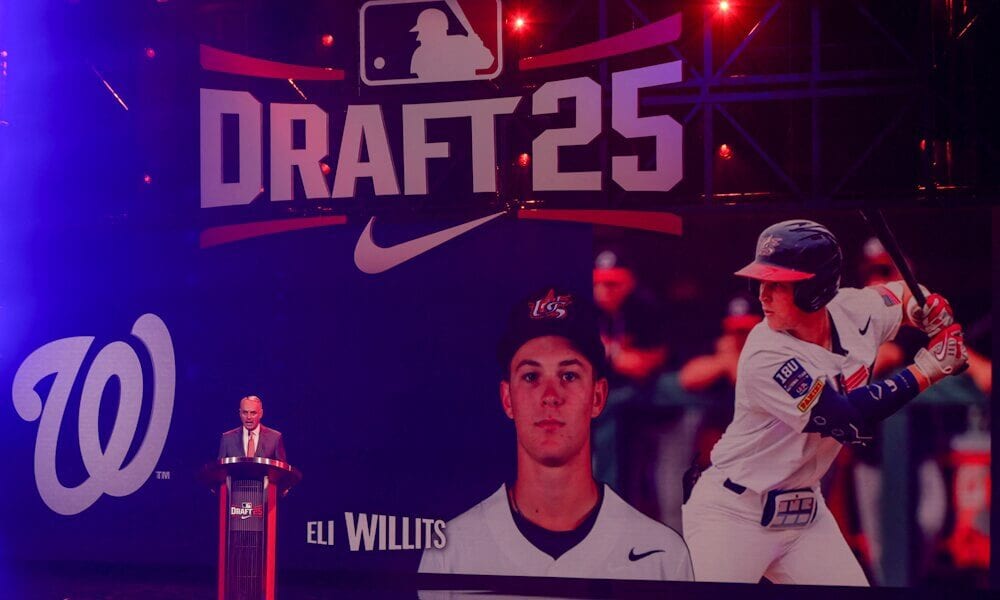
The Washington Nationals are entering a new organizational era under President of Baseball Operations Paul Toboni, with player development quickly becoming one of the defining priorities of the franchise.
DYNASTY BASEBALL: 2026 Washington Nationals Top 20 Fantasy Baseball Prospects
Toboni arrived in Washington after helping oversee amateur scouting and player development in Boston, and his early work with the Nationals has reflected that background. Rather than treating scouting, acquisition, and development as separate parts of the organization, Washington is attempting to build a more connected system—one in which identifying talent is only the beginning of the process. The larger objective is to create an infrastructure capable of turning that talent into productive major leaguers.
That philosophy has already produced significant changes throughout the minor leagues. The Nationals expanded their development staff, added coaches and coordinators, incorporated additional technology, and worked to create greater continuity between affiliates and the major-league club. The organization has also placed greater emphasis on individualized development plans and communication, giving players a clearer understanding of what they need to improve and how the Nationals intend to help them get there.
The talent pipeline itself is beginning to reflect that approach, as you’ll see in the Nationals’ Top 20 fantasy baseball prospects profiled ahead.
Washington has continued adding young upside through multiple avenues. Eli Willits remains one of the system’s foundational talents, while trades have added additional prospect depth and the 2026 draft brought another wave led by first-round selection Chris Hacopian. The Nationals have also remained active internationally, adding highly regarded young players such as Samil Serrano and Isaias Suarez. Rather than depending upon one prospect class to carry the rebuild, Toboni and his staff appear intent on creating multiple waves of talent throughout the system.
For dynasty fantasy managers, that makes Washington an organization worth monitoring closely.
That could make Washington particularly interesting for dynasty managers willing to invest before the broader market fully recognizes a breakout. The system contains prospects at very different stages of development, from teenage projection bets to upper-level players approaching major-league opportunities. In an organization increasingly focused on turning raw ingredients into major-league skills, developmental progress may matter just as much as prospect pedigree.
Under Paul Toboni, the Nationals aren’t simply trying to assemble a better farm system. They’re attempting to build an organization capable of developing one continuously.
For dynasty managers, that’s the part worth watching.
So, let’s begin with our countdown of the Washington Nationals’ top 20 prospects.
#20 — Sam Petersen | OF (ETA 2027)
Petersen entered the Nationals organization as an eighth-round pick out of Iowa in the 2023 MLB Draft. He has steadily worked his way through the system and reached Double-A, putting himself within striking distance of becoming an outfield option in Washington.
His fantasy appeal starts with athleticism. Petersen has enough speed to contribute stolen bases and enough strength to produce useful extra-base damage, giving him more dynasty intrigue than a player whose value depends entirely on reaching base.
The ceiling isn’t as loud as the names higher on this list, but proximity matters. Petersen could develop into a useful complementary fantasy outfielder, particularly in deeper dynasty formats where playing time and double-digit steals carry extra value.
#19 — Ben Grable | RHP (ETA 2027)
Grable became a National at the 2026 trade deadline when Washington acquired him from the Yankees in the deal for Luis García Jr. The right-hander brought serious velocity with him, immediately giving the organization another pitcher capable of overpowering hitters.
For fantasy managers, Grable’s ability to generate strikeouts is the reason to pay attention. He recorded 76 strikeouts in just 50 1/3 innings in 2026, and his fastball ranks among the hardest in Washington’s system.
His eventual role will determine much of his dynasty value. There’s late-inning potential if he moves permanently to relief, but any chance of sticking as a starter makes the upside substantially more interesting.
#18 — Jack Cebert | RHP (ETA 2027)
Cebert also arrived from the Yankees in Washington’s 2026 Luis García Jr. trade. Unlike some of the more developmental arms on this list, Cebert has already climbed to the upper minors and shouldn’t require a lengthy wait before receiving a major-league opportunity.
He isn’t built around one overwhelming pitch. Instead, Cebert offers a more conventional starter’s profile, and he logged 107 innings with 120 strikeouts during the 2026 season.
That makes him more appealing in deep dynasty leagues than shallow prospect formats. The upside may settle around the back half of a fantasy rotation, but pitchers capable of providing innings and respectable strikeout totals still have plenty of value.
#17 — Yeremy Cabrera | OF (ETA 2028)
Cabrera joined Washington when the Rangers sent him to the Nationals as part of the five-prospect package for MacKenzie Gore in January 2026. He’s an athletic left-handed-hitting outfielder whose speed gives him an obvious fantasy calling card.
Cabrera’s best dynasty path involves getting on base frequently enough to unleash that speed. There’s also some offensive projection remaining, so his future doesn’t necessarily have to be limited to steals and runs.
He’s still more projection than finished product, which explains this ranking. If the bat advances and he keeps producing on the bases, Cabrera has a route toward becoming an under-the-radar multi-category fantasy contributor.
#16 — Alejandro Rosario | RHP (ETA 2028)
Rosario was another member of the prospect haul Washington received from Texas for MacKenzie Gore before the 2026 season. The former Miami starter already possessed an appealing combination of velocity and strike-throwing when he entered the Nationals system.
Command is what makes Rosario particularly interesting. Power stuff becomes much more valuable in fantasy when it isn’t accompanied by constant traffic on the bases, and Rosario has demonstrated the ability to attack the zone better than many young hard throwers. MLB Pipeline rates his control as the best among Washington’s ranked prospects.
The biggest variable is health after elbow trouble disrupted his progress. If he gets back on schedule, Rosario still has the ingredients to develop into a starting pitcher who helps in both strikeouts and WHIP.
#15 — Alex Clemmey | LHP (ETA 2027)
Clemmey came to Washington from Cleveland in the 2024 deadline trade that sent Lane Thomas to the Guardians. At 6-foot-6 with a powerful left arm, he immediately stands out as one of the more physically imposing pitchers in the organization.
The strikeout potential is substantial. Clemmey collected 138 punchouts over 128 Double-A innings in 2026, but the same season also produced 78 walks. That’s the entire fantasy puzzle in two numbers.
If the control improves even moderately, Clemmey could become a valuable strikeout starter. Continued wildness would create significant WHIP risk and could eventually push him toward relief, making him a high-risk, high-reward dynasty investment.
#14 — Samil Serrano | OF (ETA 2031)
Serrano entered the organization through Washington’s 2026 international signing class, receiving a significant bonus to begin his professional career out of the Dominican Republic. He’s among the youngest players in this countdown and therefore requires a much longer developmental lens.
There’s plenty for dynasty managers to dream about. Serrano has a projectable frame and a promising left-handed bat, giving him time to add strength while developing into a more dangerous offensive player.
This is a deep-league lottery ticket rather than a near-term stash. The payoff could be substantial if the power develops alongside his hitting ability, but managers will need enough minor-league roster space to wait several seasons for the answer.
#13 — Chase Brunson | OF (ETA 2029)
Washington selected Brunson in the second round of the 2026 MLB Draft, making the athletic outfielder one of the organization’s newest high-upside additions. His combination of physical tools and offensive projection gives the Nationals plenty to develop.
Brunson is interesting for dynasty because his potential isn’t confined to one category. There is room for power, enough athleticism to create value on the bases, and the possibility of developing into a productive everyday hitter.
Professional pitching will provide the real test. For now, Brunson belongs on the radar in leagues that roster recent draft picks aggressively, with considerable room to climb once he establishes himself in full-season ball.
#12 — Coy James | SS (ETA 2029)
James became a National when Washington selected him out of Davie County High School in the fifth round of the 2024 Draft. His offensive ability has since made him one of the more intriguing young hitters deeper in the organization.
James’ fantasy appeal centers on his bat. He has shown an ability to make quality contact and offers enough offensive upside to become more than a defense-first middle infielder if his development continues.
There is still a sizable gap between the lower minors and Washington, so patience is necessary. He’s nevertheless the kind of prospect who can jump dynasty rankings quickly because a strong full-season performance would bring considerably more attention to the bat.
#11 — Ethan Petry | OF (ETA 2028)
Petry joined Washington as the 49th overall pick in the 2025 Draft following a productive college career at South Carolina. The Nationals were buying a powerful right-handed bat, and that’s also the trait that should interest dynasty managers most.
There is legitimate home-run potential here. Petry’s strength gives him a chance to develop into a middle-of-the-order power source, and MLB Pipeline currently gives him one of the best power grades in Washington’s farm system.
The question is how much average comes with the power. If Petry makes enough consistent contact, 25-homer upside becomes realistic; if not, the profile becomes much more volatile. In fantasy, that offensive ceiling is worth accepting some risk.
#10 — Landon Harmon | RHP (ETA 2029)
The Nationals selected Harmon in the third round of the 2025 Draft out of East Union High School in Mississippi. His combination of size, youth, and velocity immediately made him one of the more intriguing developmental arms in the system.
Harmon’s first full professional season offered an encouraging glimpse of what might be coming. He produced a 1.76 ERA and 0.95 WHIP over 41 innings in 2026, numbers that should make dynasty managers pay attention even with the limited workload.
There’s a long developmental road ahead, and teenage pitchers always carry considerable risk. Still, Harmon offers the ingredients fantasy managers want when chasing pitching upside: velocity, physical projection, and a plausible path to starting.
#9 — Miguel Sime | RHP (ETA 2029)
Sime entered Washington’s system through the international market after signing out of the Dominican Republic. The organization has since watched the towering right-hander develop one of the loudest fastballs anywhere in its farm system.
That’s where the fantasy excitement begins. Sime can overpower hitters with premium velocity, while his breaking ball gives him another avenue for generating swings and misses. MLB Pipeline currently places his fastball in the 70-grade class alongside Jarlin Susana and Ben Grable.
Command will ultimately decide how high he climbs. If Sime learns to harness his arsenal, the strikeout ceiling could be enormous; if he doesn’t, relief becomes increasingly possible. He’s exactly the kind of volatile young arm that can produce a major dynasty payoff.
#8 — Gavin Fien | INF (ETA 2029)
Texas originally selected Fien 12th overall in the 2025 Draft before sending him to Washington in the January 2026 MacKenzie Gore blockbuster. He instantly became one of the most important young bats in the Nationals organization.
Fien’s offensive upside drives his dynasty value. There is considerable raw power in his right-handed swing, and his ability to impact the baseball gives him a chance to eventually produce meaningful home-run totals.
The hit tool still needs refinement after he struck out at a noticeable rate during 2026. But he’s still extremely young, and a hitter with this combination of pedigree, strength, and offensive ceiling deserves patience from dynasty managers.
#7 — Chris Hacopian | 2B (ETA 2028)
Hacopian stayed close to home when Washington selected the University of Maryland star in the first round of the 2026 Draft. He entered professional baseball with a reputation as a polished hitter rather than an athlete who needed years to learn how to handle advanced pitching.
That hitting ability is the foundation of his fantasy profile. Hacopian controls at-bats well, can make consistent contact, and should eventually produce enough power to contribute beyond batting average. MLB Pipeline already places his hit tool alongside Eli Willits at the top of Washington’s system.
Second-base eligibility would make the package particularly attractive. Hacopian may not possess the loudest tools in the organization, but a high-probability bat capable of supplying average, OBP, and useful power can become extremely valuable in dynasty.
#6 — Travis Sykora | RHP (ETA 2028)
Washington landed Sykora with the 71st overall selection in the 2023 Draft and convinced the Texas high school right-hander to turn professional with an above-slot bonus. He quickly transformed from an intriguing prep arm into one of the better pitching prospects in baseball.
At full strength, Sykora can miss bats with multiple pitches rather than surviving entirely on velocity. His fastball gives hitters plenty to handle, while his secondary arsenal provides the weapons necessary to turn over a major-league lineup.
Tommy John surgery introduced substantial uncertainty and pushes his ETA back, but it doesn’t erase the upside. Pitching prospects are inherently risky dynasty assets, yet a healthy Sykora still has the arsenal to develop into a high-strikeout fantasy starter.
#5 — Ronny Cruz | SS (ETA 2029)
Cruz entered Washington’s system at the 2025 trade deadline when the Cubs sent him and Christian Franklin to the Nationals for Michael Soroka. He was still a teenager when acquired, giving Washington plenty of time to develop an unusually broad collection of tools.
For fantasy managers, the power-and-speed possibilities make Cruz exciting. He has the athleticism to steal bases, enough strength to drive the ball, and the offensive ceiling to become far more than a glove-first infielder.
His adjustment to High-A pitching hasn’t been seamless, but context matters when evaluating such a young player. Cruz spent 2026 competing at advanced levels for his age, and the underlying physical ability remains worthy of a prominent dynasty ranking.
#4 — Devin Fitz-Gerald | 2B/SS (ETA 2028)
Fitz-Gerald was drafted by Texas in 2024 before becoming one of five prospects sent to Washington in the January 2026 MacKenzie Gore trade. The switch-hitting infielder has quickly become an important piece of the Nationals’ next offensive wave.
There isn’t one fantasy tool carrying the entire profile, and that’s actually part of the appeal. Fitz-Gerald can reach base, drive the ball and contribute some speed, creating the possibility of useful production across several categories.
He finished 2026 with 20 home runs and 15 stolen bases across two levels, demonstrating exactly why his profile plays so well in dynasty. A middle infielder capable of approaching 20 homers and double-digit steals has a chance to become a valuable fantasy regular.
#3 — Jarlin Susana | RHP (ETA 2027)
Susana began his professional career with San Diego after signing out of the Dominican Republic, but he didn’t remain a Padre for long. Washington acquired him in the massive 2022 trade that sent Juan Soto and Josh Bell to San Diego.
Few pitching prospects can match Susana’s sheer firepower. His fastball can reach triple digits, and his slider gives him another devastating swing-and-miss offering; MLB Pipeline assigns 70 grades to both pitches. That arsenal creates tremendous strikeout potential.
Health and command prevent this from being a low-risk profile. Yet dynasty baseball is also about chasing difference-making ceilings, and Susana possesses one. If he stays healthy and throws enough strikes to remain in the rotation, he could become a major fantasy weapon.
#2 — Seaver King | SS (ETA 2027)
Washington selected King 10th overall out of Wake Forest in the 2024 Draft, betting that his athleticism and quick right-handed bat would translate into an everyday major-league player. After some early adjustment time, that offensive upside has begun to show itself more consistently.
King brings a particularly attractive collection of fantasy tools because he can affect both the home-run and stolen-base columns. His speed remains a major asset, while growing offensive impact has created a much more complete fantasy profile than he showed early in his professional career.
There’s still some aggression in his offensive game that opposing pitchers can exploit. Even so, an athletic middle infielder with power, speed, and proximity to Washington is an excellent dynasty asset, particularly if King keeps improving his strike-zone decisions.
Also, make sure to check out our 2026 MLB organizational Prospect Rankings!
#1 — Eli Willits | SS (ETA 2028)
Washington made Willits the first overall selection in the 2025 MLB Draft out of Fort Cobb-Broxton High School in Oklahoma. Rather than looking overwhelmed by professional baseball, the switch-hitting shortstop has moved through the system at a remarkable pace for his age.
Willits’ fantasy foundation is unusually complete. He combines advanced strike-zone judgment with contact ability and premium speed, and his 2026 season added another intriguing development: more power. He reached Double-A at just 18 while finishing the year with 14 home runs and 62 stolen bases.
That combination gives him the highest fantasy ceiling in this Nationals group. Willits has a path to contributing in all five traditional roto categories, and his patience becomes even more valuable in OBP formats. If the power continues to grow as he matures physically, he has the offensive ingredients dynasty managers look for in a cornerstone player.
Final Thoughts
Here are some very brief closing organizational thoughts you could use:
The Nationals’ system is becoming deeper, more balanced and increasingly interesting for dynasty managers. Washington now has a mix of high-ceiling teenagers, polished bats nearing the majors, and power arms capable of making a fantasy impact. Just as importantly, the organization’s renewed emphasis on player development gives those tools a better chance to translate.
Willits headlines the system, but the larger takeaway is the depth behind him. With multiple waves of talent progressing toward Washington, this is a farm system dynasty managers should continue tracking closely over the next several seasons.
Fantrax is one of the fastest-growing fantasy sites in the fantasy sports industry, and we’re not stopping anytime soon. We are the most customizable, easy-to-use, and feature-rich platform in the industry, offering the greatest fantasy experience for your dynasty, keeper, redraft, and best ball leagues. Fantasy sports doesn’t sleep, and neither does Fantrax, with seasons running 365 days a year. Take your fantasy leagues to the next level now at Fantrax.com!