I have been playing fantasy baseball for a long time now, and some of my favorite leagues I’ve played in are Quality Starts leagues. Whether they replace wins as a scored statistic or count in addition to them, rewarding pitchers for quality starts opens the door to more fantasy fun. It adds a layer to team building and can provide more information about a pitcher than just wins or losses. Quality starts require a pitcher to toss at least six innings and allow three or fewer earned runs.
For more of the great fantasy baseball rankings and analysis you’ve come to expect from FantraxHQ, check out our full 2026 Fantasy Baseball Draft Kit! We’re here for you all the way up until Opening Day and then on into your championship run.
For instance, Mitch Keller is a perfect example of why quality starts matter, and how it can impact how you draft. Including ties, Keller’s 17 quality starts ranked fifth best in baseball among qualified starters. Despite his ability to go deep in games and limit earned runs, Keller was not a high-value pitcher in most leagues because of his 6-15 win-loss record. He was a player to avoid in those leagues, but in QS leagues last season, his value was much higher.
Part of the reason for Keller’s disappointing season by traditional metrics came because he pitched for the Pirates. They finished the season with the fewest home runs and the fewest runs scored. He essentially received no help from his offense. His relief corps was not much help either. Pittsburgh blew the seventh most saves and earned the fifth fewest holds. Imagine if he played for the Dodgers – he could have turned in a completely different season in wins and losses. Using quality starts would have evened the playing field for him and for fantasy managers alike.
For anyone playing in QS leagues, the goal is to find pitchers who consistently pitch deep into games and to avoid pitchers who do not. Below, you will find some overall quality starts information and trends, as well as pitchers you should target and avoid in quality starts leagues.
Quality Starts Primer
Fastball Velocity
One sneaky important stat to look at in relation to quality starts is fastball velocity. The two may seem disconnected, but are more in line with each other than you may realize. Prior to 2014, the average fastball velocity for the league was below 93 miles per hour. Since then, it has increased nearly every year.
- 2025: 94.3 MPH
- 2024: 94.3 MPH
- 2023: 94.1 MPH
- 2022: 93.8 MPH
- 2019: 93.2 MPH
- 2018: 93.2 MPH
- 2017: 93.5 MPH
- 2016: 93.4 MPH
- 2015: 93.3 MPH
- 2014: 93.1 MPH
Pitchers nowadays throw incredibly hard, which has led to two issues affecting quality starts. First, pitchers throw hard and end up injuring their arms. This has led to teams placing innings limits on pitchers, which limits the number of possible quality starts. Teams do this to avoid injuries as well as to monitor pitchers upon return from injuries. The other major impact of increasing velocity on quality starts is the physical toll pitchers put on themselves, which limits how much they can do on the mound.
The increase in velocity has a nearly direct correlation to a decrease in quality starts. From 2014-2021, the total number of quality starts decreased each year. After an uptick in quality starts in 2024, the total has once again dropped. Here are the total quality starts each year from 2014-2025 as provided by Matt Kirk:
- 2025 – 1676
- 2024 – 1756
- 2023 – 1673
- 2022 – 1776
- 2021 – 1584
- 2019 – 1794
- 2018 – 1996
- 2017 – 2121
- 2016 – 2262
- 2015 – 2432
- 2014 – 2623
In the last 11 seasons, the total number of quality starts per season has dropped by nearly 1,000. That is to say, for anyone in Quality Starts leagues, it is essential to find starters getting quality starts regularly. It is also vital to avoid oft-injured pitchers or pitchers returning from injury. It can also be dangerous in QS leagues to roster pitching prospects in debut seasons.
To figure out which pitchers to target, fantasy managers must look into trend data.
Overall Quality Starts Trends
Nine pitchers reached 20 quality starts in 2025: Logan Webb, Cristopher Sanchez, Garrett Crochet, Tarik SKubal, Hunter Brown, Bryan Woo, Max Fried, Framber Valdez, and Paul Skenes. 10 pitchers reached that threshold in 2024, and 11 did it in 2023, which exemplifies the trend in quality start totals decreasing overall. It also shows how important it is for those in QS leagues to find studs like these.
Webb and Skubal were the only pitcher to earn 20 quality starts in both 2025 and 2024, with Webb being the only one to do it in 2023 as well. He is an excellent example of a pitcher who possesses more value in QS leagues than W/L leagues, considering his consistent dominance in that category.
Some other pitchers to perform well in 2025 can be found below. These are pitchers who earned between 15-19 quality starts last season, with an asterisk if they had 15 or more QS in 2024 as well.
- Nick Pivetta
- Merrill Kelly
- Luis Castillo*
- Carlos Rodon*
- Jesus Luzardo
- Yoshinobu Yamamoto
- Matthew Boyd
- Zack Littell
- Mitch Keller*
- Robbie Ray
- Kevin Gausman*
- Brayan Bello
- Zac Gallen
- David Peterson
- Jose Soriano
- Brady Singer
Of these pitchers, Ray, Castillo, Rodon, Gallen, Boyd, Kelly, Bello, Singer, Keller, and Soriano can all be found late in drafts, past pick 150. Some of these pitchers have flaws that drive their value down in W/L leagues. However, in QS leagues, they carry so much more value.
In particular, Castillo, Keller, and Gausman are reliable targets in QS leagues year-to-year. These are players you could reasonably reach for in leagues that score quality starts, that you may not reach for or target otherwise.
Team Quality Starts Trends
Another interesting piece of data is the breakdown of which teams let their pitchers earn quality starts. The Phillies have allowed their pitchers to go deeper into games increasingly over the last three seasons, resulting in the league’s most quality starts by a team in 2025. Teams may leave their starters in longer for a number of reasons, ranging from an organizational philosophy, to a struggling bullpen, etc.
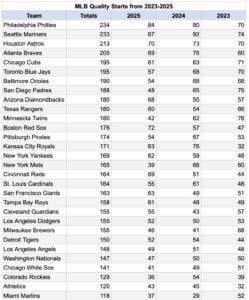
This gives an idea of which teams to target for starting pitching in quality starts leagues heading into 2026. For example, the Phillies, Astros, Braves, and Red Sox had consistently high quality start totals across all three seasons. Additionally, the Diamondbacks, Yankees, Reds, Giants, Rays, and Guardians all increased their totals from 2024 to 2025.
Teams to avoid for QS leagues may be teams like the Padres, Cardinals, Mets, Pirates, Twins, Orioles, and Blue Jays, all of whom had major declines in quality starts last season.
Plus, there are teams regularly appearing at the bottom of the chart that should be avoided aside from a handful of pitchers.
Understanding how teams use their pitchers is an important factor in scouting for QS leagues.
Pitchers Whose Quality Starts are Trending Up
I love weird baseball quirks, so here is one for you. In 2024, 134 pitchers recorded five quality starts or more. In 2025, 134 pitchers recorded five quality starts or more. That is almost as odd as Khris Davis’ .247 batting average four years in a row.
Below are the pitchers who recorded between one and four quality starts in 2024, and saw in increase in their quality starts in 2025. Their 2025 QS totals are in parentheses. These are pitchers who trended upward in quality starts due to returning from injury, changing roles, or making improvements to stuff or sequencing, etc.
- Jesus Luzardo (18)
- Matthew Boyd (17)
- Robbie Ray (16)
- Bryce Elder, Gavin Williams, Jeffrey Springs (14)
- Trevor Rogers (13)
- Slade Cecconi, Matthew Liberatore (11)
- Quinn Priester, Davis Martin, Eduardo Rodriguez, Grant Holmes (9)
- Walker Buehler, Clarke Schmidt, Michael McGreevy, Tanner Gordon (7)
- Chris Paddack, Max Scherzer, Clayton Kershaw (6)
- Emerson Hancock, Max Meyer, Sean Burke (5)
- Taijuan Walker, Michael Soroka (4)
- Kyle Bradish, Shane Bieber, Ben Brown (3)
- Tyler Wells, Joey Cantillo, J.T. Ginn (2)
Luzardo had a career year in 2025, and may not reach past the 18 quality starts from last season, though he plays on a team who lets their pitchers go deep. Similarly, Boyd had a fantastic year, seemingly out of the blue, and may not get past his 2025 total.
Some pitchers who may continue to see an increase in their quality starts for a third season could be pitchers like Rogers, Bieber, Williams, Cecconi, Priester, McGreevy, Bradish, and Cantillo. They are an extra year removed from injuries, or are expected to have expanded roles this season. Many will have no innings limitations this season.
Quinn Priester
Priester is an excellent target in this group of pitchers. Clearly, something clicked for him in Milwaukee last year. He leaned heavily on his sinker, slider, and cutter, which resulted in the best performance of his career. in turn, Priester tossed a career high 157 innings, with a 3.32 ERA. Presumably, he should be able to tack on more innings this season, and achieve more quality starts with similar results.
Moreover, Priester’s sinker and slider were both above average in Out%. In other words, they induced outs at a higher rate than league average. Those pitches helped lead to an increase in K/9 for the third year in a row for Priester.
He also induced outs on the ground. Priester’s 56% groundball rate would have ranked fifth best in baseball if he had enough innings to qualify. The Brewers defense was also a huge upgrade for him – he went from a 68% LOB rate in 2024 to a 79% rate in 2025.
Priester has two other pitches that he barely tapped into, a curveball and a changeup. Both pitches had a .250 BAA or better, while his curveball also owned a 41% whiff rate and a 22% putaway rate.
This is a pitcher who has made improvements and adjustments and should continue to see increased success. He is a major target in QS leagues.
Other Positive Quality Starts Trends
Below, you will find a list of every pitcher who earned five or more quality starts in 2024 and increased their quality start total in 2025. Their 2025 quality start totals are in parentheses. These are pitchers who perhaps bounced back from injury or were on innings limits in 2024 that did not have the same limitations last season. Likewise, they could be pitchers who made improvements and adjustments that led to better performances last year.
- Garrett Crochet, Cristopher Sanchez, Logan Webb (22)
- Bryan Woo, Hunter Brown (21)
- Paul Skenes, Max Fried, Framber Valdez (20)
- Nick Pivetta (19)
- Carlos Rodon (18)
- Merrill Kelly, Yoshinobu Yamamoto (18)
- Zack Littell, Ranger Suarez, Mitch Keller (17)
- Brayan Bello (16)
- Jose Soriano, David Peterson, Zac Gallen, Brady Singer (15)
- Nick Lodolo, Ryan Pepiot, Kyle Freeland, MacKenzie Gore, Joe Ryan, Sonny Gray (14)
- Taj Bradley, Freddy Peralta, Spencer Schwellenbach (13)
- Justin Verlander (12)
- Kyle Hendricks, Nick Martinez, Shane Baz, Andrew Abbott (11)
- Randy Valsquez, Case Mize, Andre Pallante (9)
- Logan Allen, Edward Cabrera (7)
Breaking Down Who to Target in Quality Starts Leagues
Kelly has been incredibly consistent. Outside of an injury plagued 2024, he has had exactly 18 quality starts in each season since 2022. Consequently, he is an excellent target for 2026 drafts.
This could be the year Lodolo finally puts it all together. Yes, his K/9 rate dropped last season. In spite of that, he put forth his best performance in innings and ERA (156 IP and 3.33 ERA). He features a fastball, sinker, and changeup that were all above average in Out% last season. On top of that, his curveball was .2% away from being above average. Lodolo has the stuff, is on a good team, and seems to be improving. He should be a major QS league target.
Pepiot has increased his QS total in each of the last three seasons, and with it, his innings. That could continue to happen in 2026. Pepiot’s fastball, changeup, and curveball each have 25% whiff rates or better, 19% putaway rates or better, and .235 BAAs or better. He has the stuff to keep batters guessing deep into lineups and is a great candidate to make the jump into a high quality start total.
Yamamoto saw a major innings increase in 2025, going from 90 IP the year prior to 173 last season. Additionally, he was also a workhorse for the Dodgers in the playoffs. He is also participating in the World Baseball Classic. This is likely to put a heavy toll on his arm. Los Angeles already limits the workload of their pitchers; therefore, Yamamoto could be a contender for a decreased QS total in 2026.
Of the pitchers mentioned above, Skenes, Webb, Crochet, Sanchez, Woo, Brown, Fried, Valdez, and Pivetta likely maintain high quality start totals. Although they may not increase much, or may even drop by one or two, these are pitchers who consistently perform at the top of the league in quality starts.
Additionally, Gray, Gore, Peralta, Baz, and Cabrera all have new teams, which could result in increased quality starts in 2026.
Okay, Then Who Do I Target?
Below is a list of pitchers that ATC projects to have an above average K/9 and BB/9, as well as an above-average LOB% in at least 100 IP in 2026. These are high-strikeout, low-walk pitchers who strand runners, which means that they limit baserunners and scoring. Their projected QS totals are in parentheses.
- Tarik Skubal (18)
- Logan Webb, Paul Skenes (17)
- Cristopher Sanchez (16)
- Framber Valdez, Bryan Woo, Hunter Brown, Garrett Crochet (15)
- Jesus Luzardo (14)
- Logan Gilbert, Hunter Greene, Chris Sale (13)
- Cole Ragans (12)
- Yusei Kikuchi, Jacob deGrom, Zack Wheeler, Michael King (11)
- Brandon Woodruff, Kyle Bradish (10)
- Shane McClanahan, Chase Burns (9)
- Gerritt Cole (8)
- Mike Burrows, Ryan Weathers, Reynaldo Lopez, Shohei Ohtani (7)
Which Pitchers to Avoid in Quality Starts Leagues
It is equally important to identify negative trends as it is to identify positive ones. This can help fantasy managers figure out which pitchers to avoid. You may recognize some of the names below as pitchers who were hurt last season. Others simply did not perform well. On the other hand, some have felt the effects of father time. However, these pitchers were affected, identifying these decreased quality start totals, and their causes, helps paint a picture of their performance and helps fantasy managers understand who to stay away from in 2026. Of course, not all of the players below are players you should avoid – context is important. Here are pitchers whose quality starts totals decreased by at least five from 2024 to 2025.
- Cole Ragans
- Bobby Miller
- Tanner Houck
- Corbin Burnes
- Sean Manaea
- Logan Gilbert
- Aaron Nola
- Pablo Lopez
- Reynaldo Lopez
- Michael King
- Austin Gomber
- Nestor Cortes
- Ryan Feltner
- Cal Quantrill
- Grayson Rodriguez
- Jared Jones
- George Kirby
- Frankie Montas
- Ben Lively
- Gavin Stone
- Matt Waldron
- Chris Flexen
- Joe Musgrove
- Justin Steele
- Ronel Blanco
- Bailey Ober
- Gerritt Cole
- Joey Estes
- Kyle Harrison
- Marcus Stroman
- Spencer Arrighetti
- Dylan Cease
- Jose Berrios
- Shota Imanaga
- Chris Sale
- Zach Eflin
- Tyler Glasnow
- Jake Irvin
- Miles Mikolas
- JP Sears
- Luis Gil
- Erick Fedde
- Paul Blackburn
- Tobias Myers
- Tyler Anderson
- Reese Olson
- Jack Flaherty
- Aaron Civale
- Drew Thorpe
- Alec Marsh
Breaking Down Who to Avoid in Quality Starts Leagues
Ragans dropped from 186 IP in 2024 to 61 in 2025 due to injury. He should bounce back to some better numbers in 2026. He earned 21 quality starts in that 2024 season, and although he may not reach that total this year, a total in the high teens would not be out of the question. Aaron Nola could also see an increase in quality starts after an injury-filled 2025. The same goes for pitchers like Pablo and Reynaldo Lopez, Rodriguez, Sale, and Kirby.
Cease had double-digit quality start totals every season from 2021 to 2024. He should be able to get back to that after earning eight last season. Plus, Cease signed with Toronto in the offseason, which should help him defensively. His .320 BABIP and 69% LOB rate certainly did not help him go deep in games last year. That should change in 2026.
Snell dealt with injuries in 2025, but unlike other pitchers, he probably will not come back with high quality start totals. Since 2017, he has earned more than 11 quality starts in two seasons. This is also a concern for pitchers like Olson, Weathers, Gil, Eflin, and Glasnow.
Imanaga also may not be a great target in QS leagues this season. He went from 19 to 12 quality starts the last two seasons. His velocity dipped, and his strikeout rate decreased. Despite the declining velocity and strikeouts, he arguably had a lucky season, considering his .219 BABIP and 4.36 SIERA compared to a 3.73 ERA.
Other pitchers to avoid from this group that never seem to break through in quality starts include Anderson, Myers, Blackburn, Fedde, Sears, Irvin, and Lively.
Other Risky Pitchers in Quality Starts Leagues
Below is a list of pitchers that the ATC projects to have a below-average K/9 and BB/9, as well as a below-average LOB% in at least 100 IP in 2026. These are high-walk, low-K pitchers who do not strand runners, which means that they could be a risk for getting pulled early. Or they may give up so many runs that they cannot attain quality starts. Their projected QS totals for 2026 are in parentheses.
- Jose Soriano, David Peterson (12)
- Lucas Giolito (10)
- Cade Cavalli, Hurston Waldrep (9)
- Michael Lorenzen, Randy Vasquez, Cristian Javier, Andre Pallante, Dustin May, Sean Burke, Anthony Kay, Clay Holmes (8)
- Chase Dollander, Ryan Feltner, Marcus Stroman, Simeon Woods Richardson, Tyler Anderson, Jose Quintana, Andrew Alvarez, Griffin Canning, Logan Allen (6)
- Josiah Gray, German Marquez, Walker Buehler, Kyle Leahy, Jacob Latz (5)
- Taijuan Walker, Luis Medina (4)
More Quality Starts Concerns
And here are pitchers who have not reached more than 15 quality starts in any of the last three seasons. Based on past performance, you may want to consider avoiding them, at least at cost, in 2026 drafts. These pitchers were active in every season from 2023 to 2025. You will notice some repeat names from previous sections
- Joe Ryan
- MacKenzie Gore
- Kyle Freeland
- Jeffrey Springs
- Michael Wacha
- Taj Bradley
- Brandon Pfaadt
- Tanner Bibee
- Justin Verlander
- Hunter Greene
- Ryne Nelson
- Andrew Abbott
- Luis SEverino
- Michael Lorenzen
- Tyler Glasnow
- Bailey Falter
- Logan Allen
- Clarke Schmidt
- JP Sears
- Tyler Anderson
- Max Scherzer
- Reese Olson
- Griffin Canning
- Shane Bieber
- Michael King
- Cristian Javier
Not every pitcher in baseball is in this article, but hopefully, this gave you some direction for your quality starts league drafts. Good luck!
Fantrax is one of the fastest-growing fantasy sites in the fantasy sports industry, and we’re not stopping anytime soon. We are the most customizable, easy-to-use, and feature-rich platform in the industry, offering the greatest fantasy experience for your dynasty, keeper, redraft, and best ball leagues. Fantasy sports doesn’t sleep, and neither does Fantrax, with seasons running 365 days a year. Take your fantasy leagues to the next level now at Fantrax.com!