

One week. That’s how much basketball we’ve watched so far, and already fantasy managers are behaving as if they’ve seen enough to rewrite the laws of fantasy basketball economics.
Players drafted outside the top 100 are producing like second-rounders. Established fantasy guns are suddenly being treated like waiver-wire fodder. And somewhere in your league, a manager with three injured stars is quietly wondering whether this “hobby” is a terrible idea.
Welcome to the opening weeks of fantasy basketball, where small sample sizes produce enormous overreactions, and enormous overreactions produce opportunities.
The trick isn’t identifying who’s playing well or poorly. Your league standings can tell you that. It’s recognising when a player’s perceived value has become detached from their likely rest-of-season production.
Fantasy Basketball Trade Market
SELL HIGH
Zach LaVine | Sacramento Kings
The Zach Attack is back. Now make like Sacramento and trade him.
Zach LaVine was a perfectly reasonable selection around the 100 mark on draft day. You knew what you were buying: points, threes, some efficiency, and the occasional reminder that this man was once one of basketball’s most explosive offensive players.
What you probably weren’t thinking you were drafting at Pick 104 was Shai Gilgeous-Alexander.
Yet here we are.
LaVine is averaging 27.3 points, 3.0 triples, 3.5 rebounds, 3.3 assists, and a steal. At the time of writing, he’s matching SGA’s scoring output while shooting a superior 52.2% from the field compared with Shai’s 47.8%.
Both are hitting 83.3% from the charity stripe, although LaVine is doing so on 7.3 attempts per game compared with SGA’s 4.5.
The man drafted around pick 100 is currently scoring as much as fantasy royalty, with superior shooting efficiency.
What a time to be alive. What a time to sell.
This isn’t an indictment of LaVine’s talent. But this combination of scoring volume and efficiency is an ambitious rest-of-season expectation, particularly on a Sacramento team navigating considerable uncertainty.
There’s also the possibility LaVine himself gets moved as the Kings reshape their roster. A change of scenery could dismantle the circumstances producing this early fantasy windfall.
I hesitate to suggest fantasy managers should model their decision-making on the Sacramento Kings, but desperate times call for desperate measures.
Be more like Sacramento. Trade Zach LaVine.
Just make sure you get something considerably better than Sacramento usually does.
Paul George | Boston Celtics
Availability is a fantasy category, even if your league doesn’t count it.
Paul George has arrived in Massachusetts and apparently decided to remind everybody that, when healthy, he’s still an exceptional basketball player.
Through four games, George is delivering early third-round value with 22.3 points, 6.0 rebounds, 3.5 assists and a monstrous 2.3 steals. He’s shooting 47% from the field, 43.8% from three and 86.7% from the line.
The role is established. The pedigree is unquestionable. So what’s the problem?
Well, it’s Paul George.
Across the past seven seasons, George has exceeded 56 games just once, appearing in 74 contests during 2023-24.
There’s a Thanos-level inevitability to George missing basketball games. You can run from it. You can hide from it. But somewhere, sometime, the injury report usually comes calling.
Of course, nobody can predict whether George will get injured again. The supposedly dependable player you acquire could just as easily go down tomorrow.
But fantasy basketball is about managing probabilities, not predicting certainties.
If George’s opening performances have restored his perceived value to that of a reliable early third-round commodity, I’m investigating whether another manager is willing to pay that price.
An availability upgrade without sacrificing too much per-game production is precisely the kind of transaction that can quietly win a fantasy season.
Yaxel Lendeborg | Golden State Warriors
The fantasy paradox: too good to trade, or too valuable not to?
Yaxel Lendeborg has apparently decided easing into an NBA career is for chumps.
He’s jawing with Luka Dončić, embracing the spotlight against Denver, and casually dropping 31 points as part of his second career double-double.
The rookie isn’t just announcing himself to the NBA. He’s announcing himself to every fantasy manager who didn’t draft him.
Through four games, Lendeborg is averaging 21.8 points, 9.3 rebounds, 4.8 assists and a steal while playing 33.3 minutes a night.
He’s already returning fringe top-40 fantasy value.
Which presents a fascinating problem.
Golden State’s much-discussed gap-year circumstances could provide Lendeborg with substantial opportunities and usage. That’s a compelling reason to hold him.
But here’s the paradox.
How much more upside are we realistically pricing into somebody who’s already producing at this level?
And how much upside is your league’s resident rookie enthusiast pricing in?
Because there’s a reasonable chance somebody believes Lendeborg isn’t merely a top-40 player. They believe he’s a Top-25 player waiting to happen.
That’s the manager I want to speak with.
We also need to consider the eventual returns of Moses Moody and Jimmy Butler, both of whom could influence Lendeborg’s minutes and offensive responsibilities.
I’m not advocating selling him for the sake of selling. His upside is legitimate, and his circumstances justify holding.
However, if another manager is willing to hand over a proven top-30 asset for the privilege of betting on even more upside, I’m listening.
Sometimes the smartest way to capitalise on a breakout is convincing somebody else to pay you for what they think happens next.
Sell-high honourable mentions
- Jabari Smith Jr. (Houston Rockets): The production is enticing, but if somebody is valuing him as an established fantasy star rather than a historically inconsistent contributor, investigate the return.
- Ja Morant (Portland Trail Blazers): Explosive production and enormous name recognition. If somebody is overlooking the volatility, turn that reputation into a more dependable fantasy asset.
- Davion Mitchell (Miami Heat): Enjoy the hot start, but don’t mistake a productive opening stretch for an entirely new fantasy ceiling. Test the market while the numbers are fresh.
BUY LOW
Nickeil Alexander-Walker | Atlanta Hawks
The Top-50 player hiding in plain sight.
Nickeil Alexander-Walker currently sits just outside the top 75 in fantasy rankings.
I don’t think he belongs there.
In fact, I see Alexander-Walker as a legitimate Top-50 fantasy asset, and his early-season performances have created an intriguing buying window.
Through four games, NAW is averaging 18.8 points, 3.5 rebounds, 3.8 assists and 1.8 steals, shooting 44.6% from the field and 38.2% from three.
These aren’t disastrous numbers. Far from it. But they’re not quite the fantasy heights we saw him reach last season.
The encouraging part is that his role in Atlanta remains secure. He’s playing 29.5 minutes a night, the Hawks are competing with genuine intent, and his defensive production provides a valuable foundation for category leagues.
The 66.7% free-throw shooting is ugly, although early-season percentages can be misleading on limited attempts.
I’m not suggesting Alexander-Walker is about to become a completely different basketball player. I’m suggesting he’s capable of providing more fantasy value than his current ranking indicates.
And the timing matters.
Atlanta’s four-game schedule this week provides another opportunity for an underwhelming performance to frustrate his manager. If that happens, I’m making an enquiry, particularly if I can secure him ahead of another four-game week.
Top-75 price for a player I believe can deliver top-50 value? Sign me up.
Trey Murphy III | New Orleans Pelicans
Good player. Bad team. Average start. Excellent opportunity.
Sometimes fantasy analysis doesn’t need to be complicated.
Trey Murphy III is a very good basketball player on a team that isn’t particularly good, and he’s opened the season with numbers that don’t fully reflect his fantasy capabilities.
Through three games, Murphy is averaging 15.3 points, 5.3 rebounds, 2.7 assists and just 0.7 steals. He’s shooting an impressive 48.6% from the field and 41.2% from three, yet the overall production hasn’t been particularly exciting.
Which is precisely why I’m interested.
Unlike some buy-low candidates, Murphy isn’t struggling because his shooting has abandoned him. His efficiency has actually been excellent. The issue is his modest scoring volume and limited defensive contributions.
That distinction matters.
We’re not necessarily waiting for an ice-cold shooter to rediscover his touch. We’re looking for a proven offensive weapon to become more involved.
Murphy is playing 33.3 minutes a night. The opportunity exists, and New Orleans isn’t exactly overflowing with reasons to suppress one of its most important players.
Managers who drafted Murphy expecting a meaningful fantasy contributor might already be growing impatient with a 15-point scorer on a struggling team.
Three games shouldn’t rewrite our evaluation of a player.
But sometimes three games are enough to rewrite somebody else’s.
I’m buying Murphy before the volume catches up with the talent.
OG Anunoby | New York Knicks
The shots aren’t falling. The fantasy profile hasn’t disappeared.
OG Anunoby isn’t necessarily going to dominate your league’s highlight reels. He isn’t going to deliver 30 points every second night.
But in category leagues?
He’s an absolute weapon.
Or at least, he usually is.
Through four games, Anunoby is averaging 16.3 points, 6.3 rebounds, 3.0 assists, 0.8 steals and 0.8 blocks in 34 minutes per contest.
The problem is obvious: his shot has been dreadful.
He’s shooting just 38.8% from the field and an even uglier 25.9% from beyond the arc. And the Knicks, more broadly, haven’t exactly burst out of the gates.
But here’s the important distinction between a genuinely concerning fantasy decline and an attractive buying opportunity.
The minutes are still there.
Anunoby’s role hasn’t evaporated. The opportunity to accumulate rebounds, defensive statistics and peripheral production remains.
What hasn’t arrived is the shooting efficiency we’ve come to expect.
The steals are also down, which is worth monitoring. His fantasy ceiling has always been closely connected to defensive production, and we shouldn’t assume every category will automatically recover.
But four games is a remarkably small sample on which to abandon a proven fantasy profile.
I’m wagering that the shooting improves, the defensive numbers recover, and the Knicks eventually resemble something closer to the team we expected.
If his manager is staring at those percentages and wondering whether they made a mistake on draft day, I’m happy to provide an escape route.
At a discount, naturally.
The NBA’s Most Expensive Waiting Room of Anthony Edwards, Paolo Banchero, Kawhi Leonard, Jalen Duren, Jaren Jackson Jr. and the art of being a charitable opportunist.
Now, this is where fantasy basketball stops being about statistics and starts becoming about human behaviour.
Because somewhere in your league, there is a manager in absolute crisis.
I know this because I’m currently watching it happen.
In one of my leagues, we have three injured-reserve spots. One manager has managed to collect three of the injured players we’re discussing.
Three.
Their IR is full, their flexibility is compromised, and they’ve already openly announced in the group chat that they’re willing to entertain offers.
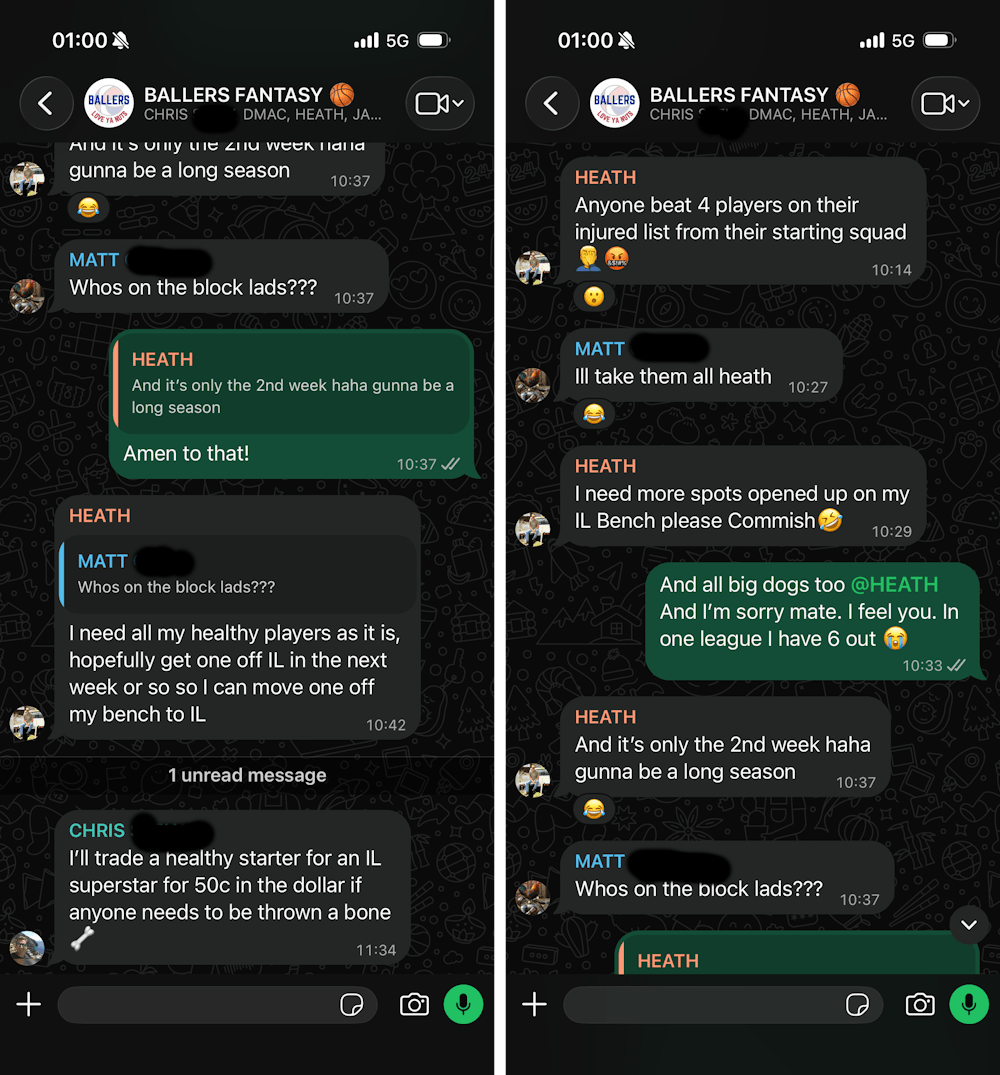
Now, a less scrupulous fantasy manager might see this situation and immediately attempt to acquire a premium asset for 50 cents on the dollar.
Naturally, this would be presented as an entirely selfless act of goodwill.
A Mother Teresa-esque intervention.
“I’m just trying to help you out, mate. You’ve got a lot of injuries. Let me take one of those problems off your hands.”
The generosity is almost overwhelming.
But here’s where the smarter fantasy manager separates themselves from the vultures circling the group chat.
Don’t offer 50 cents. Offer 60 or 65.
Because you’re not simply purchasing a dollar’s worth of fantasy production for 60 cents. You’re potentially acquiring an asset that could become considerably more valuable than today’s asking price.
If your team is healthy, you’re sitting comfortably in the standings, and you have an unused IR spot, you possess something your desperate league-mate doesn’t.
Flexibility.
You can afford to wait. They might not be able to.
Assuming recovery progresses as expected, injured stars become appreciating assets as their return approaches. A player six weeks away from returning is a very different proposition from that same player six days away.
It’s basic market economics, dressed up in compression sleeves and questionable injury designations.
Of course, these players carry different medical circumstances and timelines. Some will return smoothly. Others might require minutes restrictions, gradual conditioning, or managed back-to-backs.
This isn’t a licence to trade your entire healthy roster for an emergency department.
It’s an invitation to exploit a market inefficiency when your roster construction allows it.
Acquire an injured star at a meaningful discount, stash them, and let time work in your favour. When they return, you might have a league-changing contributor for the business end of the season.
And when their return includes restrictions or scheduled rest, use whatever IR eligibility your league permits, stream available roster spots, and manage the schedule accordingly.
The goal isn’t to win the first fortnight of November.
It’s to build the team nobody wants to face when the fantasy playoffs arrive.
Just remember to tell your league-mate you’re doing it out of the goodness of your heart.
Buy-low honourable mentions
- Bam Adebayo (Miami Heat): A proven multi-category contributor whose value shouldn’t be dictated by an underwhelming opening stretch. Frustrated managers create buying opportunities.
- Onyeka Okongwu (Atlanta Hawks): Big-man efficiency, rebounds and defensive upside remain appealing. Buy the underlying fantasy profile, not the first week’s fluctuations.
- Ryan Rollins (Milwaukee Bucks): The opportunity to contribute across multiple categories remains intriguing. If another manager is treating him as disposable, I’m interested.
The Final Word: Trade the Perception, Not Just the Production
The first few weeks of an NBA season are a wonderful time to be wrong.
Not because being wrong is enjoyable, but because everybody else is almost certainly wrong about something too.
Somebody thinks Zach LaVine has become Shai Gilgeous-Alexander. Somebody believes Paul George’s early production has erased seven seasons of availability concerns. Somebody else is convinced Yaxel Lendeborg’s current ranking is merely the beginning of his inevitable march towards superstardom.
And somewhere, a manager with three injured players is trying to remember why they agreed to play fantasy basketball.
These are the opportunities.
The best fantasy managers don’t simply identify which players are outperforming or underperforming expectations. They identify when those performances have changed the market’s perception enough to create a profitable transaction.
Because a good trade isn’t necessarily one that makes your team better tomorrow.
Sometimes it’s the trade that makes your team unbeatable in March.
So open the trade window. Send the enquiry. Make the offer.
Fantrax is one of the fastest-growing fantasy sites in the fantasy sports industry, and we’re not stopping anytime soon. We are the most customizable, easy-to-use, and feature-rich platform in the industry, offering the greatest fantasy experience for your dynasty, keeper, redraft, and best ball leagues. Fantasy sports doesn’t sleep, and neither does Fantrax, with seasons running 365 days a year. Take your fantasy leagues to the next level now at Fantrax.com!