
One of the keys to being successful in the fantasy industry is adapting to the changes on the playing field and in the hobby space. Competing in fantasy sports since 1989, I have witnessed the tremendous growth of fantasy across the country. In 2008, I first played college fantasy football on a site that no longer offers CFF leagues and transitioned to Fantrax, which is still the only platform that provides season-long College Fantasy Football leagues.
Over the past two years, Best Ball has started to take off in the College Fantasy Football space, and I absolutely love drafting and playing in these leagues. It is by far the best way to become familiar with the college football player pool and prepare for season-long drafts in the summer.
For the past decade, I have participated in the Scott Fish Bowl Tournament, and in 2025, Scott Fish is hosting the first-ever College Fantasy Football Tournament—The Tadpole Bowl—hosted by Fantrax. To join, please smash the link: https://scottfishbowl.com/college. Our incredible CFF hobby continues to evolve and grow by leaps and bounds.
In order to help CFF novices, I have participated in two different Best Ball drafts and wanted to share the results of a full FBS and Power 4 only league with analysis. Enjoy my fellow CFF diehards!
CFF Best Ball (Full FBS: 136 teams)
My friend Ethan Sauers of the Podcast Ballin with my Bestie commissioned a full FBS CFF Best Ball, and I jumped at the opportunity to join. The league settings included a 30-man roster with 11 starters (2 QBs, 2 RBs, 3 WRs, 1 TE, and 3 Flex), which is ideal for a large player pool in CFF. Receptions were worth ½-point, and passing touchdowns were four points each—I prefer six points for passing touchdowns.
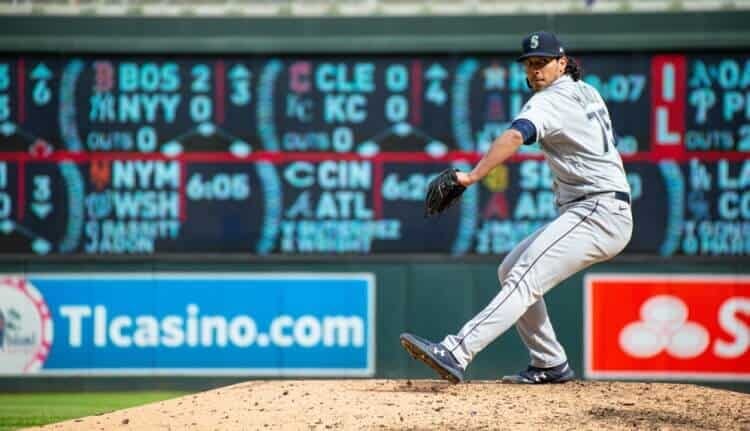
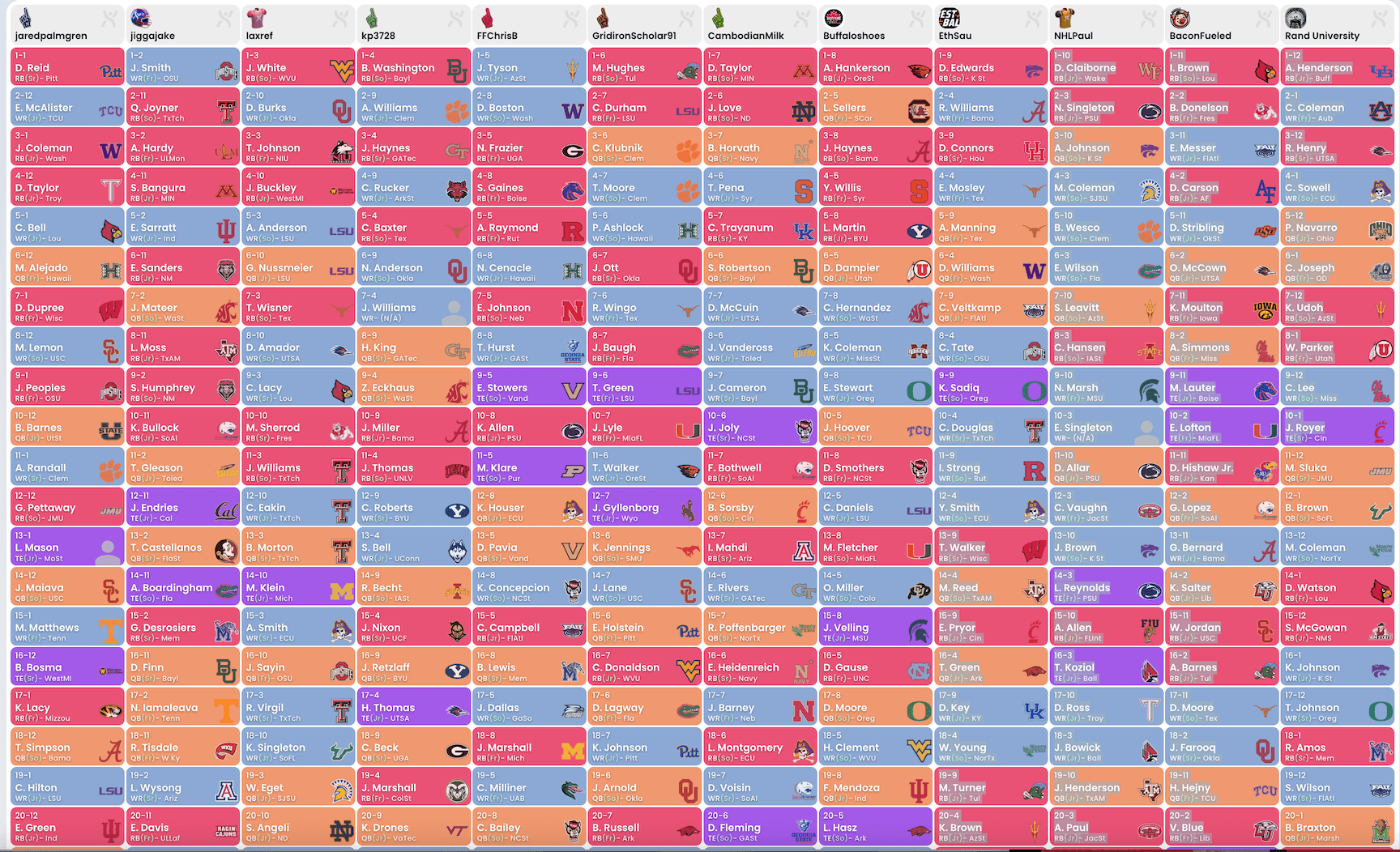
I nearly always strategize my first three picks in a CFF draft, remaining flexible if titanic selections occur. Drafting out of the sixth spot, I wanted to build a strong backfield first and foremost. Makhi Hughes, Oregon, and Caden Durham, LSU, kicked off my draft. Looking at the first two rounds, 15 running backs came off the board among the 24 picks, which has become the norm in early CFF drafts, and five coaches double-tapped the position like me. Every CFF manager must decide to follow the herd or employ a different strategy to roster building in 2025.
Scholar’s Running Backs (round, pick)
Makhi Hughes, Oregon (1-6), Caden Durham, LSU (2-7), Jaydn Ott, Oklahoma (6-7), Jadan Baugh, Florida (8-7), Jordan Lyle, Miami (10-7), CJ Donaldson, Ohio State (16-7), Braylen Russell, Arkansas (20-7), Ja’Kobi Jackson, Florida and Cam Edwards, UConn (27-6).
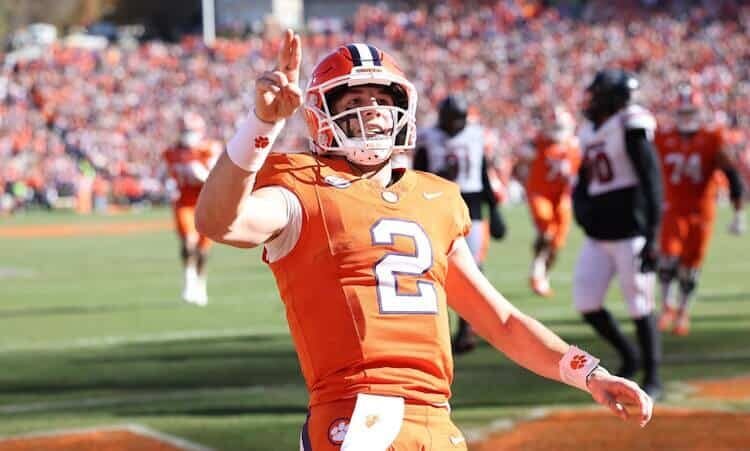
I originally planned on selecting a wide receiver in Round 3; yet, QB Cade Klubnik remained on the board, and I could not pass on a signal caller with a high floor and massive weekly ceiling. With an All-American CFF QB, I could now wait for at least 10 rounds to acquire a second field general and grabbed Kevin Jennings, SMU in Round 13.
Kevin Jennings, you are ridiculous.#PonyUpDallas pic.twitter.com/qK2fpS2pZS
— SMU Football (@SMUFB) November 23, 2024
Finally, in Rounds 4 and 5, I acquired two receivers to balance my roster, selecting TJ Moore, Clemson, and Pofele Ashlock, Hawaii, to anchor my locker room. In CFF Best Ball, I love to pair my top QB with a pass-catcher, and Moore remained available—I could not risk the Tigers’ sophomore making it back to me in 10 picks. Ashlock had a down season in 2024; nevertheless, CFF managers are excited about new Rainbows’ quarterback Micah Alejado, and if the Hawaii offense finds its groove, Ashlock will bounce back to his 2023 production.
Scholar’s Wide Receivers (round, pick)
TJ Moore, Clemson (4-7), Pofele Ashlock, Hawaii (5-6), Ryan Wingo, Texas (7-6), Trent Walker, Oregon State (11-6), Ja’Kobi Lane, USC (14-7), Kenny Johnson, Pittsburgh (18-7), Joshisa Trader, Miami (21-6), Darrell Gill, Syracuse, (22-7), Kenny Odom, UTEP (23-6), Chas Nimrod, USF and Jalen Moss, Arizona State (30-7).
Having drafted in many FBS Best Ball leagues, I have concluded that the ideal 30-player roster configuration is: 7 QBs, 9 RBs, 11 WRs and 3 TEs using the settings above. Injuries and benchings are inevitable, and it is imperative to have depth at every position, especially tight end. I used to select only two TEs and endured far too many injuries—there is not much worse than scoring zero points at the tight end spot each week in CFF Best Ball. As a bonus, if two TEs go off at the same time, one player can be inserted into the Flex position.
Twitterverse on Fire!
In a recent CFF Best Ball Draft, identify the best value at quarterback after Round 10:
- Brendan Sorsby, CIN (12-6): 23%
- Katin Houser, ECU (12-8): 30%
- DJ Lagway, FLA (17-6): 28%
- Jackson Arnold, Auburn (19-6): 19%
“Katin Houser for me. Nice production. Good schedule. Good system. The trifecta!” @aceholesrule
“I think folks are sleeping a little too much on Jackson Arnold this year. He’s going from a team that had no receivers and a poor offensive line to a team with a top 3 receiving core and 97% returning production on the O-line. Fade at your own risk.” @eliotmays
CFF Best Ball (Power 4: 65 teams)
For the first time last year, a large College Fantasy Football Best Ball Tournament was offered for CFF diehards like myself. Unlike the typical CFF Best Ball leagues that I played in, the tournament only included a player pool from Power 4 teams, including Notre Dame. With spring practices nearly over, I decided to organize a draft to prepare for the upcoming season.
The league settings were structured with 20 roster spots with eight weekly starters (1 QB, 2 RBs, 2 WRs, 1 TE, 1 Flex, and 1 S-Flex). Receptions were worth ½-point, and passing touchdowns were four points. In this draft, I had the 12th pick and needed to figure out my game plan.
When I am on the turn in any draft, I like to double-tap a position to create a sense of urgency among competitors and possibly position scarcity. Therefore, I wanted to kick off my roster with two of the top five quarterbacks in order to see how the roster turned out. In early drafts, experimenting is very important to maximize insight and identify tiers at positions. I selected Garrett Nussmeier, LSU, and Arch Manning, Texas, and Ethan Sauers with the 11th pick also grabbed two signal callers: Klubnik and LaNorris Sellers, South Carolina. It would be fascinating to watch how we both implemented the same strategy.
ARCH MANNING HAS ARRIVED. TD TEXAS🔥 🙌
FIRST TEXAS TD FOR ARCH 👏
(via @InsideTexas)
pic.twitter.com/0vsv0LtQgJ— Bleacher Report (@BleacherReport) August 31, 2024
In the first three rounds, many owners leaned into building a strong backfield: 21 running backs were selected, and two coaches structured their roster around three ball carriers, and two others picked back-to-back runners in the first two rounds. Selecting at pick 36, I had to acquire two backs, and Justice Haynes, Michigan, and Jam Miller, Alabama, were my selections.
Later in the draft, I added Jordan Lyle, Miami, Darrion Dupress, Wisconsin, Sedrick Alexander, Vanderbilt, and Star Thomas, Tennessee. It is a tricky proposition waiting to fill out my backfield so late, but it goes with the territory when taking a contrarian approach. I only need two runners to eclipse 15 points every week in my lineup, which is possible if all win the job on their respective teams.
As the selections advanced, I noticed that there were no tight ends selected in the first six rounds. I placed three in my queue and wanted to double tap at the position despite the risk involved bypassing receivers. The upside of a top tight end producer would impact my scoring more than a third or fourth receiver on my roster. Kenyon Sadiq, Oregon, went at pick 7.8, and I patiently hoped that my other highly-ranked tight ends remained available…Yahtzee!
On the turn, I plucked Trey’Dez Green, LSU, and Eli Stowers, Vanderbilt. I really like pairing a TE with one of my QBs, and the Tigers’ duo of Nussmeier-Green is a nice combo. Stowers provides a nice weekly floor option, and I did not even consider a third tight end the remainder of the draft. The key to my season will be difference makers at quarterback and tight end. If the players perform to my prognostications, the roster will be very competitive.
Twitterverse on Fire!
In a Power 4 only CFF Best Ball draft, who is the best running back value after the first five rounds?
- Kamari Moulton, Iowa (7-9): 30%
- Darrion Dupree, Wisconsin (10-1): 23%
- Davion Gause, North Carolina (9-3): 15%
- Jadan Baugh, Florida (8-11): 32%
“I’ll roll with Kamari Moulton, although all intrigue me. I like what I’ve seen from the Hawkeyes’ runner, and Iowa rocks a 64% rush rate.” @eliotmays
“Davion Gause is the best value if he actually gets the carries at Chapel Hill.” @sjjackso2
“Davion Dupree for me. Wisconsin has a history of touch hogs and Round 10 is great value.” @aceholesrule
“I’ll go with Darrion Dupree since I can get him the latest…And, in CFF Best Ball, I love the pass-catching ceiling that Dupree has and none of the others can touch!” @ChicagoAdamC
Mitch Hardt’s Draft Strategy
After seeing ADPs of early CFF Best Ball drafts and drawing pick No. 5, I was very sure I would go receiver in Round 1. Jeremiah Smith, Ohio State, went at the No. 4 pick, so I went with Jordan Tyson, Arizona State. I targeted Demond Claiborne, Wake Forest, and Jaheim White, West Virginia, with my next two picks. Regrettably, Claiborne went two picks earlier than mine; nonetheless, I snagged White and WR Denzel Boston, Washington. While the league is only ½-point PPR, my trio of Tyson, Boston, and Elijah Sarratt, Indiana, is likely the best in the league.
Waiting on quarterback was also a given: tons of value at the position. As many do, I added dual threats. In Round 6, Kevin Jennings was a great value. I loved picking up Marcel Reed, Texas A&M, in Round 9 and Kaidon Salter in Round 13.
At running back, I just wanted touches. Dean Connors, Houston, and Emmett Johnson, Nebraska, both catch passes, and with White, I have a bottom-tiered RB cadre. Could be a problem, but my depth at the position of Dante Dowdell, Nebraska, and Le’Veon Moss, Texas A&M, both could enter the fray.
Freshman All-American 🫡 pic.twitter.com/m2qiLq4X4U
— West Virginia Football (@WVUfootball) December 28, 2023
My late draft strategy was to snag a few “zags” running backs. Evan Pryor, Cincinnati, and Jordan McDonald, Boston College, are backs being drafted much later than their teammates. I think both could win the starting jobs: It was also the strategy of Heath Boyd (10th slot) and Chris Kay (7th spot).
All-in-all, waiting on quarterbacks worked. Picking wide receivers instead of runners looks effective. Punting on tight end was perilous, yet snagging Tanner Koziol, Houston, in Round 18 was a value. Honestly, I likely won’t win the league because I picked a better full-point PPR than ½ PPR team, but I should be in the hunt.
— Mitch Hardt
Steve Jackson’s Draft Strategy
My strategy is to WIN the league, so I always chase high-upside guys, elite offenses, and favorable schedules…in that order. As Ricky Bobby said, “If you ain’t first, you’re last!”
I started the draft with two running backs, which is a standard strategy for me in the 10 drafts I have done so far in 2025. Bryson Washington, Baylor, and Quinten Joyner, Texas Tech, are both volume pigs. The rest of my RB room is full of high-upside guys with time-share risk. Jaivian Thomas (formerly of California) was going to be the steal of the draft, since I grabbed him immediately after the Ott transfer, but now who knows after he entered the transfer portal.
Next, I went after my starting receivers, where I picked up Eugene Wilson, Florida, coming off injury, and Tony Pena (formerly of Syracuse), who is hopefully transferring to Miami. I always enjoy taking chances in the Oregon and LSU WR rooms, which are filled with NFL studs. Joe Royer, Cincinnati, is the only 80-target option returning to his same team in College Football.
You can wait on quarterbacks and still get exposure to great offenses. Avery Johnson, Kansas State, might be the best rushing signal caller in the country. Eli Holstein, Pittsburgh, averaged 34 fantasy points per game at the start of the season, before he got hurt. When healthy, Jalon Daniels, Kansas, is extremely dangerous against a Big 12 schedule, and I always enjoy having Ohio State (Julian Sayin) and Indiana coach Curt Cignetti (Fernando Mendoza) quarterbacks on my roster.
— Steve Jackson