

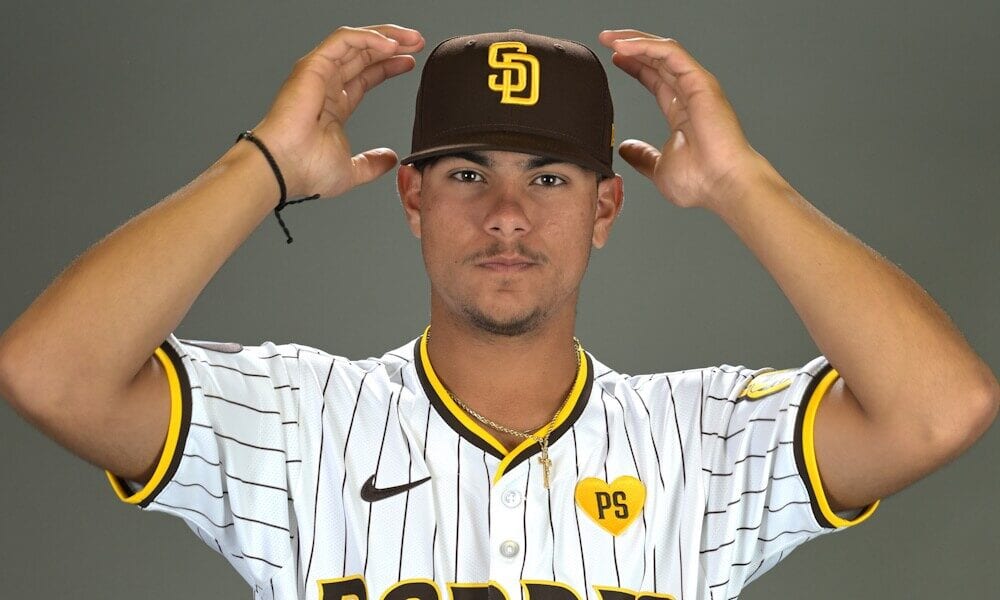
The San Diego Padres have never been shy about betting on youth. San Diego routinely pushes talented players aggressively, trusts its evaluators to identify upside before the rest of the market catches up, and is willing to live with volatility in exchange for impact. For dynasty fantasy managers, that creates a system that can be difficult to rank but extremely rewarding to follow, as you’ll see in the Padres’ Top 20 fantasy baseball prospects profiled ahead.
2026 San Diego Padres Top 20 Fantasy Baseball Prospects
That talent pipeline begins with A.J. Preller and a scouting operation that has consistently demonstrated an ability to identify upside before it becomes obvious to everyone else. The Padres haven’t simply accumulated prospects—they’ve repeatedly found athletes with impact tools, targeted premium talent in the draft and international market, and trusted their evaluations enough to make aggressive investments in young players.
That philosophy has become one of the defining characteristics of the organization. San Diego is rarely afraid of risk when the potential reward is a difference-making player. Whether it’s committing significant resources internationally, betting on high-ceiling prep talent in the draft, or identifying players whose tools could accelerate with professional development, Preller and his staff continue to prioritize upside.
For dynasty managers, that track record deserves attention. A Padres prospect doesn’t automatically become a fantasy asset because of the uniform he wears, but when this organization makes a significant investment in a young player, it’s worth asking why. San Diego’s evaluators have earned enough credibility that their most aggressive bets should immediately put those players on the dynasty radar.
This ranking is built for dynasty fantasy baseball rather than real-life prospect value. Catcher defense, shortstop range, and a pitcher’s ability to absorb innings matter here only when they improve the odds of reaching — and staying in — the major leagues. The focus is fantasy impact: offensive ceiling, power, speed, strikeouts, role probability, age-to-level context, and the price dynasty managers are likely to pay before a prospect becomes a national name.
That distinction matters in a Padres system filled with players whose value could move quickly. Some are already producing. Others are projection bets whose professional track records are measured in weeks rather than seasons. The goal is not to pretend every outcome is certain. It is to identify the twenty players from this group I would most want to roster today if I were building for the next five to ten years.
So, let’s begin with our countdown of the Padres’ top 20 prospects.
No. 20 — Carlos Alvarez | LHP (ETA 2030)
Carlos Alvarez is the type of young pitching prospect who belongs on the radar in deeper dynasty leagues, even if his fantasy impact is still several years away. The 18-year-old lefthander possesses an appealing combination of size, athleticism and projection at roughly 6-foot-4 and 195 pounds. Alvarez is also a converted outfielder who only began transitioning to pitching full-time in recent years, meaning his arm has accumulated relatively little pitching mileage compared with many prospects his age. That lack of wear, combined with his relative inexperience on the mound, adds another layer of projection to his profile. His fastball already reaches the low 90s, and there is reason to believe additional velocity could arrive as he adds strength, refines his mechanics and becomes more comfortable pitching. From a fantasy perspective, that developmental runway is especially intriguing: if Alvarez eventually pushes his fastball into the mid-90s while maintaining his athletic delivery, his strikeout ceiling could rise considerably.
The secondary arsenal gives Alvarez a pathway toward becoming a fantasy-relevant starter rather than simply a hard-throwing lottery ticket. He features a breaking ball in the low 80s along with a developing changeup, providing the foundation for a three-pitch mix. The breaking ball carries the most immediate bat-missing potential, and further development of that pitch could eventually give him the swing-and-miss weapon necessary to produce strong strikeout totals. The major concern for dynasty managers is his control. Alvarez has issued too many walks early in his professional career, and without significant improvement in strike throwing, the combination of a high WHIP and shorter outings could limit his fantasy ceiling or eventually push him toward a relief role. Some of those command issues can reasonably be viewed through the lens of his limited experience on the mound, making his progression over the next few seasons particularly important to monitor.
Alvarez is best viewed as a high-risk, high-upside pitching stash rather than a prospect who needs to be rostered universally. He is most interesting in leagues that roster 200-plus minor leaguers, where acquiring projectable teenage arms before a potential breakout can produce significant value. If Alvarez adds velocity while tightening his command and turning the breaking ball into a legitimate bat-misser, his dynasty stock could climb quickly and give him the ceiling of a strikeout-oriented fantasy starter.
No. 19 — Timothy Mogen | SS (ETA 2029)
Timothy Mogen is an intriguing long-term dynasty target whose fantasy appeal begins with athleticism, speed and plenty of physical projection. The 17-year-old Curaçao native is a quick-twitch athlete with plus speed and a strong throwing arm, while his lean frame leaves considerable room to add strength as he matures. That combination creates an interesting ceiling because Mogen doesn’t need to develop into a major power hitter to become fantasy relevant. For dynasty managers hunting for prospects before their value spikes, a teenage middle infielder who can run and consistently find his way on base, is an appealing foundation.
The early offensive results also provide both reasons for optimism and a clear developmental challenge. Mogen has hit .250 with six doubles and one home run through 145 plate appearances in the Dominican Summer League, so the present game is much more about getting on base and creating havoc than driving the baseball over the fence. Encouragingly, he has drawn 21 walks and been hit by nine pitches, helping compensate for modest power production and pushing his OBP north of .400. There is potential for more power as Mogen adds muscle to his extremely lean frame, but dynasty managers should treat that as projection rather than something already present in the profile.
Mogen is therefore best viewed as a high-variance upside play for deep dynasty formats rather than a prospect who needs to be rostered everywhere. His speed gives him an immediate fantasy carrying tool, and the combination of patience, athleticism and future physical development creates multiple avenues for his value to grow. The dream outcome is a middle infielder who reaches base at a healthy rate, develops enough impact to reach double-digit home runs and uses his plus speed to become a legitimate stolen-base contributor Mogen is exactly the type of low-level lottery ticket worth considering now whose dynasty value could rise quickly if improved contact begins to unlock the offensive upside.
No. 18 — Nu’u Contrades | INF (ETA 2029)
Contrades is one of the most immediately interesting fantasy bats from San Diego’s 2026 draft class. At Arizona State, he paired legitimate game power with an advanced understanding of the strike zone, and his 21-homer season led Division I second basemen.
The increased impact was supported by improved exit velocities and a more fly-ball-oriented approach, giving dynasty managers reason to believe at least some of the power growth is legitimate rather than simply a statistical fluke.
That combination matters. College hitters who already understand which pitches to attack have a better chance of carrying their power into pro ball without allowing strikeouts to overwhelm the profile.
Contrades is an aggressive hitter who likes to attack early and often; however, maintaining quality contact against more advanced professional pitching will be an important test as he moves through the minors.
Contrades profiles as an under-the-radar First-Year Player Draft (FYPD) target with a relatively intriguing power-speed combination for a sixth-round selection. His ability to handle second and third base gives San Diego multiple avenues to move him through the system, and his college experience could allow him to advance more quickly than younger draft picks. The biggest fantasy question is whether his 2026 power breakout translates to wood bats. If it does, Contrades has the offensive ingredients to considerably outperform his draft position and emerge as a useful multi-category fantasy infielder.
No. 17 — Luis Gutierrez | LHP (ETA 2027)
Luis Gutierrez is an intriguing near-term dynasty sleeper whose value comes from pitchability, improving velocity and his ability to consistently throw strikes. The 22-year-old Venezuelan lefthander climbed all four full-season levels in 2025, finishing the year with a 3.31 ERA and 115 strikeouts against 44 walks over 125 innings. His fastball generally sits in the 91-95 mph range and has reached 97, giving him enough velocity to keep hitters honest while allowing his command and sequencing to do much of the heavy lifting.
Gutierrez complements the heater with a low-80s slider and upper-80s changeup, giving him a legitimate three-pitch foundation. The slider is currently his most promising secondary weapon, particularly against left-handed hitters, while the changeup gives him another option for attacking righties. None of his pitches projects as dominant on their own, so his fantasy ceiling will depend on locating the fastball, limiting walks, and generating enough whiffs with the secondaries to maintain a respectable strikeout rate.
Gutierrez is more floor than a lottery ticket, but his proximity makes him worth monitoring in deeper formats. He has already demonstrated the durability to handle a starter’s workload and could provide useful innings, ratios, and moderate strikeout production if everything translates against major-league hitters. The upside may resemble a back-end fantasy starter rather than a future ace, but pitchers with solid command, three usable offerings, and an approaching MLB opportunity can become valuable depth pieces quickly. Gutierrez is a worthwhile stash in leagues rostering 150-plus prospects and a strong watch-list name in shallower formats.
No. 16 — Alex McCoy | OF (ETA 2028)
McCoy is the kind of prospect who can force a re-evaluation through performance. He has already earned Player of the Week recognition in the Padres’ system and, more recently, continued producing at High-A Fort Wayne.
Alex McCoy is quickly developing into one of the more interesting power sleepers in the Padres system. The imposing 6-foot-5, 260-pound right-handed hitter went undrafted in 2024 before signing with San Diego, but his performance has forced him onto the prospect radar. McCoy hit over .300 during his first full professional season and has continued producing after advancing to High-A in 2026. Recently, McCoy earned Player of the Week recognition in the Padres’ system as he continues producing at High-A Fort Wayne.
Power is the carrying tool, and McCoy possesses enough raw juice to make him a legitimate fantasy riser. He produced an exit velocity as high as 118 mph in 2025, showcasing impact ability that stands out even among much more highly regarded prospects. The encouraging part is that McCoy isn’t simply selling out for home runs; he has shown enough feel for the barrel to consistently punish pitches he can handle. There is still swing-and-miss risk against quality breaking and off-speed pitches, making his ability to adjust against more advanced pitching the biggest question surrounding his offensive ceiling.
McCoy is an excellent example of a prospect whose fantasy value could outpace his traditional prospect ranking. The ceiling is a middle-of-the-order power hitter capable of providing meaningful home-run production, with enough athleticism to chip in occasional steals. McCoy is worth rostering in deeper dynasty formats, and with another strong stretch against upper-level pitching, he could quickly transform from a sleeper to a legitimate everyday fantasy prospect.
No. 15 — James Guyette | RHP (ETA 2029)
James Guyette enters the Padres system as an intriguing pitching sleeper with an arsenal to generate plenty of strikeouts. The 6-foot-3, 215-pound righthander moved into Kansas State’s rotation full-time in 2026 and responded with 105 strikeouts across 79.1 innings. His fastball generally works in the low-to-mid 90s with arm-side movement and has reached the upper 90s, giving him a solid foundation for a starter’s repertoire.
Guyette’s fantasy upside becomes more interesting because of his two secondary offerings. His sweeping slider gives hitters a dramatically different look from the running action of his fastball, while his fading changeup flashes the potential to become his best pitch. That combination can create uncomfortable at-bats and generate chases outside the strike zone. Guyette still needs to improve his consistency within the zone. Better command could be the difference between developing into a strikeout-oriented starter and eventually moving to the bullpen.
San Diego can help him improve his strike throwing without sacrificing the movement that makes his arsenal effective. Guyette has the ingredients to develop into a useful fantasy starter capable of contributing innings and above-average strikeout totals.
No. 14 — Diego Serna | LHP (ETA 2030)
Diego Serna has the ingredients to become one of the more valuable pitching prospects in San Diego’s system. The 6-foot-3, 205-pound lefthander already owns a strong starter’s frame at just 17 years old and brings more polish than the typical pitcher his age. His fastball currently works around the low 90s, but there is enough physical projection to envision mid-90s velocity as he matures. That combination of youth, size, and potential velocity growth gives Serna an exciting ceiling for dynasty managers willing to invest in a long-term pitching prospect.
What separates Serna from many teenage arms is that he already shows feel for three pitches. His low-80s slider features depth and projects as his primary swing-and-miss weapon, while a fading changeup gives him another promising option against opposite-handed hitters. Serna also demonstrates an advanced ability to mix and locate his arsenal, which could eventually allow his pitches to play above their raw velocity. The strikeout upside becomes especially intriguing if his fastball takes another step forward without sacrificing that command.
Serna is a high-upside pitching stash whose value could rise considerably once he reaches full-season ball. Teenage pitchers naturally carry substantial developmental risk, and he remains years away from contributing in the majors. The combination of his three-pitch potential, command, and physical projection gives Serna a legitimate starter’s ceiling. Serna is worth rostering before the breakout arrives. Taking another jump could quickly turn Diego into a much more prominent fantasy prospect.
No. 13 — Jhoan De La Cruz | SS/2B (ETA 2030)
De La Cruz is exactly the type of lower-level hitter dynasty managers should study beyond the traditional stat line. The switch-hitter signed for $1 million and immediately showed unusual patience in the Dominican Summer League, walking more often than he struck out. His quick hands and line-drive-oriented swing give him a chance to develop into a quality contact hitter who uses the entire field, an encouraging foundation for a player who spent his debut season at just 17 years old.
That approach is especially encouraging for a teenager because it suggests he already understands the strike zone instead of surviving solely on physical tools. The question is impact.
At 5-foot-9, De La Cruz is unlikely to win with huge raw power, so his fantasy ceiling depends on contact, on-base ability, and speed. His above-average running ability and chance to remain in the middle infield give him a path to relevance even without 25-homer upside.
No. 12 — Jorge Quintana | SS (ETA 2029)
Jorge Quintana is an intriguing high-upside dynasty target whose offensive ceiling is driven by impressive bat speed and growing impact potential. The 6-foot-2 switch-hitting shortstop originally signed with Milwaukee for $1.7 million before joining San Diego at the 2025 trade deadline. Quintana can already produce eye-opening exit velocities for his age, and his frame still offers room for additional strength. If that physical development translates into more game power, there is legitimate 20-plus homer potential hiding in the profile.
The biggest question is whether Quintana will make enough contact to fully unlock that power. His aggressive promotion to Low-A exposed some swing-and-miss issues, particularly against quality breaking and offspeed pitches, and improving his pitch recognition will be critical as he climbs the ladder. There is encouraging offensive upside underneath the strikeouts, however, and his average speed gives him a chance to contribute some stolen bases while he’s young. The combination creates an enticing fantasy ceiling if the hit tool takes a meaningful step forward.
Quintana fits the mold of a high-variance prospect worth targeting before the offensive breakout arrives. He is still only 19, plays a premium position, and possesses the kind of bat speed and raw impact that can drive a rapid rise in prospect value.
No. 11 — Lamar King Jr. | C/1B (ETA 2027)
Lamar King Jr. is an unconventional catching prospect whose athleticism gives him an interesting path to dynasty value. The 6-foot-3, 215-pound right-handed hitter has battled injuries early in his career, including shoulder surgery, but finally put together a healthy full season in 2025. King has developed into a contact-oriented hitter with a patient approach, showing an ability to recognize strikes and use the gaps rather than relying on all-or-nothing power. That foundation gives him a chance to eventually provide useful batting-average and on-base production from a traditionally thin fantasy position.
The most intriguing wrinkle in King’s fantasy profile is his speed. He stole 21 bases in 105 games in 2025 and has added more in 2026, unusual production for a player who could retain catcher eligibility. King possesses enough bat speed and strength to produce respectable exit velocities, but his swing currently generates more doubles than home runs. Unlocking additional game power would dramatically change his fantasy ceiling.
King is more intriguing than his modest home-run totals might initially suggest. A catcher capable of contributing batting average, OBP, and double-digit steals has the potential to provide value through a rare category combination, even without becoming a major power threat. There is some positional risk because his previous shoulder problems have also pushed him toward first base, where the offensive expectations would be considerably higher. King is a worthwhile sleeper whose value could climb quickly if he remains behind the plate and begins converting more of his raw strength into home-run production.
No. 10 — Alex Conover | OF (ETA 2028)
Conover is one of the more intriguing upside plays from San Diego’s 2026 draft because his profile combines tools, performance, and unusual versatility. The Oklahoma State product raised his OPS from .843 to 1.101 in his senior season, showing the offensive growth teams want to see from an older college hitter.
San Diego also highlighted his plus raw power, speed, and experience at multiple positions, including catcher earlier in his career. For fantasy managers, the positional experimentation is secondary to the bat.
If Conover’s power translates quickly against professional pitching, he could move faster than several younger players ranked ahead of him. The risk is that a corner-outfield future places pressure on the offense, but the raw ingredients give him legitimate breakout potential.
No. 9 — Lan-Hong Su | RHP (ETA 2029)
Su is one of the system’s most fascinating international pitching bets. Signed out of Taiwan late in the 2025 international period, the right-hander arrived with a fastball that had reached the mid-90s and a starter’s developmental plan.
His 2026 Arizona Complex League debut offered an encouraging first look: he sat 93-96 mph, mixed an 84-87 mph slider with an 84-86 mph splitter, and struck out four over two scoreless innings. That is a real three-pitch foundation for a teenage pitcher.
There is an enormous distance between rookie ball and a major league rotation, but Su already has the ingredients dynasty managers want to see. If the command advances and the fastball holds as his workload increases, his value could jump quickly.
No. 8 — Ryan Lynch | RHP (ETA 2028)
Lynch gives the Padres a very different pitching profile from the teenage projection arms around him. The North Carolina right-hander entered the 2026 draft with a large, durable frame, a fastball that works in the mid-to-upper 90s, and experience in both starting and relief roles.
San Diego’s scouting department described him as a power starter while acknowledging the versatility to pitch out of the bullpen. That role question matters for fantasy value, but his delivery and east-west attack give hitters a look they do not see often.
If the improved command that appeared late in his college career sticks, Lynch has a chance to remain in the rotation as a useful strikeout-producing fantasy starter.
No. 7 — Ryan Wideman | OF (ETA 2028)
Wideman is one of the easiest players in the system to dream on for fantasy purposes because speed changes everything. The 6-foot-4 outfielder was a 70-grade runner entering pro ball and produced a remarkable college season with 36 extra-base hits and 45 steals.
That athleticism has translated immediately: through the 2026 numbers published by MLB, Wideman was hitting .316/.381/.459 with 57 stolen bases across two levels. The power remains more projection than present impact, but he does not need to become a 25-homer hitter to matter.
If he reaches base at an average clip and keeps center-field eligibility, his legs can carry significant fantasy value. If his frame eventually produces more over-the-fence power, Wideman has the upside to develop into a dynamic multi-category fantasy outfielder.
No. 6 — Tucker Musgrove | RHP (ETA 2027)
Tucker Musgrove has emerged as a fascinating dynasty pitching sleeper thanks to a power arsenal capable of overwhelming minor-league hitters. The athletic 6-foot-1 right-hander attacks with a fastball that sits in the mid-to-upper 90s and can reach triple digits, giving him one of the better heaters in San Diego’s system. After losing significant development time to Tommy John surgery, Musgrove has taken a major step forward in 2026 and rapidly climbed from the lower minors to Double-A.
The fantasy attraction is simple: Musgrove misses bats at an exceptional rate. He has piled up 57 strikeouts in only 27.2 innings this season, pairing his explosive fastball with a slider that gives him another legitimate swing-and-miss weapon. The concern is command, as his high-octane approach can produce too many free passes. Improving his command will be critical as more advanced hitters become less willing to chase.
Musgrove profiles primarily as a high-upside relief prospect rather than a future rotation piece, but that doesn’t eliminate his fantasy appeal. His fastball-slider combination gives him the raw ingredients to eventually work in high-leverage situations, where the strikeouts could make him valuable if saves or holds follow. He’s worth keeping on your watch list as he approaches the majors.
No. 5 — Elliot Lascelles | SS (ETA 2029-30)
Lascelles is the kind of amateur hitter the Padres have repeatedly shown confidence in: young, athletic, up the middle, and comfortable at the plate. The Canadian shortstop was San Diego’s second-round pick in 2026 and received a significant over-slot bonus, a strong signal that the organization viewed him as more than a typical pick at No. 60.
Evaluators praised his track record of hitting in Canada and during trips to face stronger competition in Florida and Arizona.
Lascelles also brings plus speed to the equation, giving his fantasy profile another potentially valuable dimension. He accelerates well and has the athleticism to become a legitimate stolen-base threat as he gains professional experience. Power is currently the biggest question mark. His projectable frame should add strength, but his line-drive approach is geared more toward contact than lifting the baseball. If additional strength eventually produces even average game power, Lascelles could develop into an appealing blend of average, runs, and steals.
Lascelles is an intriguing long-term investment whose floor may be higher than the typical teenage prospect. The ceiling rises considerably if more power develops, creating the possibility of a well-rounded middle infielder who contributes across several categories. In deeper dynasty leagues, Lascelles is already worth targeting before his professional stat line begins attracting more attention.
No. 4 — Ty Harvey | C (ETA 2029)
Catcher prospects usually require patience, but Harvey has already provided reasons for dynasty managers to accelerate the timeline. MLB’s 2026 prospect statistics showed him hitting .349/.457/.512 through his early work across two levels, with 18 walks, eight doubles, and six steals in 105 plate appearances.
Small samples demand caution, yet the combination of contact, patience, and athleticism is exactly what fantasy managers want from a young catcher. Harvey was already viewed as one of San Diego’s better prospects entering the season, and early production has only strengthened the case. Catcher development is rarely linear, and the defensive workload can slow offensive growth, but a backstop who can contribute average, on-base percentage and some speed has a very attractive fantasy floor.
Harvey is a potential top 10 fantasy catcher and a worthwhile target. His value could rise quickly if his contact gains continue.
No. 3 — Coleman Borthwick | RHP (ETA 2030)
Borthwick immediately becomes one of the highest-ceiling arms in the Padres’ system. San Diego selected the massive 6-foot-6 right-hander with the 21st pick in the 2026 draft and signed him for $3.8 million.
His fastball has reached 100 mph, and his slider already flashes the power of a legitimate out pitch. The most exciting part of the profile is that this is not simply a big teenager throwing hard.
Borthwick has been praised for unusual athleticism and control for his size, giving him a better chance than most prep power arms to remain a starter. The risk is obvious — teenage pitching prospects can travel a long and unpredictable road — but frontline fantasy starters are rarely available without accepting that risk.
Borthwick has true strikeout-anchor upside and frontline starter ceiling with 200-strikeout potential if the command and changeup develop.
No. 2 — Kruz Schoolcraft | LHP (ETA 2029)
Schoolcraft is one of the most visually imposing pitching prospects in baseball. The 6-foot-8 left-hander combines premium velocity with seven feet of extension, a potentially plus changeup, and a developing slider.
MLB Pipeline has graded both his fastball and changeup as plus offerings, and he reached 99 mph in bridge-league work after the 2025 draft. For a pitcher this tall, the athleticism is especially encouraging.
Long levers can create command problems, but Schoolcraft repeats his delivery well enough to project average control, and focusing exclusively on pitching after being a two-way amateur gives the Padres additional developmental runway. Dynasty managers should expect volatility, but left-handed starters with this combination of size, velocity, and a legitimate offspeed weapon have ace-level outcomes in the range of possibilities.
Schoolcraft is a high-strikeout SP1/SP2 ceiling with one of the best pure pitching toolkits in the system.
No. 1 — Ethan Salas | C (ETA 2027)
Salas is back where dynasty managers hoped he would be. After a difficult 2024 and a back injury that erased most of 2025, the former top international signing has re-established himself as the premier fantasy prospect in San Diego’s system.
The 20-year-old left-handed hitter has responded with a strong season at Double-A, showing improved timing, harder contact and much better offensive consistency. His combination of youth and experience is easy to overlook—Salas has been facing significantly older competition for years and is now beginning to turn that challenge into production.
His reward was an August promotion to Triple-A El Paso. Should I repeat that he’s only 20 years old? The defensive reputation has never been the concern; Salas has long been projected as a major league catcher.
The question was whether the bat would become an impact fantasy tool. This season has provided the strongest answer yet. A catcher who can hit for average, reach base, produce 20-homer power, and add occasional steals is a foundational dynasty asset.
Salas has a top-five fantasy catcher ceiling with impact OBP, average, and 20-plus homer potential.
Final Thoughts
The Padres’ system is not the deepest in baseball, but dynasty value is created by impact rather than volume. Salas gives San Diego a near-major-league cornerstone, Schoolcraft and Borthwick provide legitimate frontline pitching upside, and Harvey, Wideman, and Lascelles offer very different paths to fantasy relevance. The lower half of the list is more volatile, which is exactly why acquisition cost matters. Managers who identify the right breakout before the market adjusts can create value without paying top-100-prospect prices.
The guiding principle is the same throughout: buy skills before they become statistics. With young Padres prospects, that often means accepting aggressive assignments, uneven early performance, and role uncertainty. The Padres have shown a willingness to challenge their best talent. For dynasty managers willing to tolerate that volatility, this group offers several players capable of becoming much more valuable a year from now than they are today.
Fantrax is one of the fastest-growing fantasy sites in the fantasy sports industry, and we’re not stopping anytime soon. We are the most customizable, easy-to-use, and feature-rich platform in the industry, offering the greatest fantasy experience for your dynasty, keeper, redraft, and best ball leagues. Fantasy sports doesn’t sleep, and neither does Fantrax, with seasons running 365 days a year. Take your fantasy leagues to the next level now at Fantrax.com!