

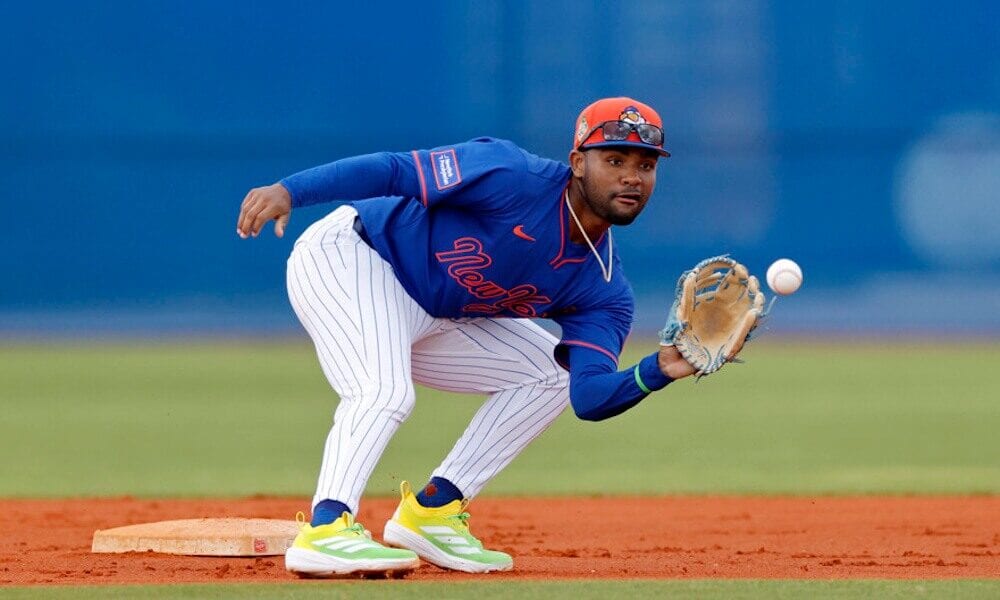
The Mets are in the middle of an organizational recalibration, and President of Baseball Operations David Stearns is firmly at the center of it. Rather than allowing a disappointing 2026 season to dictate a series of short-term fixes, New York used the trade deadline to turn established major-league pieces into a significant influx of younger talent. Stearns remains the club’s top baseball decision-maker, overseeing a baseball operations structure increasingly focused on building a deeper and more sustainable pipeline, as you’ll see in the Mets’ Top 20 fantasy baseball prospects profiled ahead.
DYNASTY BASEBALL: 2026 New York Mets Top 20 Fantasy Baseball Prospects
The result is a farm system that looks considerably different than it did only months ago. The deadline brought Jefferson Rojas, Émilien Pitre, Aidan Smith, Gary Gill Hill, Sammy Stafura and Cole Mathis into the organization, supplementing a group that already contained intriguing homegrown and internationally signed talent. Rojas immediately became the headliner, reaching Triple-A at 21 while offering the combination of contact ability, developing power and defensive flexibility that gives him several paths toward an everyday major-league role.
There is useful proximity behind him. Jonathan Santucci’s breakout carried the left-hander from Double-A to Triple-A in 2026, while Jack Wenninger has also reached the upper minors and Émilien Pitre brings a comparatively polished offensive profile at second base. Mitch Voit, meanwhile, has emerged as another potentially fast-moving position player after reaching Double-A and pairing on-base ability with impact speed. Together, that group gives the Mets something every rebuilding or retooling organization needs: prospects who may be capable of helping relatively soon rather than an entire system built around distant projection.
The deeper levels provide a different kind of upside. Shortstops Elian Peña and Wandy Asigen represent two of the organization’s more ambitious international investments, while Aiden Robbins, Carson Wiggins, Aidan Smith and others give the system additional ceiling further from Queens. There is considerable developmental risk attached to that group, but the Mets no longer need every prospect to hit for the farm system to produce meaningful major-league talent. The volume itself has become part of the organizational strength.
That depth is important because the Mets’ challenge under Stearns is larger than simply producing the next star. It is creating a system capable of continually supplying the major-league roster with inexpensive, controllable players while preserving enough prospect capital to make trades when opportunities arise. New York’s financial resources will always allow the organization to participate aggressively at the major-league level, but a healthier farm system gives Stearns considerably more flexibility in deciding where those resources should be deployed.
The 2026 deadline offered the clearest evidence yet of that approach. New York traded eight major leaguers and received 12 prospects, nine of whom entered MLB Pipeline’s organizational Top 30 immediately afterward. Stearns described those moves as an effort to add talent that could help the organization not only in the following season but in the seasons beyond it.
There are still unanswered questions. Several of the system’s most exciting arms carry substantial health or command risk, a number of the higher-upside hitters remain years from Citi Field, and some of the more advanced position players will have to prove their offensive gains against major-league-caliber pitching. The system has improved, but depth and prospect value still have to be converted into productive major-league players.
What has changed is the number of ways the Mets can get there. Rojas gives the organization a potential near-term cornerstone. Santucci and Wenninger provide upper-level pitching possibilities. Voit and Pitre offer additional proximity, while Peña, Asigen, Wiggins, Robbins and the rest of the lower-level group supply longer-range upside. Even prospects farther down the system show traits worth following: Nicolas Carreno, for example, has enough swing-and-miss ability to remain interesting if his command and secondary pitches continue developing.
For Stearns, that creates a substantially different organizational puzzle. The Mets still possess the resources and expectations of a large-market contender, but the emerging farm system gives their President of Baseball Operations something equally valuable: options. The next phase will be determining which prospects become part of the next competitive Mets core, which become useful major-league depth, and which eventually become currency for the moves designed to push New York back toward contention.
So, let’s begin with our countdown of the Mets’ top 20 prospects.
#20 — Nicolas Carreno | LHP (ETA 2029)
Carreno entered the Mets organization when New York acquired the young Venezuelan left-hander from Pittsburgh for Josh Walker at the 2024 trade deadline. He has since begun turning himself into something more interesting than a lower-level lottery ticket.
There is legitimate swing-and-miss potential here, and Carreno’s progress as a starter gives dynasty managers a reason to follow him. The development of his command and secondary pitches will ultimately determine whether his future is in a rotation or bullpen.
Carreno remains primarily a deep-league stash because pitching prospects this far from the majors carry enormous volatility. Another season of missing bats while climbing the ladder, however, could push his dynasty stock considerably higher.
#19 — Christopher Suero | C/OF (ETA 2028)
The Mets originally signed Suero as an international free agent in 2022, and his unusual developmental path has made him one of the system’s more interesting players. After beginning his professional career in the outfield, he has added catching to his defensive résumé.
Suero’s offensive appeal comes primarily from his power and willingness to take a walk. There is enough thump in his bat to envision useful home-run production, although swing-and-miss concerns leave questions about how much average he’ll ultimately provide.
Catcher eligibility is especially important for his dynasty outlook. If Suero develops into a playable major-league catcher while maintaining his offensive strengths, his fantasy value could substantially exceed what the same production would be worth from a corner outfielder.
#18 — Will Watson | RHP (ETA 2028)
New York selected Watson from USC in the seventh round of the 2024 MLB Draft. He quickly outperformed that modest draft position, emerging as one of the more productive starting pitchers from the Mets’ 2024 class.
Watson can generate strikeouts and has shown enough starter traits to make a rotation outcome realistic. His ability to keep hitters uncomfortable gives him more dynasty appeal than the typical later-round college arm.
Health interrupted his momentum, however, adding another layer of uncertainty to an already risky prospect demographic. Watson belongs on watch lists in standard leagues and rosters in deeper formats, with the potential to jump quickly if he returns healthy and effective.
#17 — Gary Gill Hill | RHP (ETA 2029)
Gill Hill became a Met at the 2026 trade deadline as part of the package Tampa Bay sent to New York for Freddy Peralta. The same deal also brought Émilien Pitre and Aidan Smith into the organization.
His fantasy case is based more on projection than proximity. Gill Hill has enough arm talent to remain a starter, and continued refinement of his secondary offerings could eventually give him the strikeout totals fantasy managers want.
There’s considerable development still ahead, so he shouldn’t be treated like a near-term rotation answer. In deeper dynasty leagues, though, he’s exactly the type of young pitching prospect whose value can change dramatically after one strong season.
#16 — Eli Serrano III | OF (ETA 2028)
Serrano joined the organization when the Mets selected him out of NC State in the fourth round of the 2024 Draft. His combination of size and athleticism immediately made him an intriguing developmental project.
At 6-foot-5, Serrano possesses the frame to grow into substantial power without looking like a traditional lumbering corner bat. That creates an appealing fantasy possibility if his contact ability develops alongside the strength.
There is still plenty of offensive uncertainty, and injuries have complicated his progression. Dynasty managers should view Serrano as an upside play rather than a high-floor prospect, but a healthy power breakout would quickly change the conversation.
#15 — Randy Guzman | 1B/OF (ETA 2029)
Guzman entered professional baseball after signing with the Mets as an international free agent in 2022. Since then, his raw strength has developed into one of the more notable offensive tools in the organization.
Power drives almost everything about his dynasty profile. MLB Pipeline currently identifies Guzman as one of the best raw-power hitters in the Mets system, giving him a conceivable path toward becoming a legitimate home-run producer.
The pressure comes from his defensive profile. First basemen and corner outfielders have to hit, so Guzman can’t rely on positional value to carry him. If his approach and contact rate advance enough to unlock the power consistently, his fantasy ceiling becomes much more exciting.
#14 — Aidan Smith | OF (ETA 2028)
Smith was one of three prospects New York received from Tampa Bay in the 2026 Freddy Peralta trade, joining Pitre and Gill Hill in the Mets system. He arrived with an established reputation as an athletic outfielder capable of affecting games in several ways.
For fantasy managers, the attraction is straightforward: power and speed can coexist in this profile. Smith has shown the ability to leave the yard and steal bases, giving him a chance to contribute across multiple roto categories if his bat develops sufficiently.
Consistency remains the missing piece. His tools can produce exciting stretches, but the offensive floor will depend on better contact and overall plate discipline. He’s a worthwhile upside investment for dynasty managers willing to tolerate some developmental turbulence.
#13 — Ryan Clifford | 1B/OF (ETA 2027)
Clifford came to New York from Houston alongside Drew Gilbert in the 2023 Justin Verlander trade. From the beginning, the big left-handed hitter’s calling cards have been patience and the ability to drive the baseball.
The fantasy blueprint isn’t complicated. Clifford has the strength to produce plenty of home runs, and his willingness to work counts makes him particularly attractive in leagues using OBP instead of batting average.
His recent development hasn’t been completely smooth, though, and corner-only players need their bats to do considerable damage. Clifford remains close enough to the majors to warrant patience, but he’ll need to prove that his power and patience can overcome the holes in his offensive game.
#12 — Jacob Reimer | 3B (ETA 2027)
The Mets selected Reimer out of Yucaipa High School in the fourth round of the 2022 Draft and paid him above-slot to begin his professional career. His offensive upside has been the primary reason he’s remained one of the organization’s more recognizable prospects.
Reimer brings an appealing combination of strike-zone awareness and power potential. Rather than being an all-or-nothing slugger, he has shown the ingredients to reach base while still doing meaningful damage when pitchers make mistakes.
Injuries and uneven stretches have slowed his ascent, so his dynasty stock isn’t as secure as it once appeared. Still, a healthy Reimer remains capable of developing into an everyday corner infielder with enough power to matter in fantasy.
#11 — Cole Mathis | 1B/3B (ETA 2028)
Mathis became a Met during the 2026 season when the Cubs sent him to New York in exchange for left-hander David Peterson. The former second-round pick immediately added another potentially impactful corner bat to the system.
The right-handed hitter offers legitimate power potential and has shown the ability to produce hard contact. His experience at both first and third gives him some defensive flexibility, although fantasy managers should ultimately evaluate Mathis on what his bat can become.
Durability is an important variable after injuries interrupted his development. If Mathis can put together an extended healthy stretch, there’s enough offensive upside here for him to emerge as one of the system’s better dynasty risers.
#10 — Émilien Pitre | 2B (ETA 2027)
Pitre joined the Mets at the 2026 deadline when Tampa Bay dealt him, Aidan Smith and Gary Gill Hill to New York for Freddy Peralta. Unlike some of the system’s boom-or-bust prospects, Pitre brings a comparatively polished offensive foundation.
His game revolves around getting on base, putting the ball in play and using his legs. He isn’t likely to become a massive home-run threat, but batting average, OBP and stolen bases can create a useful fantasy package at second base.
Proximity strengthens the appeal. Pitre has already reached Triple-A, making him one of the prospects on this list with a realistic opportunity to become fantasy relevant in the near future.
#9 — Sammy Stafura | SS/2B (ETA 2028)
The Mets acquired Stafura from Pittsburgh at the 2026 deadline in exchange for reliever Luke Weaver. The New York native had already broken out before the trade, producing 20 home runs and a .960 OPS between Single-A and High-A.
That offensive explosion is what makes Stafura particularly interesting for dynasty leagues. Middle infielders capable of combining legitimate home-run production with stolen bases can become extremely valuable fantasy pieces.
The next challenge is proving those gains against more advanced pitching. If Stafura’s power surge holds while he continues contributing on the bases, his dynasty ranking could climb significantly higher than this.
#8 — Aiden Robbins | OF (ETA 2029)
Robbins became a Met when New York selected the Texas outfielder with the 92nd overall pick in the 2026 Draft. His final college season showcased the type of offensive upside that can quickly capture the attention of dynasty baseball managers.
Robbins offers an enticing blend of strength and athleticism. There’s enough power to project meaningful home-run totals, while his overall offensive ability gives him a chance to become more than a one-dimensional slugger.
The biggest issue to monitor is contact. Increased power came with additional strikeouts in college, and professional pitching will test that vulnerability. If Robbins can maintain the damage while tightening the swing-and-miss, his fantasy ceiling could rise quickly.
#7 — Carson Wiggins | RHP (ETA 2029)
The Mets selected Wiggins in the first round of the 2026 Draft despite the Arkansas right-hander recovering from Tommy John surgery. That selection was clearly a bet on premium stuff rather than immediate availability.
When healthy, Wiggins has the arsenal dynasty managers dream about. MLB Pipeline gives both his fastball and slider 70 grades on the 20-80 scouting scale, making his pure bat-missing potential among the best in the organization.
The upside comes packaged with substantial risk. Wiggins still needs to return to full health, throw strikes consistently and prove he can handle a starter’s workload. If those pieces come together, however, few pitchers in this system can match his strikeout ceiling.
#6 — Jack Wenninger | RHP (ETA 2027)
Wenninger entered the Mets organization as a sixth-round selection out of Illinois in the 2023 Draft. He has steadily surpassed expectations and developed into one of New York’s more advanced starting-pitching prospects.
His splitter is the weapon fantasy managers should remember. The pitch can miss bats, while his fastball gives him enough velocity to attack hitters rather than simply trying to survive on command and sequencing.
Wenninger may not carry the enormous ceiling attached to some younger arms, but his proximity reduces part of the risk. With Triple-A experience already under his belt, he has a realistic opportunity to become a useful fantasy starter relatively soon.
#5 — Jonathan Santucci | LHP (ETA 2027)
New York selected Santucci out of Duke in the second round of the 2024 Draft, and he has advanced about as quickly as the organization could have hoped. His 2026 breakout carried him from Double-A to Triple-A and established him as the Mets’ top pitching prospect on MLB Pipeline’s current organizational list.
Strikeouts are the main fantasy attraction. Santucci finished the 2026 minor-league season with 157 punchouts over 119 2/3 innings while showing a mid-90s fastball and increasingly effective secondary pitches.
His command will determine how high the ceiling ultimately goes. The walks have occasionally created trouble, although there were encouraging signs of improvement late in the season. If that progress carries forward, Santucci has the ingredients to become a fantasy-relevant MLB starter.
#4 — Mitch Voit | SS/2B (ETA 2027)
Voit joined the Mets as the 38th overall selection in the 2025 Draft after starring at Michigan. He wasted little time demonstrating that his offensive game could translate to professional baseball, reaching Double-A during his second season in the organization.
His 2026 performance significantly raised his dynasty profile. After May 24, Voit hit .300 with an .866 OPS while stealing 32 bases, and his combination of athleticism, plate discipline and defensive versatility helped earn him organizational Player of the Year honors.
Speed gives the profile an especially useful fantasy dimension. If Voit develops even average major-league power while continuing to reach base and run aggressively, he could become a valuable contributor across several categories.
#3 — Wandy Asigen | SS (ETA 2031)
The Mets made Asigen one of their biggest investments of the 2026 international signing period, handing the highly regarded Dominican shortstop a multimillion-dollar bonus. He immediately entered professional baseball as one of the organization’s highest-ceiling young hitters.
Asigen’s raw power is already exceptional for his age. MLB Pipeline lists him alongside Randy Guzman for the best power tool in the Mets system, an impressive distinction for a player who is still only beginning his professional development.
Dynasty managers need patience here. Asigen is extremely young and therefore carries far more developmental risk than players already facing upper-minors pitching. The reward for accepting that wait is the possibility of eventually owning a power-hitting middle infielder with considerable fantasy upside.
#2 — Elian Peña | SS (ETA 2030)
The Mets landed Peña during the 2025 international signing period, making the Dominican shortstop one of the organization’s most significant amateur investments. He has since moved rapidly enough to reach High-A while still only 18 years old; MLB Pipeline currently gives him a 2030 MLB ETA.
Peña’s fantasy appeal comes from the possibility that both his hit tool and power develop into genuine assets. A left-handed shortstop capable of hitting for average while growing into meaningful home-run production would carry tremendous dynasty value.
There’s obviously a long developmental runway remaining. But age-relative-to-level matters when evaluating prospects, and Peña’s advancement against considerably older competition makes him one of the most compelling long-term bets in the Mets system.
Also, make sure to check out our 2026 MLB organizational Prospect Rankings!
#1 — Jefferson Rojas | 3B/SS (ETA 2027)
Rojas became the centerpiece of the Mets’ 2026 deadline haul when the Cubs sent him to New York for Clay Holmes and Tyrone Taylor. He immediately took over the No. 1 position on MLB Pipeline’s Mets prospect ranking and has since reached Triple-A at only 21 years old.
There isn’t one extreme tool carrying Rojas’ fantasy value; it’s the completeness of his offensive game that stands out. His contact ability gives him a strong foundation; there’s additional power to unlock, and his defensive flexibility at shortstop and third base provides multiple routes toward everyday playing time.
The combination of youth, hitting ability, developing power, and proximity to the majors makes Rojas the most attractive dynasty asset in this Top 20. He was already showing signs of adjusting to Triple-A in September, including consecutive games with a home run. If that offensive progression continues, Rojas could go from prospect stash to major-league contributor without a lengthy wait.
Final Thoughts
The biggest takeaway from the Mets’ 2026 system is no longer simply the presence of high-end prospects—it’s the number of legitimate paths the organization now has to create value. Jefferson Rojas gives New York a potential near-term cornerstone, while Jonathan Santucci, Jack Wenninger, Mitch Voit and Émilien Pitre form a credible wave of upper-level talent that could begin impacting the major-league roster relatively soon. Behind them, Elian Peña, Wandy Asigen, Carson Wiggins, Aiden Robbins and others provide the kind of longer-range upside that was previously lacking.
That combination of proximity, ceiling, and sheer prospect volume is what makes the system meaningfully different. The Mets do not need every player in this Top 20 to become a major-league regular. They need enough of them to emerge as productive, controllable players while others retain the value to become trade capital. That gives David Stearns considerably more flexibility to supplement the major-league roster without continually sacrificing the organization’s future.
The rebuild of the pipeline is well underway; now comes the harder part—turning prospect depth into sustainable major-league production. If the Mets can do that, 2026 may ultimately be remembered less for the season that forced an organizational recalibration and more for the year New York built the foundation of its next competitive core.
Fantrax is one of the fastest-growing fantasy sites in the fantasy sports industry, and we’re not stopping anytime soon. We are the most customizable, easy-to-use, and feature-rich platform in the industry, offering the greatest fantasy experience for your dynasty, keeper, redraft, and best ball leagues. Fantasy sports doesn’t sleep, and neither does Fantrax, with seasons running 365 days a year. Take your fantasy leagues to the next level now at Fantrax.com!