

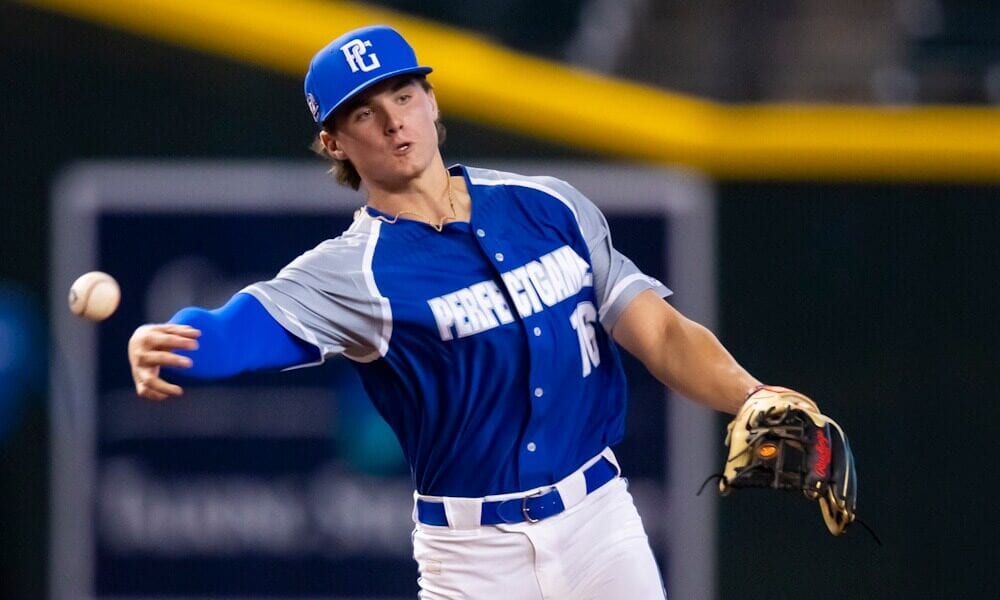
The Philadelphia Phillies remain an organization built to compete at the major-league level, but under President of Baseball Operations Dave Dombrowski, the challenge has increasingly become balancing that pursuit of October baseball with the need to maintain a sustainable pipeline of young talent. Dombrowski has never been afraid to aggressively pursue established players, yet Philadelphia has also made a concerted effort to strengthen the scouting and player-development infrastructure beneath the major-league roster.
DYNASTY BASEBALL: 2026 Philadelphia Phillies Top 20 Fantasy Baseball Prospects
That effort is beginning to produce a more interesting collection of prospects. The Phillies have attacked the amateur market from several directions, investing premium draft capital in players such as Aidan Miller and Gage Wood while making one of their most significant international investments in years to sign Venezuelan outfielder Francisco Renteria. The 2026 Draft added another wave of talent, headlined by shortstop Tyler Spangler. Following the Draft and trade deadline, Wood, Miller, and Renteria all remained in the organization and ranked among top-tier prospects, as you’ll see in the Phillies’ Top 20 fantasy baseball prospects profiled ahead.
There is an important tension here for dynasty managers.
Philadelphia is trying to win now, and Dombrowski’s history suggests the organization will remain willing to use prospect capital when an opportunity arises to improve the major-league club. At the same time, the Phillies navigated the 2026 trade deadline without surrendering Wood, Miller or Renteria, preserving the most valuable portion of a system that is not particularly deep. That combination makes the top of this farm system especially important.
The developmental environment deserves attention as well. Philadelphia has spent years attempting to improve how it turns amateur talent into major-league contributors, an area Dombrowski specifically targeted after taking control of baseball operations. Luke Murton now oversees player development, while Brian Barber remains a central figure in amateur scouting. Recent drafts have shown a willingness to adjust strategy, including a pitching-heavy 2025 class built largely around college arms before returning to a more balanced collection of players in 2026.
For dynasty fantasy managers, that creates a system where organizational context matters almost as much as prospect pedigree. Philadelphia’s best young players can develop into meaningful fantasy assets, but proximity to the majors, positional opportunity, and trade risk all need to be considered. The Phillies are not operating like a rebuilding organization with unlimited patience and open major-league jobs. Prospects must either develop quickly enough to help a contender or become valuable enough to influence how Dombrowski constructs the next version of the roster.
That makes Philadelphia one of the more intriguing systems to evaluate. The depth may not match baseball’s strongest farms, but the combination of premium talent near the top, significant international investment, and an organization determined to contend gives several Phillies prospects legitimate opportunities to become valuable dynasty pieces.
So, let’s begin with our countdown of the Phillies’ top 20 prospects.
-
Alirio Ferrebus | C/1B (ETA 2029)
Philadelphia brought Ferrebus into the organization through the international amateur market, and the Venezuelan backstop has gradually worked his way through the lower levels. His development has been interrupted by injury, but he remains interesting because his offensive potential separates him from many young catchers.
Ferrebus shows enough feel for contact to envision a future in which batting average isn’t a liability. There’s developing strength in the profile as well, although he’s more likely to grow into moderate game power than become a prototypical 25-homer slugger.
Catching prospects require patience in dynasty leagues, particularly when they’re still several years away. Ferrebus is best viewed as a deep-format stash whose value could rise significantly if his bat continues progressing while he remains behind the plate.
-
Alex McFarlane | RHP (ETA 2027)
The Phillies selected McFarlane out of Miami in the fourth round of the 2022 MLB Draft. His professional career subsequently hit a major roadblock when elbow surgery cost him the entire 2024 season, turning what had been an exciting developmental trajectory into a much longer project.
Pure arm strength has never been the concern. McFarlane can unleash upper-90s velocity and has reached triple digits, while his slider gives him another weapon capable of finishing at-bats. The bigger challenge is throwing enough quality strikes for those pitches to play consistently.
For fantasy managers, he’s an upside-over-certainty proposition. There is legitimate strikeout potential if he remains a starter, but continued command trouble could eventually push him toward relief. That volatility makes him much more attractive in deeper dynasty leagues than shallow formats.
-
Wen-Hui Pan | RHP (ETA 2028)
Pan joined Philadelphia as an international free agent from Taiwan and quickly became one of the system’s more fascinating pitching projects. Tommy John surgery interrupted that progress and created considerably more uncertainty around his timetable.
When healthy, Pan can attack hitters with serious velocity and complement the heater with a splitter capable of disappearing beneath barrels. It’s the kind of combination that can produce strikeouts quickly, particularly if his command returns as his workload increases.
The fantasy case is therefore straightforward: you’re buying the arsenal while accepting substantial injury risk. Managers with deep minor-league rosters can afford to wait because a healthy Pan still has a path to becoming a useful strikeout starter.
-
Carson DeMartini | 3B (ETA 2027)
Philadelphia selected DeMartini from Virginia Tech in the fourth round of the 2024 Draft. Although he entered professional baseball with shortstop experience, third base has become the more realistic long-term home.
His left-handed power is the feature that matters most to fantasy managers. DeMartini can drive the baseball with authority and has enough strength to project meaningful home-run production, but swing-and-miss remains the obstacle between him and an everyday offensive role.
That creates a fairly wide range of outcomes. If the contact rate improves, there is 20-plus-homer potential here. If upper-level pitchers consistently exploit the holes in his swing, his path becomes considerably narrower. He’s a worthwhile power stash rather than a cornerstone dynasty asset.
-
Juan Villavicencio | SS (ETA 2029)
The Phillies originally signed Villavicencio out of Venezuela through the international market. He has steadily moved through the organization and is beginning to emerge from the category of anonymous low-level prospect into someone dynasty managers should monitor.
Villavicencio’s attraction comes from balance rather than one overwhelming offensive tool. He’s athletic, owns a strong throwing arm and has enough bat speed and physical projection to envision contributions in several categories if the offensive development continues.
Because he’s still relatively far from Philadelphia, this is mostly a play for managers with large prospect rosters. The payoff would be a middle infielder capable of helping across categories, and another developmental jump could push his dynasty stock upward quickly.
-
Cody Bowker | RHP (ETA 2028)
Philadelphia grabbed Bowker out of Vanderbilt in the third round of the 2025 Draft. His background as a former two-way player adds some developmental intrigue, as pitching became his full-time focus relatively late.
Bowker’s fastball plays particularly well because hitters have difficulty matching its shape and approach angle. Pairing it with a useful breaking ball gives him the ingredients to miss bats, while further development of his changeup could determine whether he has enough weapons to navigate a lineup multiple times.
That’s the dynasty decision point. A complete three-pitch mix could turn Bowker into a useful fantasy starter; failure to develop that third offering increases the chance of relief work. His ability to generate strikeouts makes the gamble worthwhile in deeper formats.
-
Matthew Fisher | RHP (ETA 2029)
Fisher was Philadelphia’s seventh-round selection in 2025, but his signing bonus told a much different story about how the organization valued him. The Phillies committed $1.25 million to lure the Indiana high-school right-hander away from college, making him considerably more interesting than the round beside his name might suggest.
There’s already enough velocity to envision a major-league fastball, and Fisher shows encouraging feel for spinning a breaking ball. Because he’s young, additional physical development could give the arsenal another gear before he reaches the upper minors.
Teenage pitching prospects are inherently risky dynasty investments, so expectations should remain measured. Still, Fisher offers exactly what managers should seek this far down a system ranking: youth, stuff, and considerable room for his value to grow.
-
Will Gasparino | OF (ETA 2029)
The Phillies selected Gasparino from UCLA with the 161st overall pick in the fifth round of the 2026 Draft. He quickly reached Single-A Clearwater, where his first taste of professional baseball included a .387 on-base percentage and five steals in a small sample. Philadelphia had followed him since his high school days.
Gasparino’s 6-foot-6 frame creates enormous leverage, and the resulting raw power gives him an exciting offensive ceiling. He’s also athletic for his size and isn’t merely a stationary slugger. The challenge will be keeping his long swing efficient enough against better professional pitching.
He’s an excellent boom-or-bust dynasty target. If the contact ability holds, Gasparino could eventually supply substantial power without being empty in the other categories. If strikeouts overwhelm the profile, the floor drops quickly. That’s a gamble worth watching closely.
-
Moisés Chace | RHP (ETA 2027)
Unlike most players on this list, Chace arrived through a trade. Philadelphia acquired him from Baltimore with Seth Johnson at the 2024 trade deadline in the deal that sent reliever Gregory Soto to the Orioles.
Chace built his prospect reputation on the ability to miss bats with multiple offerings rather than surviving with one dominant pitch. Unfortunately, elbow trouble eventually required Tommy John surgery, delaying his climb toward the majors and adding a major variable to his projection.
Pre-injury Chace looked capable of developing into a strikeout-oriented starter. That upside hasn’t disappeared, but dynasty managers now need to price in recovery, workload management, and the possibility that his post-surgery stuff isn’t identical. He’s an intriguing discounted stash for rebuilding teams.
-
Ruger Riojas | RHP (ETA 2028)
Philadelphia selected Riojas from the University of Texas with the 100th overall choice in the third round of the 2026 Draft. As an experienced college pitcher, he enters professional baseball with considerably less developmental guesswork than many younger arms in the system.
Riojas can operate in the mid-90s and reach higher when necessary, but the depth of his arsenal is what makes him interesting. He can manipulate several secondary pitches and vary his arm slot, giving hitters more than velocity to process.
His age limits some of the projection, but it could also help him advance rapidly. For dynasty purposes, Riojas offers an appealing blend of strikeouts, control, and starter probability. He may lack ace-level upside, but a dependable fantasy rotation piece has plenty of value.
-
Griffin Burkholder | OF (ETA 2028)
The Phillies selected Burkholder in the second round of the 2024 Draft and paid above-slot value to convince the Virginia high-school outfielder to begin his professional career. Injuries have interrupted portions of his development, but the physical upside remains enticing.
Burkholder brings two ingredients that immediately attract fantasy managers: power and speed. He can produce impressive exit velocities and has enough athleticism to become a genuine stolen-base contributor. The unresolved part of the equation is contact, particularly against quality spin and offspeed pitching.
If Burkholder improves his pitch recognition, his fantasy stock could explode. A player capable of reaching 20 homers and 20 steals doesn’t need an elite batting average to matter. Conversely, persistent swing-and-miss could prevent those tools from ever receiving enough playing time to flourish.
-
Cade Obermueller | LHP (ETA 2028)
Philadelphia used the 63rd overall selection in the 2025 Draft on Obermueller after his college career at Iowa. The investment reflected the organization’s belief that his electric left arm could become much more than organizational pitching depth.
Obermueller can generate premium velocity from the left side and pairs it with a slider capable of becoming his primary finishing pitch. That combination gives him a straightforward route to strikeouts, which is precisely why he’s intriguing for fantasy purposes.
Control will determine the ultimate role. Better strike-throwing could produce a high-strikeout starter; continued inconsistency would make a bullpen future more likely. Either way, the ability to miss bats gives Obermueller a higher fantasy ceiling than the typical pitching prospect at this stage.
- Caden Bogenpohl | OF (ETA 2029)
Bogenpohl became a Phillie when Philadelphia selected the Missouri State outfielder 64th overall in the second round of the 2026 Draft. The organization had shown considerable interest before draft day, including bringing him to Clearwater for a private workout.
At 6-foot-6, Bogenpohl can create exceptional impact when he squares the baseball. He demonstrated that ability throughout college, although his home-run production didn’t always match the quality of his hardest contact because too many balls were driven into the ground. Philadelphia is betting that mechanical refinement can unlock more of the power already inside the bat.
That’s precisely what makes him exciting in dynasty leagues. We’re not waiting for Bogenpohl to develop power so much as waiting to see whether he can access it consistently. If the launch profile and contact rate cooperate, there is legitimate middle-of-the-order home-run upside.
-
Bryan Rincon | SS (ETA 2028)
Rincon is one of the more unconventional success stories in the organization. Philadelphia selected him in the 14th round of the 2022 Draft, and he has since developed far beyond what that draft position would normally imply. By September 2026, MLB Pipeline had elevated him to No. 4 in the Phillies system.
He’s a switch-hitting shortstop whose defensive ability should provide a sturdy path toward major-league playing time. For fantasy managers, however, the exciting development is that the offense has begun catching up. Rincon has become increasingly capable of doing damage rather than simply reaching base and playing quality defense.
There’s still some uncertainty surrounding the ultimate offensive ceiling, but a shortstop who can contribute power, speed, and on-base production doesn’t need to become a superstar to matter. His improving bat and defensive security make him one of the system’s more compelling risers.
-
Aroon Escobar | 2B (ETA 2028)
The Phillies signed Escobar from Venezuela during the 2022 international period. His early professional seasons didn’t immediately signal stardom, but a major offensive breakthrough subsequently pushed him rapidly through the organization and into Double-A.
Escobar succeeds through a compact offensive approach rather than imposing physical size. He makes frequent contact, understands the strike zone, and generates more impact than his smaller frame might suggest. He’s also shown enough baserunning aptitude to make stolen bases part of his fantasy profile.
The next test is proving that his offensive breakthrough survives upper-level pitching. If it does, Escobar has an appealing route toward becoming a batting-average and on-base contributor who chips in homers and steals rather than dominating one particular category.
-
Dante Nori | OF (ETA 2027)
Philadelphia selected Nori in the first round of the 2024 Draft, betting on an unusually polished high-school outfielder. That decision quickly looked promising as Nori accelerated through the lower minors and reached Double-A much sooner than most prep selections.
Speed is the fantasy headline, but reducing Nori to a stolen-base specialist undersells the profile. He controls at-bats well, makes contact, and gets on base frequently enough to give that speed plenty of opportunities. His defensive ability in center field should also help keep him in the lineup.
Power remains the category most likely to determine whether Nori becomes merely useful or genuinely valuable in fantasy. He doesn’t need to become a slugger. Even moderate double-digit home-run production paired with a strong average, on-base skills, and substantial steals could make him an excellent dynasty asset.
-
Tyler Spangler | SS (ETA 2030)
Philadelphia made Spangler the 36th overall selection in the first round of the 2026 Draft and signed him for $3.25 million. A back issue had prevented the De La Salle High School shortstop from playing his senior season, but Philadelphia was comfortable enough with his health to make a substantial investment.
Spangler is a big left-handed hitter with an unusually smooth offensive foundation for an 18-year-old shortstop. His ability to make contact is already one of his strongest attributes, and his frame offers room for additional strength and power as he matures. MLB’s current organizational tool survey places his hit tool alongside Aidan Miller’s at the top of the system.
Dynasty managers will need patience because he’s years from Philadelphia. But young shortstops who combine hitting ability, physical projection and power potential can become premium fantasy commodities quickly. His professional debut is only the beginning of what should be a fascinating developmental story.
-
Francisco Renteria | OF (ETA 2031)
Renteria entered the Phillies organization as one of the centerpieces of their 2026 international signing class. Philadelphia committed a significant portion of its international bonus resources to the Venezuelan outfielder, immediately establishing him as one of the highest-upside teenagers in the farm system.
The offensive package is unusually broad for his age. Renteria brings quick hands, physical strength, developing power, and enough athleticism to contribute on the bases. Most importantly, he has the ingredients to become more than a one-category player if his pitch recognition develops as expected.
The drawback for dynasty managers is distance. MLB Pipeline currently projects a 2031 arrival, meaning there’s a long developmental road between rookie ball and Citizens Bank Park. In leagues where managers can afford that wait, Renteria is exactly the type of high-ceiling teenager capable of becoming dramatically more valuable before reaching Double-A.
-
Gage Wood | RHP (ETA 2027)
Philadelphia selected Wood out of Arkansas with the 26th overall pick in the 2025 Draft. He has moved quickly since entering professional baseball, reaching Double-A and climbing to the top spot on MLB Pipeline’s current Phillies prospect ranking. His official Pipeline ETA is now 2027.
Wood attacks hitters with a fastball that can overwhelm them even when they know it’s coming. His curveball gives him a second bat-missing weapon, and improved command has made the overall package increasingly difficult for minor-league hitters to solve. MLB’s updated organizational survey rates his fastball as the best in Philadelphia’s farm system.
Pitching prospects always carry more volatility than comparable hitters, and Wood’s previous shoulder issues deserve consideration. Still, the fantasy upside is substantial. If he handles a starter’s workload, his combination of strikeouts and improving control gives him a realistic chance to become an impact fantasy starter rather than simply filling out a rotation.
Make sure to check out all of our 2026 MLB organizational Prospect Rankings!
-
Aidan Miller | SS (ETA 2027)
Philadelphia selected Miller 27th overall in the first round of the 2023 Draft after a hand injury limited his final high school season. Since then, his combination of offensive polish and physical development has turned him into one of the organization’s most important young hitters. A back injury wiped out most of his 2026 regular season, but he returned to game action in September and reached Double-A. MLB Pipeline currently lists his ETA as 2027.
Miller’s fantasy appeal begins with balance. He has the bat control to project for average, enough strength to produce substantial home-run totals, and sufficient athleticism to add value on the bases. Rather than depending on one carrying skill, he has several different avenues to fantasy production.
The lost 2026 season adds health risk, but it doesn’t erase the offensive ceiling. Among Philadelphia’s current minor leaguers, Miller offers my preferred combination of proximity and potential across the traditional fantasy categories. A healthy 2027 could put him on the doorstep of Philadelphia and give dynasty managers a potential long-term building block in the infield.
Final Thoughts
This system offers something for nearly every type of dynasty manager. Miller and Wood provide relatively near-term impact potential, while Renteria and Spangler represent longer-term bets with substantial ceilings. Nori brings speed, Bogenpohl and Gasparino supply power upside, and pitchers such as Obermueller, Riojas, and Fisher offer opportunities for managers willing to absorb the inherent volatility of developing arms.
The most important point is that these rankings shouldn’t be treated as a static list. Prospect value changes quickly. A teenager improving his contact rate, a pitcher adding two miles per hour or an upper-level hitter demonstrating that his breakout survives better competition can completely alter the dynasty landscape.
For fantasy managers, that’s what makes Philadelphia’s current farm system interesting. There are recognizable premium prospects at the top, but there are also enough high-variance players deeper down the system to reward managers who identify the next breakout before everyone else does.
Fantrax is one of the fastest-growing fantasy sites in the fantasy sports industry, and we’re not stopping anytime soon. We are the most customizable, easy-to-use, and feature-rich platform in the industry, offering the greatest fantasy experience for your dynasty, keeper, redraft, and best ball leagues. Fantasy sports doesn’t sleep, and neither does Fantrax, with seasons running 365 days a year. Take your fantasy leagues to the next level now at Fantrax.com!