

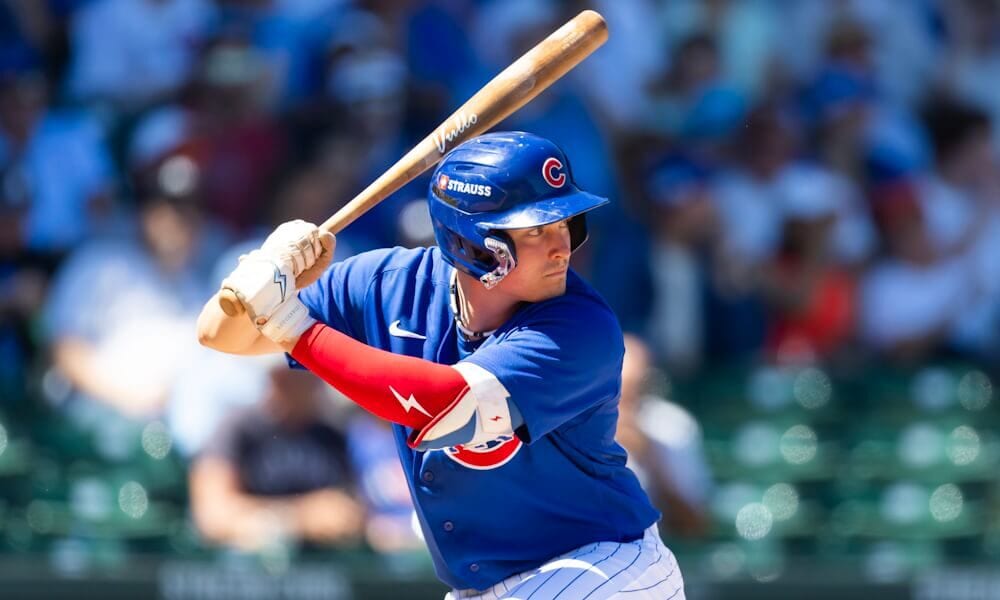
The Chicago Cubs have reached an interesting stage in their evolution under President of Baseball Operations Jed Hoyer and General Manager Carter Hawkins. Years of rebuilding the talent pipeline have helped Chicago transition back into contention, but the challenge now is maintaining that success without allowing the farm system to run dry. That philosophy has become increasingly important as young players have graduated to Wrigley Field and the organization prepares for another wave of roster turnover, as you’ll see in the Cubs’ Top 20 fantasy baseball prospects ahead.
DYNASTY BASEBALL: 2026 Chicago Cubs Top 20 Fantasy Baseball Prospects
For dynasty fantasy managers, the Cubs remain an organization worth following closely because of their ability to identify and develop hitters. Chicago has established a strong recent track record with position players through both the amateur draft and trades, emphasizing athleticism, offensive upside, and players capable of controlling the strike zone. The 2025 draft added another intriguing collection of bats, including Ethan Conrad, Kane Kepley, and Josiah Hartshorn, who have quickly become important pieces of the system’s next generation.
Pitching, however, has become the next major developmental challenge. The Cubs openly entered the 2026 MLB Draft wanting to inject more quality arms into a system that had become thinner on pitching, ultimately using their first-round selection on Ole Miss right-hander Cade Townsend. That increased investment in pitching, combined with a young offensive core developing throughout the lower minors, gives Hoyer and Hawkins an opportunity to replenish the system while keeping Chicago competitive at the Major League level. For dynasty managers, that makes this an especially interesting farm system: some of its biggest names have already graduated, but another collection of potential fantasy assets is beginning to emerge underneath them.
So, let’s begin with our countdown of the Cubs’ top 20 prospects.
No. 20 — Isaac Morton | RHP (ETA 2029)
The Cubs grabbed Morton in the sixth round of the 2026 MLB Draft out of Minnesota, signing the right-hander after an encouraging breakout as a college starter. Unfortunately, Tommy John surgery puts an immediate speed bump in his development path.
Morton is fascinating because of his unusually low, sidearm release point. The delivery gives hitters a different look and can make his stuff play nastier than the raw velocity suggests, while improved strike-throwing during his final college season added to his starter intrigue.
For dynasty managers, this is a stash built almost entirely around patience and projection. The elbow recovery creates considerable risk, but Morton has enough deception and starter ingredients to become interesting again once healthy.
No. 19 — Dylan Blomker | RHP (ETA 2030)
Chicago selected Blomker 159th overall in the fifth round of the 2026 Draft, buying into an 18-year-old prep arm with considerable developmental runway. He signed shortly afterward and began his career in the Arizona Complex League.
The attraction is projection. Blomker already brings a promising pitching foundation, and his frame leaves room for additional strength and potentially more impactful stuff as the Cubs develop him.
He is firmly a deep-league dynasty play because teenage pitchers carry enormous attrition risk. There is legitimate upside here, but fantasy managers should expect a long developmental climb before knowing exactly what Chicago has.
No. 18 — Pierce Coppola | LHP (ETA 2028)
Few pitchers in the organization are harder to miss physically than the 6-foot-8 Coppola. Chicago selected the former Florida left-hander in the seventh round of the 2025 Draft after injuries limited him to only 49 1/3 collegiate innings.
His enormous frame and low release create a difficult angle, while a low-to-mid-90s fastball and sweeping slider can generate whiffs. The problem has always been availability and command, with back and shoulder issues preventing Coppola from building a normal workload.
That makes him a classic high-variance dynasty pitching stash. A healthy Coppola could miss plenty of bats, but his two-pitch lean and shaky command may eventually push him toward relief.
No. 17 — Jaims Martinez | SS (ETA 2031)
Martinez joined Chicago as part of the 2026 international class, signing for $900,000 after leaving Cuba and eventually receiving clearance to begin his professional career. The switch-hitting shortstop immediately became one of the system’s more intriguing teenage lottery tickets.
Quick-twitch athleticism drives the profile. Martinez combines plus speed with advanced shortstop actions and a contact-oriented approach, while showing enough surprising impact for his size to dream on moderate future power.
He is years away, but dynasty managers should remember this name. A shortstop capable of contributing average, steals and eventually double-digit-to-mid-teens homers offers an attractive fantasy ceiling if the bat develops.
No. 16 — Jostin Florentino | RHP (ETA 2028)
Florentino was a true under-the-radar find, signing with Chicago for just $10,000 out of the Dominican Republic in 2023. He subsequently exploded onto the prospect radar and earned Cubs Minor League Pitcher of the Year honors in 2025.
He doesn’t overpower hitters with premium velocity. Instead, Florentino creates uncomfortable looks through a low release height, extension, and a sweeping slider, while his simple delivery helps him consistently throw strikes.
The dynasty question is whether his arsenal becomes powerful enough for upper-level hitters. Another velocity jump could dramatically change his ceiling; without it, the fantasy upside is more modest.
No. 15 — Carson Jasa | RHP (ETA 2029)
The Cubs selected the towering 6-foot-7 Jasa 98th overall in the third round of the 2026 Draft out of Nebraska. Chicago was betting on both his huge frame and the significant progress he made with his control during his final college season.
Jasa can reach the upper 90s, but his curveball is the attraction. The pitch devastated college hitters, and pairing that breaking ball with a power fastball gives him legitimate strikeout potential if his command continues trending upward.
Pitching prospects with size, velocity, and a potential out pitch deserve dynasty attention. Jasa remains developmental, but there’s enough starter upside here to make him considerably more than just another college arm.
No. 14 — Dominick Reid | RHP (ETA 2028)
Chicago selected Reid in the third round of the 2025 Draft out of Abilene Christian, where he struck out 112 hitters in 88 1/3 innings after previously seeing little action at Oklahoma State. The Cubs signed him for $649,125.
His changeup is the money maker. Reid confidently deploys the fading pitch against hitters on either side, complementing it with a low-to-mid-90s fastball and a developing breaking ball.
Fantasy value hinges on that third pitch. If the breaker improves, Reid has enough command and changeup quality to remain a starter; if not, his ceiling becomes much less exciting.
No. 13 — Brooks Caple | RHP (ETA 2027)
Caple looks increasingly like a draft-day steal after Chicago selected him in the ninth round of the 2024 Draft out of Lamar. The 6-foot-6 right-hander has watched his stuff tick upward since entering professional baseball.
His fastball has climbed into the mid-90s and can touch higher, while a slider, cutter, and curveball give him several ways to attack hitters. Extension makes the heater particularly uncomfortable, and he generally supplies enough strikes to keep starting.
Caple is exactly the type of pitcher who can gain dynasty value quickly near the upper minors. He doesn’t carry ace-level projection, but a mid-to-back-rotation starter with strikeout ability has real value in deeper formats.
No. 12 — Juan Tomas | SS (ETA 2030)
Tomas became a Cub during the 2025 international signing period, receiving a $1.1 million bonus after returning to the market. Chicago bought an extremely projectable Dominican switch-hitter with some of the loudest raw tools in its lower minors.
This is a ceiling-over-floor profile. Tomas brings explosive bat speed, plus running ability, and enough defensive talent to remain at shortstop, creating tantalizing power-and-speed possibilities if his hitting approach catches up.
For dynasty baseball, that’s exactly why he’s exciting—and dangerous. Significant swing-and-miss risk accompanies the massive ceiling, but a legitimate power/speed shortstop warrants patience.
No. 11 — Kaleb Wing | RHP (ETA 2029)
Chicago used its fourth-round pick in 2025 on Wing, then went well over slot with a $1.5 million bonus to steer the athletic California prep right-hander away from Loyola Marymount. His stuff had taken an important step forward during his senior season.
Wing combines a lively fastball with a potentially plus curveball and developing changeup. His background as a position player shows in his athletic delivery, giving him a better chance than many teenage pitchers to repeat his mechanics and throw strikes.
He’s one of the better long-range pitching investments in this countdown. There are many developmental innings ahead, but another velocity jump could push Wing into a completely different dynasty tier.
No. 10 — Juan Cabada | INF (ETA 2030)
Cabada signed with Chicago for $1.5 million during the 2025 international period, making him one of the organization’s significant investments in that class. The Dominican infielder immediately rewarded that confidence with an impressive professional debut.
The left-handed swing is compact and geared for contact, while Cabada already demonstrates impressive strike-zone awareness for his age. He isn’t physically imposing, but his barrel skills provide hope that respectable power develops as he matures.
Dynasty managers should focus on the bat. Cabada may ultimately settle at second or third rather than shortstop, making offensive development particularly important, but a strong average/OBP foundation with some speed and emerging pop is valuable.
No. 9 — Myles Bailey | 1B (ETA 2029)
The Cubs couldn’t pass on Bailey’s enormous power when he remained available with the 75th overall selection in the 2026 Draft out of Florida State. Chicago signed the imposing left-handed first baseman shortly afterward.
Bailey’s carrying tool is thunderous raw power. He was slugging .913 with 13 homers in only 26 games before an ankle injury ended his 2026 college season, illustrating the kind of damage his bat can produce when healthy.
First-base prospects need to mash, so there’s pressure on the hit tool. But in dynasty leagues where home-run upside is king, Bailey has the raw juice to become a serious middle-of-the-order fantasy asset.
No. 8 — James Triantos | 2B/3B/OF (ETA 2026)
Triantos has been in the organization since Chicago selected him 56th overall in the second round of the 2021 Draft, eventually paying him an above-slot $2.1 million bonus. Years later, his standout carrying tool remains his natural ability to put the bat on the baseball.
His contact ability can produce batting-average value, and improved speed has transformed him into a legitimate stolen-base contributor. Limited home-run power remains the drawback, especially because his swing produces plenty of balls on the ground.
Triantos is the closest thing to immediate fantasy help on this list and reached Chicago in 2026. The realistic dynasty appeal is average plus steals and multi-position usefulness rather than middle-of-the-order production.
No. 7 — Caden Sorrell | OF (ETA 2029)
Chicago landed an exciting power-speed package by selecting Sorrell 62nd overall in the second round of the 2026 Draft out of Texas A&M. The left-handed outfielder had already established himself as one of the SEC’s more dangerous power bats.
Sorrell offers plus speed, considerable bat speed, and enough raw power to envision 25-plus homers at maturity. His aggressive, uphill swing creates the obvious concern, because chasing and swing-and-miss could keep the hit tool from reaching its potential.
From a dynasty standpoint, embrace the upside. Few fantasy profiles are more valuable than an outfielder capable of combining meaningful home runs with stolen bases, and Sorrell has that type of ceiling if the contact holds.
No. 6 — Kane Kepley | OF (ETA 2028)
Kepley’s unconventional path took him from Liberty walk-on to North Carolina standout before Chicago selected him 56th overall in the second round of the 2025 Draft and signed him for $1.4 million. He wasted little time showing why the Cubs valued his offensive approach.
Kepley controls the zone, makes abundant contact, and possesses plus speed. The left-handed swing isn’t built for big home-run totals, but his ability to reach base creates endless opportunities to turn that speed into fantasy production.
He could become a sneaky dynasty asset in OBP formats. Think runs, average/OBP, and steals rather than homers and RBI, with his center-field defense giving the bat additional opportunities to reach Chicago.
No. 5 — Cade Townsend | RHP (ETA 2029)
The Cubs made Townsend their first-round pick at No. 23 overall in the 2026 Draft out of Ole Miss, adding one of the class’s most accomplished spin artists. He officially signed with Chicago less than a week later.
Townsend can work in the mid-to-upper 90s and backs the heater with an unusually deep collection of breaking pitches. His curveball, slider, and cutter all flash plus potential, giving him several weapons for generating swings and misses.
For dynasty managers, this is one of Chicago’s more intriguing pitching ceilings. Improved command could turn the deep arsenal into a mid-rotation-or-better starter, although the usual pitcher-development and health risks remain.
No. 4 — Owen Ayers | C/1B (ETA 2027)
Ayers might be the best development story on this list. Chicago discovered him through a pre-Draft workout and selected the Marshall catcher in the 19th round of the 2024 Draft, signing him for only $50,000 before watching his stock surge.
The switch-hitter now shows legitimate pull-side power and encouraging exit velocities, with enough patience to reach pitches he can drive. His cannon arm gives him a chance to stick behind the plate despite beginning his catching career relatively late.
Catcher eligibility makes the offensive breakout especially interesting for dynasty managers. If Ayers settles in as a regular with 20-homer potential, his fantasy value could significantly outperform his modest draft pedigree.
No. 3 — Ethan Conrad | OF (ETA 2028)
Chicago selected Conrad 17th overall in the first round of the 2025 Draft after his college career took him from Marist to Wake Forest. A shoulder injury ended his final college season early, but the Cubs still viewed the complete offensive package as first-round caliber.
Conrad’s smooth left-handed swing generates frequent hard contact, and he combines it with enough strength for average-or-better future power. Solid speed adds another fantasy dimension, while his advanced bat gives him a relatively balanced offensive foundation.
This isn’t necessarily a 40-homer or 40-steal ceiling; the appeal is that Conrad could contribute everywhere. A future .275-type hitter with 20-ish homers and double-digit steals would be extremely useful in dynasty formats.
No. 2 — Jaxon Wiggins | RHP (ETA 2027)
Chicago gambled on premium stuff when it selected Wiggins 68th overall in the supplemental second round of the 2023 Draft out of Arkansas, despite Tommy John surgery wiping out his final college season. The Cubs paid an above-slot $1.4015 million to secure him.
The healthy version is electric. Wiggins can sit 96-98 mph and reach triple digits, pairing the fastball with a vicious upper-80s slider while also showing a useful changeup. That combination gives him legitimate bat-missing starter weaponry.
Command and durability separate Wiggins from fulfilling a potential No. 2-starter ceiling. For dynasty purposes, though, this is exactly the kind of pitching prospect worth chasing: upper-level proximity combined with genuine strikeout upside.
No. 1 — Josiah Hartshorn | OF/1B (ETA 2028)
Hartshorn looks like a massive win for Chicago’s 2025 scouting department. The Cubs selected the Orange Lutheran switch-hitter in the sixth round of the 2025 Draft and shattered the round’s bonus record by giving him $2 million to bypass his Texas A&M commitment.
The offensive ceiling is enormous. Hartshorn combines advanced strike-zone awareness with serious raw power, and his switch-hitting ability gives him multiple avenues toward becoming an impact middle-of-the-order bat. His 2026 performance has only intensified the excitement surrounding him.
For dynasty fantasy baseball, Hartshorn owns the best blend of ceiling, age, and offensive impact in this group. The defensive destination could eventually be right field or first base, but fantasy managers won’t care if the bat develops into a legitimate average-plus-power run producer.
Final Thoughts
The Cubs’ system is clearly transitioning into its next wave of talent. While much of the upper-level depth has graduated, Chicago has rebuilt intriguing upside around young hitters with strong offensive traits while beginning to replenish its pitching pipeline. Hartshorn, Wiggins, and Conrad headline the system, but the depth behind them—particularly among the 2025 and 2026 draft classes—gives dynasty managers plenty of names to monitor.
Overall, this remains a hitter-driven organization with considerable long-term fantasy upside, while the development of its newest pitching additions could ultimately determine just how deep this farm system becomes.
Fantrax is one of the fastest-growing fantasy sites in the fantasy sports industry, and we’re not stopping anytime soon. We are the most customizable, easy-to-use, and feature-rich platform in the industry, offering the greatest fantasy experience for your dynasty, keeper, redraft, and best ball leagues. Fantasy sports doesn’t sleep, and neither does Fantrax, with seasons running 365 days a year. Take your fantasy leagues to the next level now at Fantrax.com!