

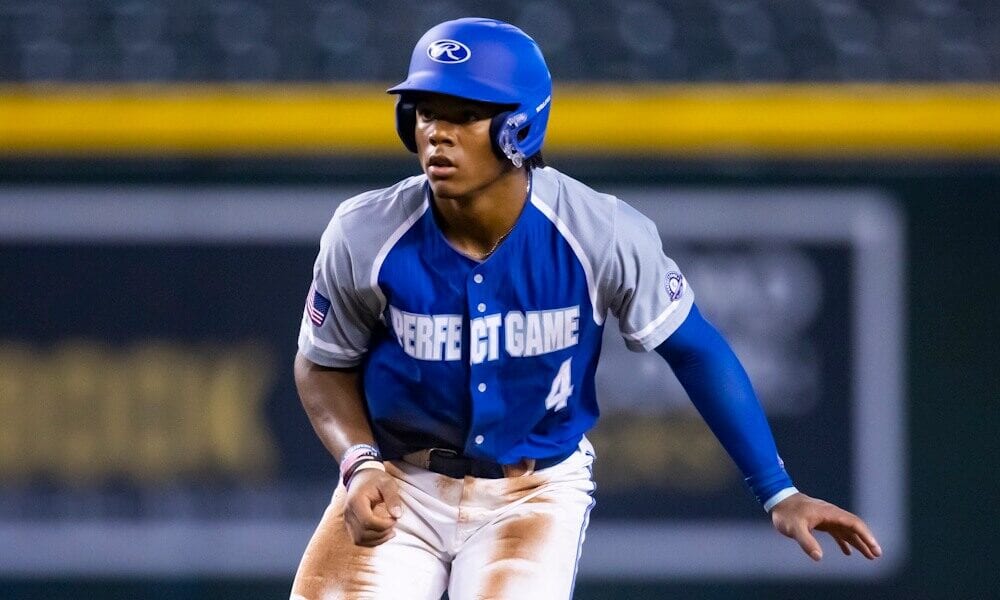
The Kansas City Royals are building toward sustained contention under Executive Vice President and General Manager J.J. Picollo, whose leadership has increasingly shaped the organization’s approach to scouting, player development, and roster construction. Rather than relying solely on waves of high draft picks, Kansas City has worked to create a more complete development pipeline—one capable of turning young talent into productive major-league contributors.
DYNASTY BASEBALL: 2026 Kansas City Royals Top 20 Fantasy Baseball Prospects
That evolution is particularly important for dynasty fantasy managers, as you’ll see in the Royals’ Top 20 fantasy baseball prospects profiled ahead.
Kansas City has long operated in a market where developing their own impact players is essential. Under Picollo, that reality places added importance on identifying players whose tools can grow within the organization, improving the development of pitchers after they enter the system, and finding offensive prospects capable of becoming more than simply complementary major-league pieces.
The Royals’ pathway also creates something dynasty managers should value: opportunity.
Unlike organizations with veteran-heavy rosters blocking prospects at nearly every position, the Royals can provide legitimate major-league opportunities when young players demonstrate they are ready. That does not mean every productive minor leaguer will immediately receive an everyday role, but prospects who force the issue have a clearer path toward meaningful playing time than they might in some of baseball’s deeper organizations.
For dynasty managers, that combination of opportunity and organizational development makes the Royals an intriguing system to evaluate. The most valuable players in this pipeline will not necessarily be the safest real-life prospects. Fantasy value demands a different lens—power, speed, plate skills, strikeout potential, age-to-level performance, positional opportunity, and ultimately the ceiling a player can reach if his development breaks correctly.
That distinction matters in a Kansas City system attempting to build sustainable talent around its major-league core. Some prospects may offer proximity and a relatively clear path to Kansas City. Others are longer-term bets whose physical tools and developmental upside make them considerably more interesting for dynasty leagues than their current national prospect rankings might suggest.
With Picollo and his baseball operations group continuing to shape that pipeline, this is an organization dynasty managers should be monitoring closely. The question is not simply which Royals prospects are closest to the majors. It is which players possess the combination of talent, opportunity, and developmental runway to become meaningful fantasy assets over the next five to ten years.
So, let’s begin with our countdown of the Kansas City Royals’ top 20 prospects.
-
Steven Zobac | RHP (ETA 2027)
Kansas City selected Steven Zobac in the fourth round (115th overall) of the 2022 MLB Draft out of California after he transitioned from a two-way player to a full-time pitcher. His development peaked with a breakout 2024, although a knee injury and subsequent surgery derailed much of his 2025 season.
Zobac attacks hitters with a fastball/slider foundation and generally throws enough strikes to give both pitches a chance to play. The slider can miss bats, while his command is important because his arsenal doesn’t give him the overwhelming margin for error possessed by higher-ceiling power arms.
For dynasty managers, Zobac is more of a near-term depth arm than a future fantasy ace. There is a starter outcome if the changeup and durability cooperate, but his fallback into a multi-inning or traditional relief role makes him primarily a deep-league stash.
-
Lucas Braun | RHP (ETA 2027)
Unlike most players on this list, Braun wasn’t drafted or signed by Kansas City. The Royals acquired him from Atlanta alongside LHP Carter Holton at the 2026 trade deadline for Lane Thomas and Bailey Falter; Braun was Atlanta’s No. 8 prospect according to MLB Pipeline at the time.
Braun brings an attractive combination of upper-minors experience, usable starting-pitcher depth, and enough stuff to continue getting opportunities in a rotation. He reached Triple-A before the trade, which immediately makes him one of the more MLB-ready arms in this countdown.
His dynasty ceiling isn’t as exciting as the teenage pitchers near the top, but proximity has value. Braun could become a useful streaming starter in deeper formats if his strikeout production translates, with a swingman outcome providing the primary downside.
-
Carson Roccaforte | OF (ETA 2027)
The Royals selected Roccaforte out of Louisiana-Lafayette in the second round of the 2023 Draft. He has steadily climbed the ladder and reached Triple-A, putting himself within striking distance of Kansas City’s outfield picture.
Roccaforte’s athleticism is the centerpiece. He can handle center field, run, and provide some power, and his 2026 performance has made the offensive upside more interesting. The lingering concern is swing-and-miss, which could determine whether he’s an everyday player or a defense-first fourth outfielder.
Fantasy managers should pay attention because power plus speed is considerably more interesting than Roccaforte’s prospect ranking suggests. Even without a star-level hit tool, everyday playing time could produce useful homers and steals, making him an appealing deeper-league sleeper close to the majors.
-
Maxx Yehl | LHP (ETA 2028)
Kansas City added Yehl through the 2026 MLB Draft, selecting the West Virginia left-hander with the 91st overall pick. He was part of a draft class in which the Royals emphasized college talent that they believe can progress relatively quickly.
Yehl brings the ingredients of a potential starter rather than simply being a polished college innings-eater. The left-handed delivery, ability to miss bats, and developing arsenal give Kansas City multiple avenues for refining him now that he’s in professional development.
In dynasty, Yehl is a deep pitching prospect with some upward mobility. College arms can move quickly when their strike throwing holds up, and a strong first full professional season could make him much more prominent by this time next year.
-
Ben Kudrna | RHP (ETA 2027)
Kudrna is literally a hometown prospect: Kansas City selected the Blue Valley Southwest High School righty 43rd overall in the second round of the 2021 Draft and went well above slot to sign him for roughly $3 million. He’s since climbed all the way to Triple-A and was added to the 40-man roster.
His arsenal has evolved considerably since his hard-throwing prep days. The changeup is now arguably his best weapon, supported by a slider and fastball, and he has accumulated the workload needed to remain a legitimate starting-pitching option.
The dynasty equation is now about role and results rather than projection. Kudrna doesn’t carry enormous strikeout upside, but a durable MLB starter has value in AL-only, 20-team and very deep dynasty leagues. His proximity makes him more useful than his ceiling alone would indicate.
-
Felix Arronde | RHP (ETA 2028)
The Royals found Arronde on the international market, signing the Cuban right-hander for $100,000 in June 2021, shortly after his 18th birthday. After two DSL seasons, his stock took off stateside, including an impressive 2024 campaign at Columbia.
Arronde has developed into more than a lottery-ticket signing. His changeup is the standout offering, while the fastball gives him enough velocity to attack hitters and his improving strike-throwing provides a plausible route toward starting.
He’s an intriguing deep-dynasty pitching sleeper because the acquisition cost should remain modest. Arronde probably doesn’t become a fantasy rotation anchor, but continued command gains could turn him into a useful back-end starter whose changeup produces enough whiffs to matter.
-
Jack Slightom | RHP (ETA 2030)
Kansas City selected Slightom 56th overall in the second round of the 2026 Draft out of Lyons Township High School in Illinois, buying into one of the more projectable prep arms in the class. The former high school quarterback was committed to Cincinnati before turning pro.
At 6-foot-5, Slightom combines athleticism with a fastball that climbed into the mid-90s during his draft spring. His slider and changeup remain developmental pitches, but the body and athletic background create reasons to envision both added strength and improved pitch quality.
This is a long-horizon dynasty investment. Slightom has more ceiling than certainty, and pitching prospects this far from Kansas City carry enormous attrition risk. In leagues rostering 200-plus prospects, however, he’s exactly the type of athletic prep arm worth monitoring before a potential breakout.
-
Michael Lombardi | RHP (ETA 2028)
Lombardi was another fascinating amateur athlete, playing center field, first base, and pitching at Tulane before the Royals made him a second-round pick, No. 61 overall, in the 2025 Draft. Kansas City signed him for approximately $1.3 million and committed to developing his arm.
The attraction is easy to see. Lombardi can generate mid-90s velocity and pairs the fastball with a potentially nasty curveball, while his athleticism offers hope that his delivery and command can become more consistent. Developing the changeup and throwing enough strikes will decide whether he can start.
For fantasy purposes, there’s a starter/reliever fork in the road. If Lombardi develops average command and a credible third pitch, his fastball-curveball combination could produce meaningful strikeouts from a rotation. If not, the same two pitches could make him a potent late-inning reliever.
-
Sean Gamble | OF (ETA 2029)
Kansas City selected Gamble 23rd overall in the first round of the 2025 Draft out of IMG Academy, signing him for just under $4 million and steering him away from Vanderbilt. His athleticism had already stood out against high-end prep competition.
Gamble’s left-handed swing, bat speed, and running ability form an exciting fantasy foundation. He’s capable of impacting games on the bases and has room to grow into more power, while his athleticism gives him a legitimate opportunity to remain in center field.
He’s a classic dynasty upside play. There is enough speed to envision strong stolen-base totals and enough physical projection to dream on double-digit-to-above-average home-run production. The ultimate ceiling depends on how much impact develops without sacrificing contact.
-
Asbel Gonzalez | OF (ETA 2029)
The Royals signed Gonzalez out of Venezuela for $157,500 during the 2023 international signing period, and that modest investment has developed into a legitimate prospect. His speed, center-field defense, and contact ability quickly distinguished him from a typical low-dollar international signing.
Gonzalez’s best fantasy weapon is his legs. He’s a plus runner with the defensive ability to remain in center, while his bat is geared more toward contact than over-the-fence damage. Additional strength could unlock another level, but he doesn’t need to become a slugger to reach the majors.
His dynasty value hinges on on-base ability plus stolen bases. A top-of-the-order outcome could make Gonzalez surprisingly useful, particularly in formats that reward steals heavily. The risk is that limited power leaves little fantasy cushion if the hit tool stalls.
-
Yandel Ricardo | SS (ETA 2029)
Kansas City made a major international investment in Ricardo, signing the Cuban shortstop for $2.4 million in January 2024. He had ranked among MLB Pipeline’s better prospects in that international class and entered pro ball with a combination of physicality and offensive upside.
Ricardo is a switch-hitter with strength and potential power from both sides, particularly the right side. He has the hands and arm to continue developing at shortstop for now, although his growing frame could eventually push him elsewhere on the dirt.
In dynasty leagues, Ricardo is a high-variance offensive stash. A shortstop who develops into an above-average power hitter carries obvious value, but he’s still young enough that the hit tool and defensive home remain unsettled. The payoff could be substantial if his offensive tools consolidate.
-
Justin Lamkin | LHP (ETA 2028)
Kansas City grabbed Lamkin with the 71st overall pick in the 2025 Draft out of Texas A&M. His polish was already attractive, but an increase in velocity after turning pro quickly made him one of the organization’s more interesting pitching risers.
Lamkin can attack with multiple fastballs and breaking balls, with his slider standing out as a legitimate bat-missing weapon. His deceptive delivery helps the arsenal play up, and he opened 2026 brilliantly before a shoulder-area strain interrupted his ascent to Double-A.
Health is therefore the immediate dynasty checkpoint. If Lamkin returns with his improved velocity intact, he has a realistic mid-to-back rotation pathway with useful strikeout upside. Because he’s an advanced college arm, he could move rapidly once healthy.
-
Ramon Ramirez | C (ETA 2028)
One of Kansas City’s better international bargains, Ramirez signed out of Venezuela for only $57,500 in January 2023. Interestingly, he grew up as an outfielder before the Royals signed and developed him as a catcher.
The bat is what makes Ramirez exciting. He generates impressive raw power, handles velocity, and has enough barrel feel to project as much more than a defense-only catcher. His strong throwing arm helps his chances behind the plate, although receiving and blocking remain important developmental areas.
That combination makes Ramirez especially appealing in two-catcher dynasty formats. An everyday catcher capable of eventually reaching 20-plus homers has significant scarcity value. Even if the defensive development slows his ETA, the offensive ceiling is worth waiting for.
-
Blake Mitchell | C (ETA 2027)
The Royals made Mitchell the eighth overall pick in the 2023 Draft out of Sinton High School in Texas, then signed him for roughly $4.9 million. Kansas City was betting on a rare combination of left-handed power, patience, athleticism, and a huge throwing arm behind the plate.
Mitchell’s calling card remains impact power. A broken hamate and subsequent setbacks made 2025 ugly statistically, but flashes of huge exit velocity after his recovery reminded everyone why he was drafted so highly. His patience can generate walks, though strikeouts remain the major offensive concern.
For dynasty, Mitchell remains a high-upside fantasy catcher rather than a prospect to abandon after one difficult stretch. If he gets the strikeout rate under control, 25-plus homer upside at catcher can overcome a merely average batting average. He’s close enough now that 2027 should be firmly on fantasy radars.
-
Taylor Rabe | RHP (ETA 2028)
Rabe’s stock exploded at Ole Miss, and Kansas City selected him 30th overall in the 2026 Draft. After Tommy John surgery cost him 2024, he returned with dramatically better velocity and eventually forced his way from a piggyback role into the Rebels’ rotation.
The fastball can reach triple digits and sat in the upper 90s during his draft year, but velocity isn’t the only attraction. Rabe throws strikes, owns a hard cutter and complements it with slider/changeup options, giving him a starter’s toolkit rather than a one-dimensional power profile.
Rabe is one of my favorite pitching upside plays in this Royals group. Power stuff plus control is an enticing fantasy combination, and his college background should shorten the developmental timeline. The Tommy John history adds risk, but the strikeout ceiling could make the reward worthwhile.
-
Zion Rose | OF (ETA 2028)
Kansas City used the sixth overall selection in the 2026 Draft on Rose out of Louisville, making him the centerpiece of its newest draft class. He immediately jumped into High-A after signing, an aggressive assignment that speaks to the polish in his offensive game.
Rose’s strongest trait is his ability to hit. He combines athleticism with advanced contact skills and has a chance to develop an above-average hit tool, while enough physicality exists to produce useful power. MLB Pipeline already identifies his hit tool as the best in Kansas City’s system.
That makes him a very attractive dynasty prospect because hitters who move quickly and make consistent contact carry comparatively lower developmental risk. If Rose adds game power while retaining that contact ability, he could become a five-category contributor rather than merely a high-average outfielder.
-
David Shields | LHP (ETA 2029)
Shields was only 17 when Kansas City selected him 41st overall in the second round of the 2024 Draft out of Mt. Lebanon High School in Pennsylvania. A former high-school quarterback, he quickly justified the aggressive pick with an outstanding first full professional season.
David doesn’t overpower hitters with premium fastball velocity, but everything else is unusually advanced for his age. Shields commands the baseball, mixes multiple secondaries and misses bats with his breaking stuff, while his physical development leaves open the possibility that more velocity arrives.
Dynasty managers should resist dismissing him because the heater isn’t huge. Young lefties with command, multiple usable pitches, and a track record of performing against older competition can become extremely valuable starters. Added velocity would raise the ceiling considerably; even without it, there’s a plausible MLB rotation outcome.
-
Josh Hammond | SS/3B (ETA 2029)
Kansas City selected Hammond in the 2025 MLB Draft out of high school, betting on a powerful, athletic infielder with two-way ability as an amateur. He has since emerged as one of the organization’s premier teenage position players and is currently a Top-100 prospect for MLB Pipeline.
Hammond combines strength with impressive athleticism and one of the strongest infield arms in the organization. There is legitimate offensive impact here, with enough bat speed and physicality to project power, while his defensive versatility gives Kansas City multiple ways to keep his bat in the lineup.
The dynasty appeal is substantial because Hammond has a path to power production at a valuable infield position. He remains several years away, so there’s considerable hit-tool risk, but the ceiling is high enough that managers in deep leagues should be willing to tolerate the wait.
-
Angeibel Gomez | OF (ETA 2031)
Kansas City landed Gomez as the centerpiece of its 2026 international class, signing the Venezuelan outfielder for $2.9 million after MLB Pipeline ranked him No. 4 in the class. He immediately began validating that investment with an advanced showing in the Dominican Summer League.
Few players in this system can match his collection of tools. Gomez has a smooth right-handed swing, burgeoning power, excellent speed, a strong arm, and the defensive instincts for center field. Even more encouraging for dynasty purposes, the athletic tools come with early signs of strike-zone awareness and contact ability.
He’s obviously a long-term dynasty play, but the upside is enormous. A center fielder with plus-plus speed, power projection, and a potentially quality hit tool can become a true five-category fantasy star. Gomez is exactly the type of teenager whose dynasty price can skyrocket well before he gets anywhere near Kansas City.
-
Kendry Chourio | RHP (ETA 2029)
Kansas City signed Chourio out of Venezuela for just $247,500 in January 2025, a transaction that already looks like a scouting and development coup. He raced from the Dominican Summer League through Arizona and into full-season ball at only 17, then continued climbing in 2026.
Chourio’s appeal isn’t based solely on projection. His fastball has climbed into the mid-to-upper 90s, while his curveball and changeup give him a legitimate three-pitch mix. Most impressive is the strike-throwing: he showed exceptional control at an age when most pitchers are still trying to repeat their mechanics. That rare marriage of stuff, command, and youth separates him from the typical teenage pitching prospect.
Pitchers this young always carry major dynasty risk, but Chourio has front-of-the-rotation fantasy upside. He’s already reached High-A as an 18-year-old and sits inside MLB Pipeline’s Top 100, so the breakout is no longer hidden. If the velocity, secondary pitches, and elite control continue progressing together, Chourio has the ingredients to eventually become a high-strikeout MLB starter rather than simply another promising arm.
Also, make sure to check out our 2026 MLB organizational Prospect Rankings!
Final Thoughts
Kansas City’s system offers an appealing blend of near-term opportunity and long-range upside. The greatest fantasy ceiling resides with Chourio, Gomez, Hammond, Shields and Rose, while players such as Mitchell, Rabe and Ramirez provide intriguing upside a little closer to the majors.
The larger takeaway is that this is a system worth tracking beyond the obvious names. Kansas City has enough opportunity at the major-league level—and enough developmental upside throughout the pipeline—that several prospects could eventually outperform their current dynasty-market value.
Fantrax is one of the fastest-growing fantasy sites in the fantasy sports industry, and we’re not stopping anytime soon. We are the most customizable, easy-to-use, and feature-rich platform in the industry, offering the greatest fantasy experience for your dynasty, keeper, redraft, and best ball leagues. Fantasy sports doesn’t sleep, and neither does Fantrax, with seasons running 365 days a year. Take your fantasy leagues to the next level now at Fantrax.com!