

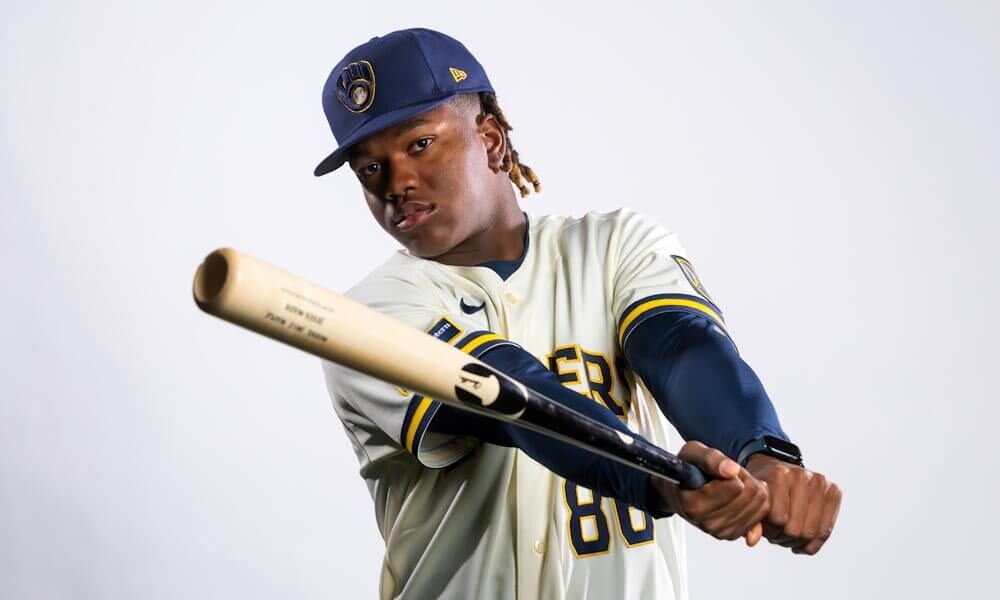
The Milwaukee Brewers have quietly built one of baseball’s most dependable organizations, consistently finding ways to compete without possessing the financial resources of the sport’s biggest markets. At the center of that success is President of Baseball Operations and General Manager Matt Arnold, whose front office continues to emphasize scouting, player development, roster flexibility, and identifying value before the rest of the league catches up, as you’ll see in the Brewers’ Top 20 fantasy baseball prospects ahead.
After you get done here, make sure to check out the rest of our 2026 MLB Organizational Prospect Rankings!
2026 Milwaukee Brewers Top 20 Dynasty Fantasy Baseball Prospects
Milwaukee’s organizational strength has rarely been about collecting the biggest names. Instead, the Brewers have built a system designed to maximize talent. Pitchers can arrive with intriguing raw ingredients and emerge with sharper arsenals, improved pitch usage, and legitimate swing-and-miss weapons. Position players are similarly challenged to develop the skills necessary to contribute in multiple ways, creating a steady pipeline of players capable of helping the major-league roster.
That philosophy makes the Brewers particularly interesting for dynasty fantasy managers.
Milwaukee has demonstrated a willingness to trust young players when they prove they are ready, creating meaningful opportunities for prospects to establish themselves at the major-league level. At the same time, the organization’s ability to develop pitching means arms within this system deserve attention even when their prospect pedigree does not immediately command it. A pitcher entering the Brewers’ development pipeline can become considerably more interesting than his original scouting report might suggest.
Arnold and his staff also operate with the realities of a smaller market in mind. Milwaukee cannot simply solve every roster problem through free agency, making the farm system an essential part of the organization’s competitive model. Drafting well, developing efficiently, identifying undervalued players, and knowing when to turn established talent into the next wave of contributors are necessities rather than luxuries.
For dynasty managers, that creates an organization worth monitoring from top to bottom. Milwaukee prospects may not always generate the immediate attention attached to players in larger markets, but the Brewers have repeatedly shown that organizational development can transform intriguing tools into legitimate major-league value.
The result is a system where opportunity and development intersect—and where the next significant dynasty asset may emerge before the broader fantasy market realizes what Milwaukee has built.
So, let’s begin with our countdown of the Brewers’ top 20 prospects.
No. 20 — Trey Ebel | INF (ETA 2029)
Ebel brings a fascinating blend of youth, athleticism, and offensive projection to Milwaukee’s lower levels. The Brewers brought him into the organization through the 2026 MLB Draft, adding another member of the talented Ebel baseball family to a system that already included his younger brother Brady.
For dynasty managers, Ebel is a deep-league stash rather than someone who should occupy a valuable roster spot in shallower formats. His offensive game remains years from its finished form, but there is enough bat speed and physical projection to envision useful power developing as he matures.
The appeal here is buying before the statistical breakout. Ebel carries substantial developmental risk because of his distance from Milwaukee, but young infielders with offensive upside can gain dynasty value rapidly once they begin producing in full-season ball.
No. 19 — Ethan Dorchies | RHP (ETA 2029)
Milwaukee selected Dorchies out of Cary-Grove High School in Illinois in the 10th round of the 2024 Draft, signing the teenager away from a college commitment. The 6-foot-5 right-hander has since developed into a legitimate pitching prospect, reaching High-A while still only 19.
His splitter is particularly intriguing, and he complements it with a fastball, slider and cutter. The combination of size, youth, and a surprisingly complete repertoire gives Dorchies more starting-pitcher upside than his draft pedigree suggests.
Pitching prospects this far away are inherently dangerous dynasty investments, but Dorchies is exactly the type worth watching before mainstream rankings catch up. If the velocity climbs as his frame matures, his fantasy ceiling could change considerably.
No. 18 — Coleman Crow | RHP (ETA 2027)
Crow took an unusual route to Milwaukee. Originally drafted by the Angels, he went to the Mets in the Eduardo Escobar trade before the Brewers acquired him from New York for Adrian Houser and Tyrone Taylor in December 2023 while Crow was recovering from Tommy John surgery.
His calling card is spin rather than overpowering velocity. Crow’s curveball can miss bats, and his deep assortment of breaking pitches allows the fastball to play better than its radar-gun readings suggest. That gives him a plausible back-end starter path.
The dynasty ceiling isn’t enormous, but proximity matters. Crow is already knocking on the major-league door and recently delivered six scoreless innings for Triple-A Nashville, making him much more relevant in NL-only and deep dynasty leagues than his traditional prospect ranking suggests.
No. 17 — Bishop Letson | RHP (ETA 2027)
Milwaukee found Letson in the 11th round of the 2023 Draft out of Floyd Central High School in Indiana and paid him well above typical 11th-round money to bypass Purdue. That gamble has paid off, with Letson reaching Double-A at age 21.
The attraction starts with a fastball that can play as plus, backed by a promising slider and usable cutter/changeup combination. He’s more starter than thrower, although a previous shoulder injury deserves consideration when assessing his long-term risk.
For dynasty, Letson is a worthwhile pitching stash because there’s still room between his present ability and eventual ceiling. If the command and secondary pitches progress another half-grade, he could become a mid-rotation starter capable of helping fantasy managers in strikeouts without wrecking WHIP.
No. 16 — Eric Bitonti | 1B (ETA 2028)
The Brewers drafted Bitonti 87th overall in the third round in 2023 and paid him $1.75 million to turn pro rather than attend Oregon. He was just 17 at the time, giving Milwaukee plenty of developmental runway for his enormous 6-foot-5 frame and left-handed power.
There’s no mystery about the fantasy attraction: power. Bitonti has legitimate 30-homer upside if everything clicks, but his long swing and elevated strikeout rates create significant batting-average risk. His move down the defensive spectrum to first base also increases the pressure on his bat.
That makes him a classic boom-or-bust dynasty asset. I’d value him considerably higher in leagues that reward OBP or where 30-homer ceilings are difficult to acquire, but managers need to accept the possibility that upper-level pitching exposes the hit tool.
No. 15 — Jeferson Quero | C (ETA 2026)
Quero was one of Milwaukee’s international finds, signing out of Venezuela for $200,000 in July 2019. He developed into one of baseball’s premier catching prospects before a major right-shoulder injury wiped out his 2024 season and interrupted his ascent.
His real-life value remains driven heavily by catching. Quero is an advanced receiver with a strong arm, but there’s enough offensive ability and raw power to envision roughly 15-18 homers if he receives regular MLB playing time.
That distinction matters in dynasty. Quero is significantly more valuable in two-catcher leagues than one-catcher formats because his fantasy ceiling isn’t comparable to the elite offensive catchers. Still, an everyday MLB catcher with respectable average and power has considerable value in deeper leagues.
No. 14 — Ricki Moneys | SS (ETA 2031)
Moneys represents the extreme long-term play on this list. Milwaukee signed the highly regarded shortstop during the 2026 international period, and he received one of the organization’s largest bonuses in a class that also included Diego Frontado and José Rodríguez.
There’s already substantial offensive intrigue. MLB Pipeline gives Moneys 60-grade power, unusual thunder for such a young shortstop, while his athleticism gives him a chance to remain on the dirt.
He’s years away, which makes his dynasty value extremely format-dependent. In leagues rostering 300 prospects, he’s compelling; in shallow formats, he’s unnecessary. But if you like acquiring teenagers before their first major stateside breakout, Moneys is exactly that type of lottery ticket.
No. 13 — Marco Dinges | C (ETA 2027)
Milwaukee selected Dinges from Florida State in the fourth round of the 2024 Draft, 123rd overall. His bat immediately translated to professional baseball, and the Brewers have continued developing him behind the plate rather than limiting him to DH duties.
Dinges’ fantasy appeal comes from above-average raw power at catcher. He’s capable of driving the baseball with authority, while his strong throwing arm gives him another avenue toward regular playing time even if the receiving remains a work in progress.
Catcher development is rarely linear, but Dinges has a potentially valuable fantasy combination: power plus positional scarcity. If he sticks behind the plate and becomes a 20-homer hitter, he’ll be considerably more valuable in dynasty than his overall prospect ranking suggests.
No. 12 — Luke Adams | 1B/3B (ETA 2026)
Adams may become one of Milwaukee’s better late-round success stories. The Brewers selected him from an Illinois high school in the 12th round of the 2022 Draft and paid him above-slot money to turn professional rather than attend college.
His carrying skill is elite strike-zone control. Adams combines huge walk totals with improving power, and that combination has followed him to Triple-A. He’s recently been hitting around .260/.407/.544 with 16 homers, putting an MLB opportunity within reach.
He’s particularly attractive in OBP dynasty leagues, where his patience can turn him into a substantially better asset than his traditional prospect ranking implies. The defensive profile limits the ceiling somewhat, but a corner bat producing homers and a high OBP can become quietly valuable.
No. 11 — Blake Burke | 1B (ETA 2027)
Burke was Milwaukee’s 34th overall selection in the 2024 Draft after starring at Tennessee. Interestingly, the Brewers obtained that Competitive Balance Round A pick from Baltimore in the Corbin Burnes trade, so Burke is effectively one of the long-term pieces produced by that blockbuster.
The left-handed slugger’s calling card is easy to identify: huge power. Burke has learned to elevate the baseball more consistently as a professional, turning his strength into game production rather than merely impressive exit velocities. His recent surge earned him a promotion to Triple-A.
Burke’s defensive limitations put nearly all of the pressure on his bat, and so far the offensive trajectory is encouraging. In dynasty, he’s a power-first near-MLB stash who could provide 25-plus homers if the hit tool survives major-league pitching.
No. 10 — Josh Knoth | RHP (ETA 2028)
Milwaukee used the 33rd overall pick in the 2023 Draft on Knoth, signing the 17-year-old Long Island prep right-hander for $2 million. Tommy John surgery subsequently cost him all of 2025, temporarily putting one of Milwaukee’s most exciting young arms on hold.
The stuff explains why Milwaukee invested so heavily. Knoth can miss bats with both his curveball and slider, while his riding fastball gives hitters another problem at the top of the zone. It’s a starter’s strikeout arsenal if the command becomes adequate.
That makes Knoth a high-risk, high-reward dynasty pitcher. Tommy John history plus developing command makes him volatile, but healthy starters with two potential plus breaking balls can climb rankings very quickly. I’d rather gamble on that ceiling than roster a safer No. 5 starter.
No. 9 — Sawyer Strosnider | OF (ETA 2029)
Strosnider is the newest addition to this countdown. Milwaukee selected the TCU outfielder 66th overall in the second round of the 2026 Draft, even though MLB Pipeline had rated him as the No. 22 prospect in the entire draft class.
There’s genuine fantasy intrigue because Strosnider isn’t dependent on one category. Strosnider offers fantasy value in more than one category, pairing legitimate raw power with the athleticism and speed to contribute on the bases, pairing the physicality to continue driving the ball as a professional, creating a potential multi-category offensive profile.
He’s obviously less proven than most players above him, so this ranking is an upside bet. Dynasty managers should watch his first extended professional sample closely; strong contact rates combined with his existing power and athleticism could send Strosnider flying up Milwaukee’s organizational rankings.
No. 8 — Tyson Hardin | RHP (ETA 2026)
Hardin is a terrific example of Milwaukee finding pitching value where others didn’t. The Brewers took the Mississippi State reliever in the 12th round of the 2024 Draft, signed him for $147,500, and converted him into a professional starter.
That conversion unlocked something. Hardin pounds the strike zone, has a useful slider, and gets more from his fastball than the raw velocity suggests. His 2025 season included a 2.72 ERA, 1.18 WHIP, and 96 strikeouts in 96 innings while demonstrating excellent control.
The 2026 Triple-A results have been much rougher, which prevents me from pushing him higher. But he’s close enough to Milwaukee and has shown enough strikeout ability to remain interesting in deeper dynasty leagues, particularly formats where inexpensive starting pitching has value.
No. 7 — Braylon Payne | OF (ETA 2028)
Milwaukee made an aggressive upside play by selecting Payne 17th overall in the 2024 Draft out of Elkins High School in Texas. He was only 17, making him one of the youngest players in that draft class.
Speed is the fantasy separator. Payne has the wheels to become a serious stolen-base contributor, and his athleticism gives him plenty of opportunities to remain in the lineup defensively. The question is how much offensive impact accompanies those legs as he fills out physically.
For dynasty purposes, I’m willing to dream. A center fielder capable of producing strong stolen-base totals while developing double-digit or better home-run power has substantial category upside. Payne is risky, but the potential fantasy payoff is considerably higher than that of a typical lower-minors outfielder.
No. 6 — Jett Williams | SS/OF (ETA 2027)
Williams is unusual on this list because Milwaukee didn’t draft or originally sign him. The Brewers acquired Williams and Brandon Sproat from the Mets on January 22, 2026, for Freddy Peralta and Tobias Myers, instantly adding one of baseball’s better-known upper-level prospects.
At only 5-foot-7, Williams doesn’t look like a conventional impact hitter, but his fantasy game has never depended on size. His patient approach, speed, defensive versatility, and ability to reach base create a pathway toward runs and steals with enough pop to avoid becoming empty speed.
The dynasty question is whether the hit tool lets everything play against MLB pitching. He’s already at Triple-A and therefore carries far less developmental distance than most of this countdown. A 15-HR/25-SB type of outcome remains plausible, making Williams a strong stash despite some prospect-stock volatility.
No. 5 — Andrew Fischer | 3B (ETA 2027)
Milwaukee selected Fischer 20th overall in the first round of the 2025 Draft after his monster season at Tennessee. The left-handed hitter had already shown patience and power in college, but his professional performance has elevated his dynasty ceiling dramatically.
Fischer has been destroying minor-league pitching in 2026, reaching Double-A while producing 33 homers and an OPS above 1.100 in his current season line. The combination of patience, strength, and all-fields power gives him legitimate middle-of-the-order upside.
There’s some swing-and-miss risk and the eventual defensive home could be a corner, but dynasty managers shouldn’t overthink the position. Impact bats win fantasy leagues. Fischer has a realistic path toward becoming a .250-plus hitter with 30-homer seasons and excellent OBP production.
No. 4 — Brady Ebel | SS (ETA 2029)
The Brewers selected Ebel 32nd overall in the 2025 Draft, using the compensation pick they received after Willy Adames departed in free agency. Milwaukee then signed the highly regarded California prep shortstop away from an LSU commitment for $2.75 million.
Ebel’s advanced offensive feel is exciting for such a young player. He’s showing patience, contact ability and surprising baserunning impact; in 2026 he’s already produced eight homers and 33 steals with an OPS above .800.
He’s a dynasty manager’s dream developmental profile: young for his level, potentially valuable position, strong approach and multiple-category upside. The power still needs time, but if that arrives while Ebel retains even above-average speed, he could eventually offer 20/20 upside from the infield.
No. 3 — Josh Adamczewski | OF (ETA 2028)
Few Brewers prospects have improved their stock as dramatically as Adamczewski. Milwaukee grabbed him from the Indiana high school ranks in the 15th round of the 2023 Draft and paid $252,500 to convince him to bypass a Ball State commitment.
The left-handed hitter has blossomed into an advanced offensive prospect because he combines contact quality with excellent strike-zone judgment. His swing adjustments have helped him lift the ball more effectively, and he rarely expands the zone, creating an attractive foundation for both AVG and OBP leagues.
Moving from second base to the outfield reduces his positional fantasy value, but I’m buying the bat. Adamczewski has reached Double-A at 21 and now ranks sixth on MLB Pipeline’s current Brewers list. If more power arrives, we’re looking at a potential high-average, high-OBP fantasy regular rather than merely an organizational success story.
No. 2 — Luis Peña | INF (ETA 2028)
Peña joined Milwaukee alongside Made during the 2024 international signing period, signing out of the Dominican Republic as part of a loaded Brewers class. That international haul now looks increasingly important to the organization’s future.
Peña’s offensive profile screams fantasy upside. He combines excellent bat-to-ball ability with explosive speed, developing power and enough aggressiveness on the bases to envision significant stolen-base totals. Even better, he’s performing against much older competition and recently produced a monster week at High-A.
There aren’t many minor leaguers I’d rather own in a dynasty league. Peña has a legitimate pathway toward becoming a five-category fantasy infielder, and his ceiling rises considerably if the power continues developing. MLB Pipeline currently places him No. 2 in Milwaukee’s system with a 2028 ETA.
No. 1 — Jesús Made | SS (ETA 2026)
Made is the crown jewel. Milwaukee signed the Dominican switch-hitter for $950,000 in January 2024, and he has since rocketed through the organization, reaching Double-A as an 18-year-old. It’s another remarkable success for Milwaukee’s international scouting operation.
Made’s appeal comes from how complete the offensive foundation already looks. He combines advanced contact skills and plate discipline with legitimate power and speed, giving him multiple ways to become an impact fantasy player. He’s also physically matured significantly without losing the athleticism that made him special in the first place.
The upside is a genuine first-round fantasy player: a switch-hitting infielder capable of contributing heavily in all five standard categories. At only 19, he’s already at Double-A and carries a 2026 MLB Pipeline ETA. Of everyone on this list, Made is the player I’d be least willing to trade away in a dynasty league.
Final Thoughts
Milwaukee’s system is especially appealing for dynasty managers because it offers a strong mix of high-end upside, proximity, and developmental depth. Jesús Made and Luis Peña headline the organization as potential five-category impact players, while Andrew Fischer, Josh Adamczewski, Brady Ebel, and Jett Williams give the system another tier of legitimate fantasy upside.
The bigger takeaway, though, is the depth behind those names. Milwaukee continues to turn less-heralded hitters and pitchers into meaningful prospects, making this an organization dynasty managers should monitor well beyond the top 10. The Brewers’ combination of player development and willingness to create opportunities for young players makes buying into the organization early a worthwhile dynasty strategy.