

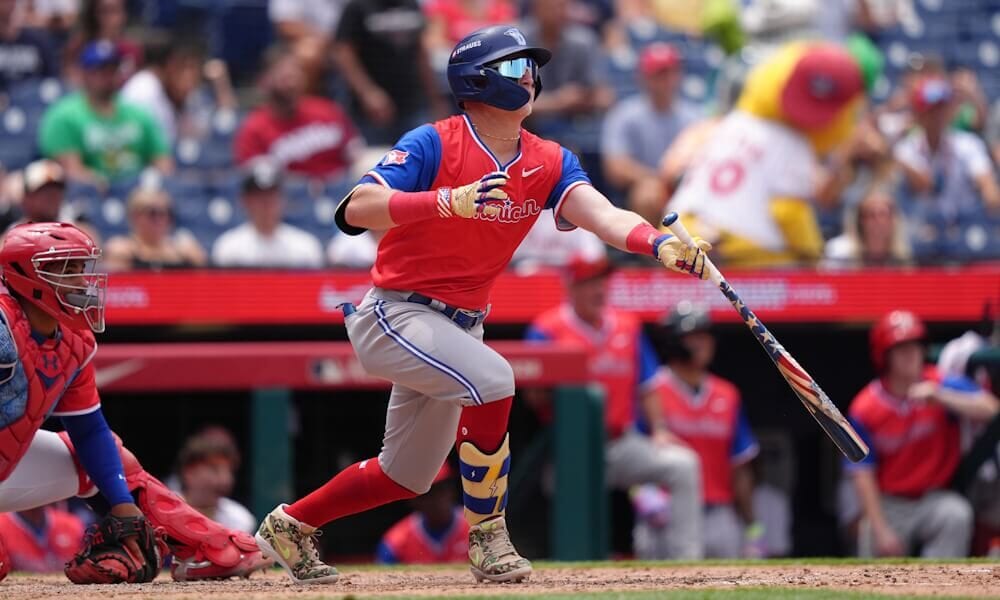
The Toronto Blue Jays have spent the better part of the last decade building an organization designed to compete at the major-league level without treating the farm system as a separate operation. Under President and CEO Mark Shapiro and General Manager Ross Atkins, Toronto has invested heavily in infrastructure, player development, technology, scouting, and the processes that connect young players to the major-league roster.
Dynasty Baseball: 2026 Toronto Blue Jays Top 20 Fantasy Baseball Prospects
That organizational philosophy has become increasingly important, as you’ll see in the Blue Jays’ Top 20 fantasy baseball prospects ahead..
The Blue Jays aren’t simply asking their farm system to produce future everyday players. They have shown a willingness to use prospect capital aggressively when it can improve the major-league club, while continuing to replenish the system through the draft, international scouting, trades, and development. That makes Toronto an interesting organization for dynasty managers because prospect value here can take more than one form: a player may eventually contribute in Toronto, or his development may turn him into valuable currency in a larger roster move.
Shapiro and Atkins have also overseen significant investment in the developmental environment itself. Toronto’s player development complex in Dunedin was built around a more integrated approach to performance, incorporating technology, research, strength and conditioning, pitching development, and sports science. That infrastructure matters because the organization is increasingly showing signs that it can translate those resources into tangible development, particularly on the pitching side.
Recent results have provided evidence of that progress. The emergence of Trey Yesavage became one of the organization’s most visible developmental successes, while the system has continued producing both major-league contributors and prospects valuable enough to headline significant trades. Toronto’s front office has repeatedly demonstrated that it views the farm system as an organizational resource rather than simply a collection of players waiting for promotions.
That approach can create an unusual dynamic for dynasty managers.
A highly regarded Blue Jays prospect isn’t necessarily being developed with a clear, uninterrupted path to Toronto in mind. The organization has been willing to move meaningful prospect talent when the major-league roster demands it. At the same time, the Blue Jays have become increasingly capable of replacing some of that lost depth through amateur acquisition and player development.
The current system reflects that cycle. JoJo Parker has emerged as one of the organization’s premier young position players, while arms such as Nolan Perry, Johnny King, and Cole Carlon give Toronto another wave of pitching upside. The system may fluctuate in industry rankings as prospects graduate or are traded, but that volatility shouldn’t automatically be mistaken for developmental weakness. In Toronto’s model, successfully developing a prospect into a valuable trade asset can be nearly as important organizationally as graduating him to the major-league roster.
For dynasty managers, that distinction matters.
The Blue Jays are becoming an organization where developmental context deserves attention alongside raw scouting grades. When Toronto invests heavily in a young player—or when a prospect begins making meaningful developmental gains—it is worth examining closely. Shapiro and Atkins have built an infrastructure intended to turn amateur talent into major-league value, whether that value ultimately appears in a Blue Jays uniform or helps acquire the next piece of a contending roster.
Toronto’s system therefore shouldn’t be viewed only through the traditional question of: Who is next?
The more useful question may be: Which players are gaining value fastest inside an organization increasingly capable of turning development into major-league impact?
That’s the lens we’ll use as we begin our countdown of the Toronto Blue Jays’ top 20 prospects.
#20 — Ryan Cooney | SS (ETA 2029)
The Blue Jays brought Cooney into the organization with their third-round selection in the 2026 MLB Draft. The former Oregon infielder arrived with a polished offensive approach, giving Toronto another middle-infield prospect whose game is built more around controlling at-bats than overwhelming pitchers with raw power.
For dynasty managers, Cooney’s contact skills are the main attraction. He has the ingredients to hit for average, reach base at a healthy clip and contribute some stolen bases. Additional strength could eventually turn a few more of his doubles into home runs, but power probably won’t be his defining fantasy category.
Cooney’s ceiling isn’t enormous, yet there are several avenues to fantasy usefulness. A middle infielder who hits near the top of a lineup and contributes average, runs, and steals can quietly become valuable. He’s a deeper-league prospect now, with room to climb as his professional résumé grows.
#19 — Josh Kasevich | 2B/SS (ETA 2027)
Toronto selected Kasevich in the second round of the 2022 MLB Draft out of Oregon, and his steady climb through the system has taken him to Triple-A. Rather than relying on one spectacular tool, Kasevich has advanced largely because he consistently puts together competitive at-bats and makes pitchers work.
Contact is his ticket to the majors. Kasevich has a compact offensive game that could produce respectable batting averages and on-base percentages, while his defensive versatility gives Toronto different ways to work him into a lineup. What remains noticeably absent is significant home-run upside.
That limits his dynasty ceiling, particularly in shallow leagues where managers need impact production from every roster spot. In deeper formats, however, Kasevich has value as a high-probability major leaguer who could supply average, runs, and occasional steals while qualifying at useful infield positions.
#18 — RJ Schreck | OF (ETA 2027)
Schreck entered Toronto’s system at the 2024 trade deadline when the Blue Jays acquired him from Seattle in the Justin Turner deal. Originally a ninth-round Mariners selection in 2023, Schreck has developed into an advanced upper-level hitter whose offensive approach deserves more dynasty attention.
He rarely looks overmatched by the strike zone, and that patience creates opportunities for his power to surface. Schreck isn’t a classic middle-of-the-order masher, but there is enough thump in his left-handed bat to envision useful home-run production accompanying strong on-base numbers.
His fantasy stock gets a noticeable boost in OBP leagues. Schreck probably won’t develop into a category-winning player, but a regular outfielder producing respectable power with a strong walk rate can have considerable value. His proximity to Toronto also makes him safer than many lower-level prospects.
#17 — Blaine Bullard | OF (ETA 2029)
Toronto used a 12th-round pick in the 2025 Draft on Bullard, a switch-hitting high school outfielder from Texas. His draft position undersells the intrigue because Bullard possesses the athletic traits that can turn an unheralded teenage selection into a legitimate prospect.
Speed is the fantasy hook. Bullard can create havoc once he reaches base, giving him a potential path toward significant stolen-base production. There’s also enough developing pop in the bat to dream on something more interesting than a one-dimensional speedster, although his offensive approach still needs considerable refinement.
Bullard is exactly the type of prospect who can make a dramatic jump on dynasty lists before becoming a household name. The risk remains substantial because he’s young and raw, but if the contact rate improves without sacrificing his aggressiveness on the bases, a compelling power-speed profile could emerge.
#16 — Danny Thompson Jr. | RHP (ETA 2027)
Thompson joined Toronto as an eighth-round selection in the 2025 Draft out of UNC Greensboro and quickly began outperforming the expectations normally attached to that draft slot. His rapid progress has made him one of the better pitching-development stories in the organization.
The right-hander has shown an ability to miss bats while handling a starter’s workload, which is exactly the combination dynasty managers should monitor. He’s not simply surviving with deception; there is enough quality in the arsenal to give him a chance to keep starting as he approaches the upper minors.
His ultimate role remains important to his fantasy valuation. If the command and secondary pitches hold up over longer outings, Thompson could develop into a useful strikeout starter. A bullpen future would lower the ceiling, but his trajectory has already made him far more interesting than his original draft pedigree suggested.
#15 — Daniel Guerra | RHP (ETA 2027)
Guerra entered professional baseball when Toronto signed him as an international free agent out of Venezuela. The organization has gradually developed the tall right-hander, and his progression into the upper minors has transformed him from a projectable arm into a pitcher with legitimate major-league possibilities.
His 6-foot-6 frame creates an imposing look, and the fastball gives him a weapon capable of generating swings and misses. There’s enough supporting stuff to envision a starting role, particularly if Guerra continues improving his ability to repeat his delivery and locate consistently.
Dynasty managers should be interested because strikeout upside is present without an excessively distant ETA. The bullpen remains a possible destination if the command stalls, but Guerra’s combination of size, velocity, and proximity gives him an appealing chance to outperform his current fantasy-prospect recognition.
#14 — Jake Cook | OF (ETA 2028)
The Blue Jays selected Cook in the sixth round of the 2025 Draft out of Southern Mississippi, betting heavily on his exceptional athleticism. Few players in Toronto’s system can match his pure physical tools, and his speed gives him a fantasy characteristic that immediately separates him from most prospects.
Cook can absolutely fly. His top-end speed has the potential to translate into large stolen-base totals, while that same athleticism makes him an excellent defensive outfielder. The glove should buy the bat additional development time because he won’t need to become an offensive star to earn major-league opportunities.
Fantasy value ultimately hinges on how frequently he reaches base. If Cook develops even an average hit tool and reasonable plate discipline, his legs could do the rest. There’s substantial risk, but the possibility of an everyday center fielder capable of stealing 25-plus bases makes him worth patience in dynasty formats.
#13 — Ty Southisene | 2B/SS (ETA 2029)
Toronto acquired Southisene from the Chicago Cubs at the 2026 trade deadline after Chicago had originally drafted him in the fourth round in 2024. The young middle infielder brought another layer of upside to a Toronto system that has increasingly emphasized athletic position players.
Southisene’s appeal comes from balance rather than one carrying tool. He can make contact, has enough speed to matter on the bases, and possesses some power projection. His ability to remain somewhere in the middle infield would further enhance his eventual fantasy usefulness.
There is plenty of development ahead, so this is more projection than certainty. Still, players who can potentially contribute in four or five categories are valuable dynasty targets before the statistical breakout occurs. A jump in power production could move Southisene considerably higher on future rankings.
#12 — Charles McAdoo | 3B/OF (Made MLB debut in 2026)
McAdoo became a Blue Jay at the 2024 trade deadline when Pittsburgh sent him to Toronto in the Isiah Kiner-Falefa deal. The Pirates had originally found him in the 13th round of the 2023 Draft, making his subsequent rise into a major-league option an impressive developmental story.
There’s an appealing collection of fantasy skills here. McAdoo has enough strength to produce home runs and enough athleticism to contribute on the bases, while his ability to move around defensively creates additional opportunities to remain in the lineup.
Now that he’s reached the majors, the question changes from projection to opportunity. McAdoo needs to demonstrate that his bat can support regular playing time, but there is enough power-speed balance to make him intriguing. He could become considerably more useful in fantasy than his original draft position would suggest.
#11 — Ricky Tiedemann | LHP (Made MLB debut in 2026)
Toronto selected Tiedemann in the third round of the 2021 Draft out of Golden West College. He subsequently developed into one of baseball’s most exciting pitching prospects before injuries repeatedly interrupted his ascent, turning what once looked like a rapid trip to Toronto into a much longer journey.
The talent that fueled his original breakout hasn’t vanished. Tiedemann can attack hitters with a lively fastball, a difficult changeup, and a breaking ball capable of finishing at-bats. When everything is operating together, the arsenal still looks capable of producing plenty of strikeouts.
For dynasty managers, however, risk has to be priced into the equation. Tiedemann’s upside remains substantially higher than that of a typical back-end starter, but his injury history makes projecting innings difficult. He’s now a high-variance asset: tantalizing enough to hold, but no longer someone to value solely on his former prospect reputation.
#10 — Gage Stanifer | RHP (ETA 2027)
Stanifer is one of Toronto’s better late-round discoveries. The Blue Jays selected the Indiana high school right-hander in the 19th round of the 2022 Draft, then watched his stuff improve enough to carry him from developmental lottery ticket to one of the organization’s more interesting pitching prospects.
His fantasy appeal begins with swing-and-miss stuff. Stanifer can challenge hitters with velocity and owns a breaking ball capable of ending plate appearances. When he’s locating both pitches, there is legitimate strikeout potential that looks much different from what you’d normally expect from a 19th-round selection.
Command will determine whether that upside survives in a starting rotation. If Stanifer throws enough quality strikes, a mid-rotation outcome with above-average strikeout production is conceivable. If not, his arsenal could still be dangerous in relief. That uncertainty creates risk, but the potential reward is substantial.
#9 — Brett Bateman | OF (Made MLB debut in 2026)
Bateman joined Toronto from the Cubs at the 2026 trade deadline after originally being selected by Chicago in the eighth round of the 2023 Draft. His arrival gave the Blue Jays an athletic, polished outfielder who was already close enough to the majors to contribute quickly.
Bateman’s profile is built around contact, speed, and outstanding center-field defense rather than huge raw power. That defensive ability matters for fantasy indirectly because it creates a clearer path to everyday at-bats. Once he’s playing, his legs and bat-to-ball skills can produce value even without gaudy home-run totals.
The ceiling may be more solid regular than fantasy superstar, but players with a dependable route into the lineup shouldn’t be overlooked. Bateman could provide batting-average stability, runs, and steals, with enough extra-base ability to avoid becoming empty fantasy production.
#8 — Dasan Hill | LHP (ETA 2028)
Hill arrived from Minnesota in the August 2026 trade that sent reliever Jeff Hoffman to the Twins. The young left-hander immediately became one of Toronto’s more exciting developmental arms because the raw ingredients hint at significantly more than a back-end rotation outcome.
Hill can bring premium velocity from the left side, giving hitters very little time to get comfortable. Pair that fastball with a promising breaking ball, and there’s considerable strikeout potential. At his best, he offers the sort of arsenal dynasty managers dream about when speculating on young pitchers.
The obvious hurdle is control. Hill still needs to demonstrate that he can consistently harness his weapons and handle a starter’s workload. That makes him risky, but fantasy pitching upside is often found by embracing this type of volatility before everything clicks. If the command arrives, his value could jump dramatically.
#7 — Sean Keys | 3B/1B (Made MLB debut in 2026)
Toronto selected Keys in the fourth round of the 2024 Draft out of Bucknell, targeting the offensive potential in his powerful left-handed swing. He moved rapidly enough through the system to reach the majors in 2026, turning himself into one of the organization’s better recent college-hitter success stories.
Keys is here to do damage. His strength allows him to drive the baseball without needing an excessively violent swing, creating legitimate home-run potential. He’s not going to generate much fantasy value with his legs, so the offensive equation revolves around getting on base and converting his raw strength into consistent game power.
Corner-infield profiles demand production, which leaves little margin for an underdeveloped hit tool. But if Keys makes enough contact to secure everyday opportunities, 20-plus home runs are a reasonable type of ceiling to chase. He’s especially attractive in OBP formats where patience can supplement the power.
#6 — Juan Sanchez | 3B/SS (ETA 2029)
Sanchez entered the Blue Jays organization as an international free-agent signing out of the Dominican Republic. Toronto has been developing the teenage infielder slowly, but his combination of youth, physical projection, and offensive upside has already made him one of the system’s most intriguing long-term bats.
Power is what makes dynasty managers pay attention. Sanchez has the frame and bat speed to grow into a legitimate home-run threat, and there’s enough hitting ability to envision more than an all-or-nothing slugger. His body is still developing, so both his eventual defensive position and offensive ceiling remain fluid.
That uncertainty is part of the appeal. Sanchez is young enough that a major developmental leap could completely alter his fantasy value in a short period. Managers in deep leagues should view him as an upside investment rather than a finished product; the payoff could be a power-hitting infielder with considerable category impact.
#5 — Will Brick | C (ETA 2030)
Toronto selected Brick out of Christian Brothers High School in Tennessee in the fourth round of the 2026 MLB Draft. The Blue Jays paid well beyond what you’d normally associate with that draft slot, signaling how strongly the organization valued his combination of catching ability and offensive projection.
Brick has the defensive ingredients to remain behind the plate, including a powerful throwing arm, which is crucial to his dynasty outlook. The bat offers intrigue as well. There is enough strength and projection to envision meaningful home-run production once he matures physically and gains experience against professional pitching.
Patience is mandatory with teenage catchers, and Brick may require more of it than most players on this list. But dynasty managers willing to wait can potentially capture a valuable positional advantage. An everyday catcher who supplies real power is difficult to find, giving Brick a ceiling worth betting on.
#4 — Cole Carlon | LHP (ETA 2029)
Carlon became Toronto’s first selection in the 2026 MLB Draft when the Blue Jays took the Arizona State left-hander in the second round. His arrival immediately added another high-upside pitching prospect to the organization, and his breaking stuff gives him a legitimate weapon to build around.
The slider is the centerpiece. It’s a potential wipeout pitch that can miss bats both inside and outside the strike zone, giving Carlon the foundation for strong strikeout totals. His large frame and left-handed delivery only make the matchup more uncomfortable for opposing hitters.
Dynasty managers should focus on what develops around that slider. If Carlon improves his fastball consistency, changeup, and command enough to turn over major-league lineups multiple times, there’s meaningful fantasy-starter upside. The distance from Toronto adds risk, but few pitchers in this system possess a better individual bat-missing weapon.
#3 — Johnny King | LHP (ETA 2028)
The Blue Jays drafted King in the third round of the 2024 Draft out of high school, betting that the young left-hander’s athleticism and projectable frame would eventually produce bigger stuff. That gamble has paid off as King has developed into one of Toronto’s premier pitching prospects.
His fastball has become a legitimate weapon, and a quality curveball gives him another pitch capable of generating empty swings. The combination is particularly exciting because King is still young enough to continue refining both his command and the rest of his repertoire.
Pitching prospects always carry volatility, and King is no exception. The strikes need to become more consistent before fantasy managers can comfortably project a substantial major-league workload. Still, a young lefty with legitimate bat-missing ability and starter upside belongs near the top of Toronto dynasty lists.
#2 — Nolan Perry | RHP (ETA 2027)
Toronto selected Perry in the 12th round of the 2022 Draft out of Carlsbad High School in New Mexico. His path hasn’t been straightforward, with Tommy John surgery interrupting his development, but his emergence afterward has turned a late-round selection into one of the best pitching prospects in the organization.
Perry’s attraction is the completeness of the package. He can miss bats with his breaking stuff, has enough fastball to keep hitters honest, and increasingly looks capable of controlling at-bats rather than simply overpowering lower-level competition. His progress into Double-A also reduces some of the developmental uncertainty.
For dynasty purposes, Perry offers a compelling combination of strikeout upside and proximity. The previous elbow surgery can’t be ignored, particularly with young pitchers, but the performance since returning has substantially changed his trajectory. If the health and command cooperate, he has a realistic path toward becoming a fantasy-relevant MLB starter.
Also, make sure to check out our 2026 MLB organizational Prospect Rankings!
#1 — JoJo Parker | SS (ETA 2029)
The Blue Jays made Parker the eighth overall selection in the 2025 MLB Draft, bringing the Mississippi high school star into the organization as a potential cornerstone prospect. Since turning professional, Parker has reinforced the qualities that made Toronto comfortable investing such a premium pick in his bat.
His offensive foundation is what separates him from the rest of this group. Parker combines natural barrel control with emerging power, and his athleticism gives him another avenue to generate fantasy production on the bases. Rather than depending on one loud tool, he has the ingredients to contribute across multiple offensive categories.
That’s the profile dynasty managers should chase. Parker has a chance to become a hitter who helps in average while producing home runs, runs, RBI, and useful stolen-base totals from an infield position. There’s still significant development ahead, but among Toronto’s current prospects, Parker offers the most enticing combination of offensive ceiling and potential all-category fantasy impact.
Final Thoughts
Toronto’s system stands out less for overwhelming depth than for the variety of ways it can create value. The Blue Jays have a legitimate centerpiece in JoJo Parker, several intriguing young arms, and a collection of prospects whose fantasy value could rise quickly with continued development.
The larger takeaway is that Toronto’s investment in scouting, technology, and player development appears to be creating multiple paths to major-league value. Prospects may ultimately contribute in Toronto or become valuable trade assets, making developmental momentum especially important when evaluating this organization.
For dynasty managers, this is a system worth monitoring beyond the obvious names at the top. The next significant riser may come from the pitching pipeline, one of the younger athletic position players, or another less-heralded prospect who takes advantage of Toronto’s developmental infrastructure.
Fantrax is one of the fastest-growing fantasy sites in the fantasy sports industry, and we’re not stopping anytime soon. We are the most customizable, easy-to-use, and feature-rich platform in the industry, offering the greatest fantasy experience for your dynasty, keeper, redraft, and best ball leagues. Fantasy sports doesn’t sleep, and neither does Fantrax, with seasons running 365 days a year. Take your fantasy leagues to the next level now at Fantrax.com!