
We all know what Nick Kurtz did last year, but what about some of the other list prospects that broke the 130 AB threshold without making a big splash? We can’t keep them in a minor league spot anymore and might have a hard choice about keeping them or where to draft them if someone else gives up on them. Are they busts, or post-hype sleepers? Let’s take a closer look at five of them.
5 MLB Former Prospects for 2026
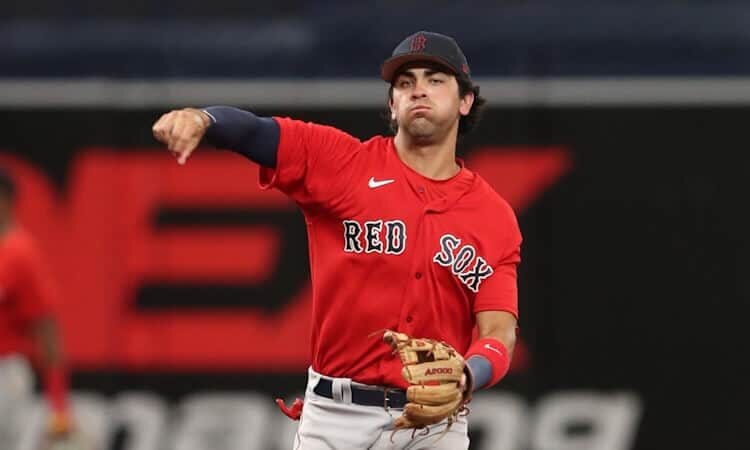
Marcelo Mayer, Boston Red Sox
A late-May call-up, Boston’s #3 prospect behind Roman Anthony and Kristian Campbell, Mayer exceeded rookie eligibility by just six plate appearances before going down with an injury. That sample is too small to take much from, but his hard hit (51.7%) and barrel (9.2%) rates were decent, resulting in a solid 90mph average EV, despite a well below-average 108.7 max EV. That narrow gap indicates that he was getting to his limited power with similar efficiency to Mike Yastrzemski, Alec Bohm, Trent Grisham, and Dansby Swanson. Mayer showed a good 74.1mph bat speed to back that up and hit a ball 111.2 in AAA, suggesting closer to average power
Verdict: Sleeper
Mayer is penciled in as the starter at third base, and I feel better about what Mayer is doing right already and his playing time outlook compared to the names below. Manager Craig Breslow has also said he thinks Mayer can play anywhere on the infield, so there’s a chance he gets reps at 2B or SS too. Trevor Story has not been a pillar of good health, and Romy Gonzalez is currently listed as the starting second baseman. Even if the Sox trade for someone like Isaac Paredes, Mayer could take the second base job.
Coby Mayo, Baltimore Orioles
After trading Ryan O’Hearn at the deadline to open the door for Mayo to see regular playing time, the O’s slammed it shut by signing Pete Alonso to a five-year deal this offseason. A top prospect for his power, Mayo never reached even a 110 mph maximum exit velocity on a ball in 2025, even with a decent 10% barrel rate.
Verdict: Cautious dynasty buy-low
Mayo hit balls hard enough to earn a 70 power grade in the minors and did bring his K rate down to the high 20s when he did get more regular run later in the year. There’s not much else encouraging in his 2025 line, though, and no job might mean his owner has soured if they’re more competitive. If you can afford to sit on him and don’t have to pay his prospect price, he’s worth a flyer.
Alejandro Osuna, Texas Rangers
Player A: 87.3 avEV, 109.8 max, 10% Barrel, 35.8% HH
Player B: 88.9 avEV, 110.2 max, 5.9% Barrel, 37% HH
Not much of a mystery as they’re the two players I’m talking about, Player A is Mayo, and Player B is Alejandro Osuna, owner of a 50 power grade per FanGraphs, two full grades lower than Mayo, who put up an almost identical line in terms of quality of contact to the much-touted Oriole. It says more about Mayo than it does Osuna, as both are below average for MLB hitters.
More of a backend/honorable mention type prospect, injuries created an opportunity for Osuna to jump to the big leagues earlier than expected. He struggled to consistently make good contact, resulting in a .264 BABIP and similarly poor average, but he did make contact (19.3% K rate, 91.3% zone contact) as a 22-year-old with only 15 games at AAA. His exit velocities still showed just below-average power, and he walked almost 12% of the time. That might be a side effect of watching too many pitches go by (44% swing), which isn’t surprising for a rookie who jumped a level and hasn’t seen much big league quality stuff.
Verdict: Deep Dynasty Stash
The off-season acquisition of Brandon Nimmo pushed Osuna to a 4th outfielder role and maybe a trip back to AAA. Hard to roster in shallow leagues or non-dynasty, but his first taste of the majors didn’t have many of the common pitfalls. Making poor contact with big league stuff is still more encouraging than swinging through it. I think when he’s seen more pitches, he’ll start attacking more and get closer to his .271 xBA. Combine that with walks and 80th percentile speed, and you’ll have a useful player; the question is when.
Kristian Campbell, Boston Red Sox
Campbell looked like the Rookie of the Year front-runner after a hot start in April, but cooled to the point of demotion in June. Like Osuna, a poor barrel rate and a large gap between his average and max EV point to a lot of bad contact, though he didn’t make as much, and more than half was into the ground. He still showed plus bat speed and a good eye, which should lead to better results.
Verdict: Medium league stash
Campbell’s role is also uncertain, but he has the versatility to play outfield or second base, though he didn’t grade well there in his debut. Reports out of winter ball are that he was focused more on swing adjustments. Like Mayo and Osuna, you need to be ready to use a bench spot on him as his playing time is far from guaranteed, but his outlook is better.
Brady House, Washington Nationals
Once a top-50 prospect, Brady House was still in or around the top 100 of most lists last year. FanGraphs listed him 4th on the team in July with a 45+ projected future value and one glaring weakness in his grades: Hit tool, especially against breaking balls. This showed up in 73 games with the Nationals in a 36.8% chase rate and 2.9% walk rate. That said, his 28.5% strikeout rate was in line with his high-minors numbers, unlike a lot of prospects in their debuts (See: Coby Mayo).
As for what went right, House had a solidly above average 46.3% hard hit rate and 111.5mph max EV. His average exit velocity was a little more middle of the road, just shy of 90mph, suggesting he also made some bad contact when he wasn’t whiffing 31% of the time. His defense was also good at the hot corner, suggesting he’ll get some run on a still rebuilding Nats roster.
Verdict: Deep Leaguer
The projections aren’t exciting, and even if I’d expect the higher end of the range, teens power and non-zero steals with a .245 average and sub-300 OBP is only playable in 16+ team leagues, preferably in a CI slot. The upside here is in the playing time, so he might be a good value in NL-only leagues.
There’s a lot of playing time and adjustment concerns, but expectations for these players haven’t changed as much as their perceived value.
Fantrax is one of the fastest-growing fantasy sites in the fantasy sports industry, and we’re not stopping anytime soon. We are the most customizable, easy-to-use, and feature-rich platform in the industry, offering the greatest fantasy experience for your dynasty, keeper, redraft, and best ball leagues. Fantasy sports doesn’t sleep, and neither does Fantrax, with seasons running 365 days a year. Take your fantasy leagues to the next level now at Fantrax.com!