
In my ongoing quest to quantify pitch recognition, I asked Duke, who runs Prospect Savant, if he could add swing rates by pitch type to the site, and he did! This can be found in the Pitch Type Performance box if you scroll over. You also get quantity data and xBA, xSLG, and xwOBA for each pitch. We’ll see why that’s important very soon.
Pitch Recognition and Pitch Type Discipline
Swing Rate per Pitch Type
I took an export of this data and threw it into a sheet, as ya do. I started by bucketing pitches by broad type: Fastballs (4-Seamers, Sinkers, and Cutters), Off-speed (Changeups, Splitters), and Breaking Balls (Sliders, Sweepers, Curves). For now, I’ve left out all the other pitch types because they don’t make up more than a couple percent of the pitches a batter sees. After mathing these buckets by number of pitches, I subtracted the player’s overall swing rate from their pitch-type rates to get how much more or less they swing at each bucket.
Fastball Hunters
First, we’ll look at the players who hunt fastballs. In general, these are the pitches they can do the most damage on as they move the least, and their speed contributes to exit velocity. I took out players over 25 since I’m looking for true prospects, and limited the list to players with above-average ev90 values (104+) because I don’t have AAA swing speed, and how much you should hunt fastballs changes if you don’t swing hard.
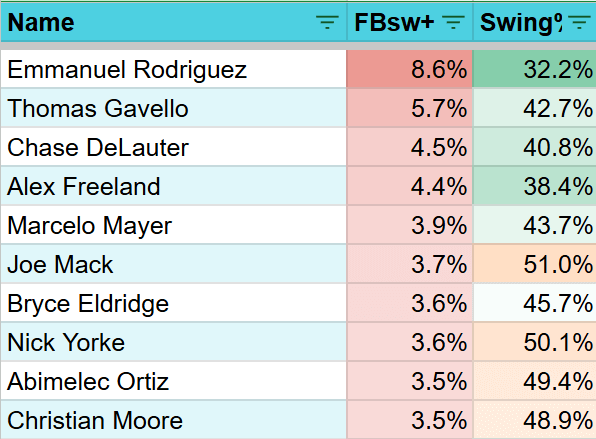
This list is almost all current or former top100 prospects. More such names with positive values after this include Kyle Teel, Max Muncy, Coby Mayo, Luis Matos, Brady House, Dalton Rushing, Sal Stewart, and Moises Ballesteros. Travis Bazzana and Kristian Campbell pop without the EV filter. That’s a pretty good list to start things off.
Offspeed Avoiders
If swinging at fastballs is good, avoiding getting fooled by off-speed pitches is good, too, right? This one is a little trickier since if you know it’s coming, a change-up can look like a batting-practice fastball. I left the ev90 filter off here
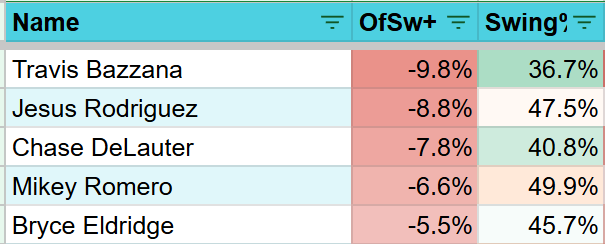
Mikey Romero is interesting here because he actually had a .300 xBA and .614 xSLG on change ups, yet still swung less often at them, suggesting he had a pretty good idea what they were when he did swing. Bazzana, DeLauter and Eldridge are just adding to the confirmation bias.
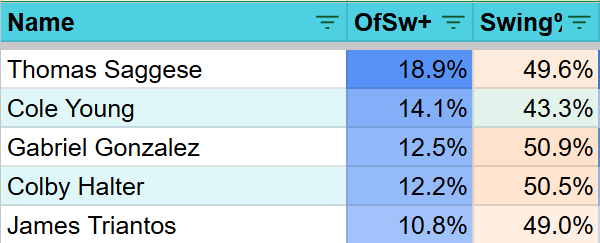
Cole Young does seem to get fooled by change ups, swinging at +9.4% on them with awful results, but he swung at 77% of splitters he saw, and actually did pretty well with a .329 xBA, so the bucketing isn’t helping here. So you definitely have to check the profile before judging a player too harshly
Bendy Bois
Laying off the big breaking pitches should be a bit more universally good
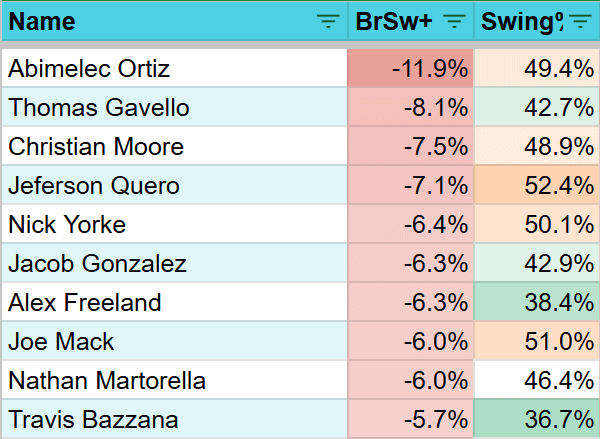
Not as strong a list, some of these players are pretty anonymous, but it’s encouraging to see Moore, Quero, Freeland, Mack, and Bazzana here. Sal Stewart, Kristian Campbell, and Max Muncy aren’t far off either.
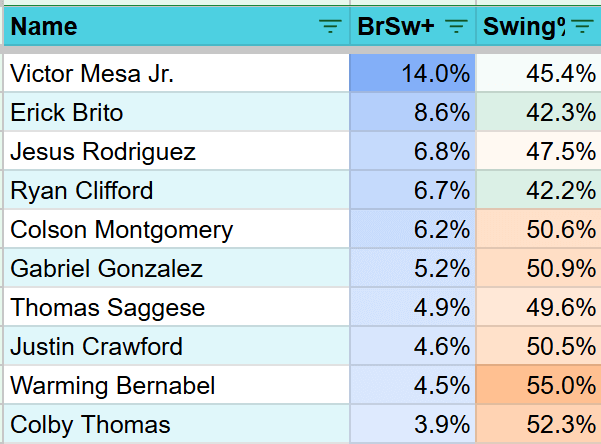
The flipside is a bit stronger in terms of “Yeah, these guys can’t hit” vibes. I think we can say that this is a definite red flag.
Putting it All Together
So what do we do with this now? Well, last week we talked about Seager, which combined swinging at pitches in the zone and avoiding chase. What if we did the same thing here?
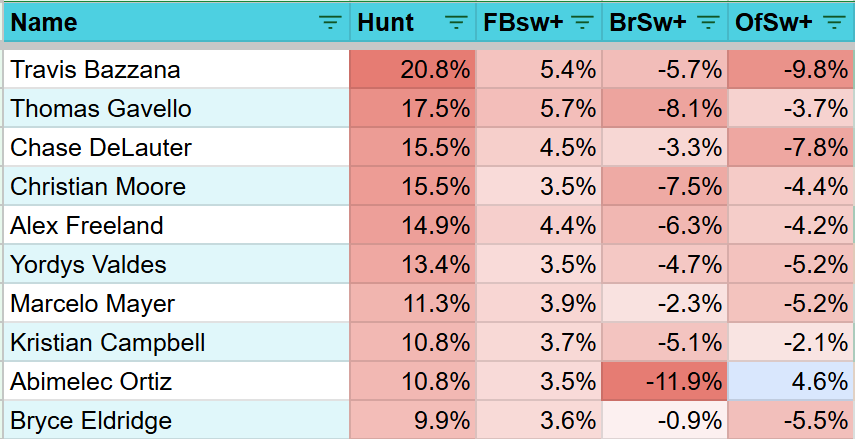
- Did Jeff make up another new composite stat? Yeesh
I didn’t filter this one and am again encouraged by seeing Does-Not-Chase DeLauter here, along with Bazzana and Eldridge, who has some strikeout concerns. Gavello and Valdes are poor at SEAGER but are at least type-disciplined, showing that there is a distinction between knowing pitches and knowing the zone.
We Need to Talk about Abimelec Ortiz
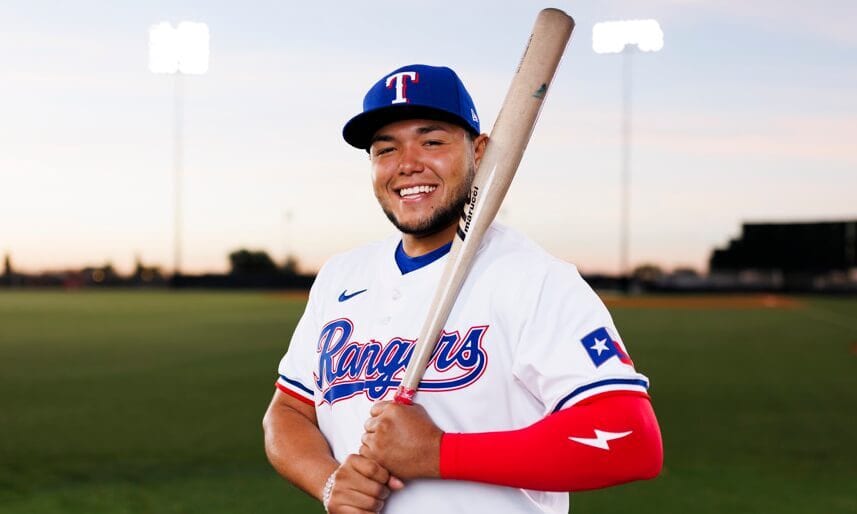
You might’ve noticed that Ortiz was on all the “good” lists, and I hadn’t mentioned him yet. To be honest, I didn’t know who he was until I was researching the STOWER piece because he kept showing up there. He had a 102.9% STOWER, showing he already had a selective aggressiveness on balls and strikes. Now he shows even stronger selectiveness on pitch types.
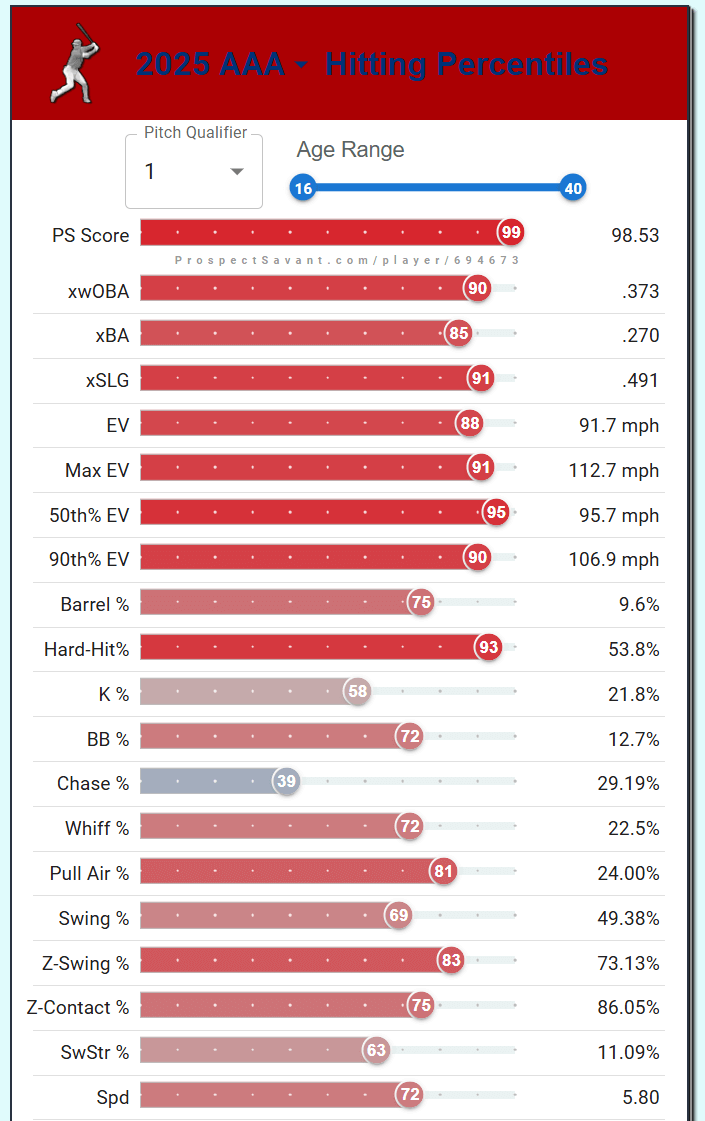
- Seeing Red on Prospect Savant
The only concern here is Chase%, which is just on the fringe of problematic, but brings plenty of contact and borderline plus power along with it. FanGraphs had him 28th on Texas’ org list last June when he was still at Double-A. His 35+ FV is dragged down by a 35/40 hit tool they hung on him, along with below-average defense and 20-grade speed. I can’t speak to the defense at first, and at 5’10” 230, you wouldn’t expect 72nd percentile sprint speed. Judging him by his good swing decisions and the consistent quality of contact, what he’s shown would translate to a hit tool that’s a full grade or two better than they gave him. I don’t need to tell you how going from below average to pushing plus on hit tool can change a player’s profile, especially when the raw power is already there.
The report notes a vulnerability to sliders, which Statcast supports with a .166 xBA and .235 xSLG, but with swing data, we see that he’s good at laying off with a 39.6% swing rate (average is around 45%). The Nationals acquired him in the MacKenzie Gore trade and have Luis Garcia Jr. listed as their top first baseman. Garcia is also listed as their starting second baseman, so I don’t know how that’s supposed to work. Besides Garcia and Ortiz, it’s Andres Chaparro, Yohandy Morales, and Matt Mervis… I think Ortiz might come out of spring with a job. Sleepers are hard to find these days, but he might just be one you can get with the last pick of your draft, or for $1 off the wire.
The Other Side
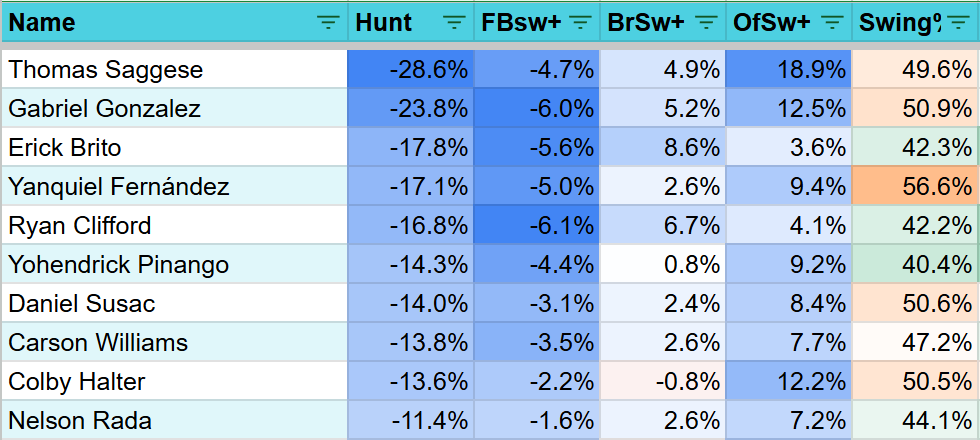
Oof, that’s bad company. Duke said he was the leader of the “Carson Williams can’t hit” club, and I don’t know when he took the title from me, but we’re sharing a smug glance seeing him here.
I don’t have as easy access to this data to look at the major leagues as a whole, but FanGraphs does have this on individual player pages under Pitch-Type Splits. I took a look at Corey Seager as the patron saint of pitch selection, and he swings almost the same amount at every pitch type… so I looked at Juan Soto instead. He swings around 37% of the time, around 40% for fastballs, and ~34% for sliders and change-ups. You can’t fool him with a curveball, swinging at only 27% and chasing 8.4%. Oneil Cruz is a guy I wanted to look at on the opposite end, and while he’s decent at laying off curve balls, everything else he swings at within 2% of his baseline rate.
In Conclusion
I don’t think I’m gonna be stumping to get Hunt added to the stat canon, but pitch type discipline is a weapon we can add to the arsenal when statline scouting a prospect. Just calibrate it to their overall swing rate and how they handle those pitch types before you go shooting holes in their profile. Oh, and go get Abimelec Ortiz.
For more of the great fantasy baseball rankings and analysis you’ve come to expect from FantraxHQ, check out our full 2026 Fantasy Baseball Draft Kit! We’re here for you all the way up until Opening Day and then on into your championship run.
Fantrax is one of the fastest-growing fantasy sites in the fantasy sports industry, and we’re not stopping anytime soon. We are the most customizable, easy-to-use, and feature-rich platform in the industry, offering the greatest fantasy experience for your dynasty, keeper, redraft, and best ball leagues. Fantasy sports doesn’t sleep, and neither does Fantrax, with seasons running 365 days a year. Take your fantasy leagues to the next level now at Fantrax.com!