

Pitching isn’t easy. The first month of the season is always going to be difficult as pitch counts are still being built up. Not only are pitchers still finding their groove, but the weather is an issue, and opposing offenses are still making themselves known. Seeing results on the field is one thing, but finding supporting data to back up the success takes things to the next level. Let’s dig into the advanced pitching stats of three pitchers whose ERAs are showing a real disparity with their FIPs.
Fantasy Baseball Advanced Pitching Stats
Is Gore Headed to the All-Star Game?
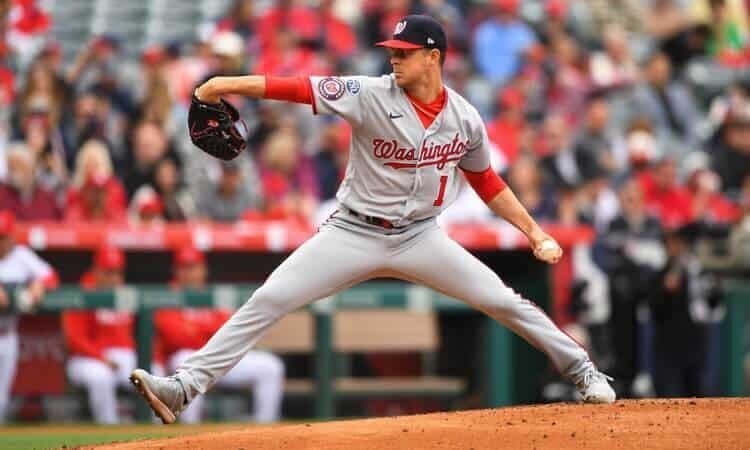
MacKenzie Gore was drafted third overall in 2017. While that is eight years ago, high school pitchers, especially left-handers, do take a long time to develop. There’s a clear difference between dominating over-matched hitters in high school and in facing established professional hitters. The thing with Gore, though, is that his talent, tools, and upside were never in question. After all, he was a large part of Washington’s return for Juan Soto.
In making 32 starts last year, Gore turned in a solid performance. He struck out 9.79 batters per nine innings and finished with a 3.90 ERA. A 3.53 FIP offered up a little more upside, but walks were still an issue for Gore. However, it truly was a step in the right direction for the southpaw.
Through his first six starts of 2025, Gore has built on that success while taking things to the next level. He’s now striking out 13.63 batters per nine innings, and that’s the flashiest piece of his season. His first pitch strike rate is up to 60.6% while his swinging strike rate is up to 14.8%.
Gore isn’t a ground ball pitcher, 32.5% on the season and 38.3% for his career, so things are often a little bumpier. The best development is seeing Gore bring his walk rate down to 2.31 per nine innings. This is part of the reason why, despite a .368 BABIP, his ERA sits at 3.34. However, it’s the disparity between that and his 2.01 FIP that highlights a buying opportunity. The strikeout upside fits on any fantasy team, and the difference between his ERA and FIP generates more optimism.
Has Liberatore Found It?
We’re going with a theme this week as Matthew Liberatore is another left-handed pitching prospect who was traded and has taken a bit to develop. In 2025, Liberatore received a rotation spot at the start of the season and, to this point, he hasn’t disappointed.
For a pitcher who had minimal, at best, fantasy value to begin the season, it’s hard to argue with a 3.19 ERA. Opposing hitters are batting just .235 against Liberatore, but given the 10th highest ERA to FIP difference, at the very least this level of performance appears sustainable. At 1.87, his FIP represents a pretty substantial ceiling.
Through five starts, Liberatore is striking out a career high 8.13 batters per nine innings, but more impressively, is his 0.58 walks per nine innings. Along those same lines, Liberatore is also allowing just 0.29 home runs per nine innings. With a barrel rate of just 5.5%, the left-hander is doing a great job of keeping hitters off balance.
Does Verlander Have Something Left?
On the opposite end of the career spectrum, we have Justin Verlander. In 90.1 innings last year, it was a rough go for the veteran who finished with a 4.99 ERA. For as rough as things were for the right-hander, he did have a 3.78 xERA and 4.78 FIP.
While Verlander is heading for the Hall of Fame five years after he retires, it’s clear that he’s not the same pitcher he was in his prime. We have to be fair, though, as at this point in his career, expectations need to be recalibrated. However, that doesn’t mean we should write Verlander off from a fantasy perspective. Maybe he is just a step above a streamer as a back-end of the rotation option, but there’s value in that.
Through six starts, his ERA does sit at 4.99, but a 3.85 xERA and 4.11 FIP do point to that upside. He’s striking out over eight batters per nine innings, and Verlander didn’t forget how to pitch.