
Pitching isn’t easy. The first month of the season is always going to be difficult as pitch counts are still being built up. Not only are pitchers still finding their groove, but the weather is an issue, and opposing offenses are still making themselves known. Seeing results on the field is one thing, but finding supporting data to back up the success takes things to the next level. Let’s dig into the advanced pitching stats of three pitchers whose ERAs are showing a real disparity with their FIPs.
Fantasy Baseball Advanced Pitching Stats
Don’t Rush to Judgment on Houck
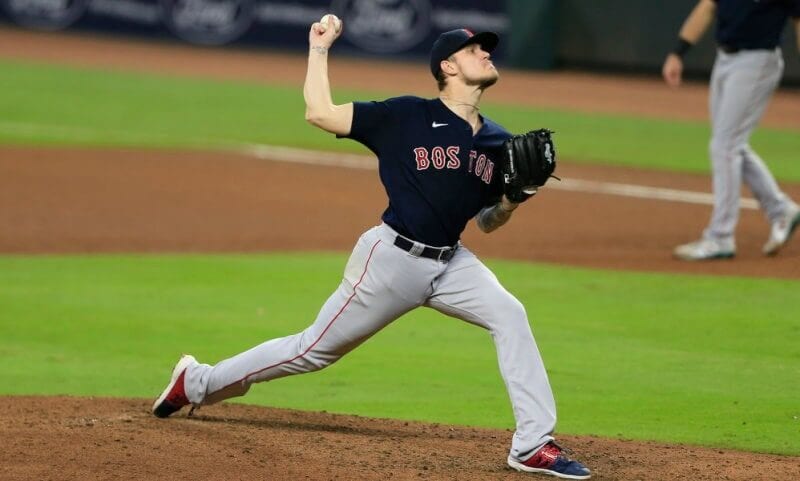
It stinks. The damage is already done, and quite frankly, it’s ugly. Looking at your roster, Tanner Houck and his 6.38 ERA jump off the page at you. In fact, that might be putting it mildly. What it really does is smack you in the face and tell you to get it off your team. Instead, the opposite should be true. Not only should you hold on to Houck, but instead, you should be adding him to your rosters.
We know how difficult it can be to find good pitching, and Houck isn’t one to be discarded. Yes, his ERA is unsightly, but there are multiple indicators that it will be moving in the opposite direction. For the purposes of this exercise, Houck has the sixth-largest difference between his ERA and 5.14 FIP. If you take things a step further, Houck’s 4.58 xERA and 3.93 xFIP both point to better days ahead. This is why we should be buying and holding on to Houck as opposed to selling and dropping the right-hander.
Ultimately, Houck needs to keep the ball in the park. With 1.72 home runs allowed per nine innings, it’s no surprise that he’s having issues. It’s about a home run per nine innings higher than his career average, but again, we’re talking about just 36.2 innings. The average fastball velocity is there, at 95.1 miles per hour, which is also a nice increase compared to last year’s 93.8. With 7,36 strikeouts per inning, along with about three walks, you’d like to see Houck be more overpowering, but the results generally have been solid. With a 6.6-degree average launch angle, Houck does a good job of limiting potential issues; despite the home runs.
Did San Francisco Do it Again?
If so, it just took another season for Jordan Hicks to find his groove with the San Francisco Giants. So far this season, Hicks appeared to be on the right rack, but then things didn’t take the best turn. Now, we are left to search for upside. The good news is that the disparity between his 6.03 ERA and 3.38 FIP provides that.
In his first season as a starter last year, things actually went the other way for Hicks. He did a solid job transitioning and finished with a 4.10 ERA (4.37 FIP and 4.91 xERA). This year, Hicks’ 3.51 xERA also points to better days being ahead. The biggest culprit is appears to be Hicks’ 57.2% strand rate, although his .333 BABIP against doesn’t exactly help. Walking 3.62 batters per nine innings doesn’t exactly help, but things could be worse. Hicks is striking out over eight batters per nine innings and with just 0.48 home runs per nine innings, the right-hander is keeping the ball in the park.
When looking at future success for Hicks this season, it’s his 59.3% ground ball rate that jumps out. With a 3.4 degree average launch angle, hitters aren’t driving the ball against Hicks and his 4.4% opposing barrel rate means the quality of contact is weak as well. Despite the ugly ERA, Hicks should be a waiver wire target.
The Transition is Working
Prior to this season, Clay Holmes last started a game in 2018. In fact, his seven starts so far in 2025 are already three more than he previously had in his career. He was an All-Star closer with 74 saves in the last three years, but now, Holmes is a starting pitcher for the New York Mets.
Any concerns about Holmes’ transition to the rotation have been paused, at least for now. He’s averaging just over five innings per start, so a little more depth to his starts would certainly be an asset. However, this early in the season, do we need to get that picky?
Holmes has a 2.95 ERA, and between his 2.97 xERA and 2.16 FIP, optimism abounds. He has yet to allow a home run this season while striking out over a batter per inning. His 51.5% ground ball rate is down from his time as a reliever, but it’s still nothing to discount.