
The Minnesota Twins are entering an important new chapter under Executive Vice President and General Manager Jeremy Zoll, with an organization that has long understood the importance of developing talent from within. For dynasty fantasy managers, Minnesota remains a system worth studying because the Twins have consistently shown a willingness to give homegrown players meaningful opportunities at the major-league level.
DYNASTY BASEBALL: 2026 Minnesota Twins Top 20 Fantasy Baseball Prospects
That philosophy begins with an organization that has traditionally placed considerable value on the draft, player development, and finding ways to maximize players whose tools may not immediately jump off the scouting report. Rather than relying exclusively on premium physical traits, Minnesota has often built depth by identifying players with strong underlying skills, advanced approaches, and developmental characteristics that can translate as they move through the minor leagues, as you’ll see in the Twins’ Top 20 fantasy baseball prospects ahead.
Under Zoll, that developmental foundation becomes particularly important. The Twins need their farm system to do more than simply produce major leaguers—they need it to produce impact. That means continuing to develop hitters capable of controlling the strike zone while unlocking power, and helping pitchers turn raw stuff into weapons that can consistently miss major-league bats.
For dynasty baseball managers, opportunity is part of the appeal. Minnesota generally does not present the same level of roster congestion found in organizations loaded with expensive veterans at nearly every position. When a prospect proves he is ready, there can be a legitimate path toward playing time. That makes upper-level Twins prospects particularly interesting, while younger players with breakout tools can gain dynasty value quickly as their developmental progress becomes clearer.
There is also an element of transition that makes this system especially intriguing. Zoll is now tasked with shaping the next generation of Twins baseball, and the prospects moving through the organization will provide some of the earliest evidence of how that vision will take shape. Draft decisions, international investments, development gains, and future trades will gradually establish the identity of Minnesota’s baseball operation under his leadership.
That makes the Twins an organization worth monitoring closely for dynasty managers. The system should not be evaluated simply by how many recognizable names sit near the top of prospect lists. The more important question is which players Minnesota can turn into productive major leaguers—and which of those players possess the power, speed, bat-to-ball ability, strikeout upside, and opportunity necessary to become meaningful fantasy assets.
So, let’s begin with our countdown of the Minnesota Twins’ top 20 prospects.
#20 — Ethan Wachsmann | RHP (ETA 2030)
Minnesota landed Wachsmann in the 2026 MLB Draft, buying into the upside of a Colorado prep right-hander who had been committed to Wake Forest. He is one of the longer-term projects in this system, but the athleticism and physical projection make him an intriguing deep-league stash.
Wachsmann offers the ingredients dynasty managers should chase at the back end of a farm system: youth, velocity potential and considerable room for development. The downside is equally obvious, as teenage pitching carries enormous developmental and injury risk.
This is a player for patient managers in leagues with 200-plus prospects rostered rather than someone who needs to be grabbed everywhere immediately. If Minnesota develops the arsenal into legitimate starter stuff, Wachsmann could eventually make this ranking look conservative.
#19 — Khadim Diaw | C (ETA 2027)
The Twins selected Diaw in the third round of the 2024 Draft out of Loyola Marymount, betting on an athletic catcher whose experience behind the plate was limited. His development as a receiver has been important because remaining at catcher gives his bat a much easier path to fantasy relevance.
Diaw isn’t a classic bat-first fantasy catcher yet. There is some contact and power projection here, but much of his prospect value comes from the possibility that continued development turns a relatively raw player into a legitimate two-way backstop.
He is more interesting in two-catcher dynasty formats than shallow one-catcher leagues. The ceiling isn’t enormous, but catchers who can reach the majors and provide useful offense have a way of becoming considerably more valuable than expected.
#18 — C.J. Culpepper | RHP (ETA 2026)
Minnesota originally selected Culpepper in the 13th round of the 2022 Draft, and he has greatly outperformed that modest draft position. Now at Triple-A, he’s close enough to the majors that dynasty managers searching for near-term pitching depth should know the name.
Culpepper’s appeal comes more from proximity and a starter’s repertoire than overwhelming ace-level upside. He can attack hitters with multiple offerings and has developed enough to put himself on the doorstep of Minnesota’s rotation.
For fantasy purposes, think useful depth rather than a future rotation anchor. His relatively short ETA raises his value in deep leagues, especially for contenders who would rather roster a potential 2026 contributor than wait several seasons on a higher-risk arm.
#17 — Brett Renfrow | RHP (ETA 2028)
The Twins added Renfrow from Virginia Tech in the 2026 MLB Draft, targeting one of the more experienced college starters available. He brings a durable 6-foot-3 frame, extensive starting experience, and a broad arsenal rather than relying upon one overwhelming pitch.
Renfrow can work in the mid-90s and reach higher while mixing a slider, curveball, cutter, and changeup. That variety gives him a plausible starter’s foundation, although none of the secondaries currently screams future fantasy ace.
He profiles as a relatively polished pitching prospect whose floor may ultimately be more attractive than his ceiling. In dynasty leagues, he’s a watch-list arm who becomes much more interesting if Minnesota unlocks another gear in either his fastball or breaking stuff.
#16 — Ryan Gallagher | RHP (ETA 2027)
Gallagher entered Minnesota’s system at the 2025 Trade Deadline when the Twins dealt Willi Castro to the Cubs. Originally a sixth-round Cubs selection in 2024, he has moved quickly and already reached Triple-A.
He succeeds more through pitch quality, command, and sequencing than radar-gun fireworks. His fastball can play better than its velocity, while the slider and changeup give him legitimate weapons for missing bats.
Gallagher’s dynasty ceiling looks more mid-to-back-rotation than frontline starter, but proximity counts. Managers in deep formats should keep him nearby because a pitcher capable of providing innings, respectable ratios, and strikeouts can become useful quickly once an MLB opportunity arrives.
#15 — Adrian Bohorquez | RHP (ETA 2027)
Bohorquez might be one of Minnesota’s better scouting finds after signing with the organization as an international free agent in January 2023 for only $10,000. He has since developed from an unheralded arm into a legitimate pitching prospect.
His fastball leads a four-pitch arsenal, with multiple breaking balls giving him ways to attack hitters. The biggest question is whether his command and changeup become good enough for him to remain a starter as the competition gets tougher.
For dynasty managers, Bohorquez is exactly the type of lesser-known arm worth tracking before the broader fantasy market catches up. There’s meaningful risk, but his developmental trajectory gives him more upside than his original signing pedigree suggests.
#14 — James Ellwanger | RHP (ETA 2028)
Minnesota selected Ellwanger in the third round of the 2025 Draft out of Dallas Baptist, signing him for $1 million. The Twins were buying premium arm talent and projection despite some understandable questions surrounding command and an earlier elbow issue.
The attraction starts with a fastball that can flirt with triple digits and a curveball capable of generating plenty of empty swings. At 6-foot-4, Ellwanger also has the frame and athleticism to envision additional refinement.
This is a classic high-risk/high-reward dynasty pitching prospect. Improved strike-throwing could send him flying up rankings because the raw ingredients are starter-caliber; continued command trouble could instead steer that power arsenal toward the bullpen.
#13 — Hendry Mendez | OF (ETA 2026)
The Twins acquired Mendez from Philadelphia in the 2025 Harrison Bader trade, adding a young left-handed outfielder with advanced strike-zone control. He’s since climbed to Triple-A and has a realistic opportunity to reach Minnesota in short order.
Mendez makes contact, controls at-bats, and can hit the ball hard, but unlocking more game power remains crucial. Too much contact on the ground limits the fantasy ceiling of a player who isn’t expected to provide substantial stolen-base value.
There is still an everyday-outfielder outcome if he learns to elevate consistently. Dynasty managers should view him as a strong deeper-league target because his combination of youth, upper-level experience, and plate discipline creates both proximity and remaining upside.
#12 — Kendry Rojas | LHP (ETA 2026)
Rojas came to Minnesota at the 2025 Trade Deadline from Toronto in the Louis Varland/Ty France deal. He subsequently reached the majors in 2026, although elbow inflammation interrupted his season, so his ETA has effectively arrived.
The left-hander’s stuff has climbed substantially during his professional career, giving him a lively fastball backed by a slider and changeup. When healthy, the combination is good enough to project Rojas as a legitimate major-league starter rather than merely organizational depth.
Health is the reason he isn’t higher on this dynasty list. Pitching prospects already carry volatility, and arm trouble adds another layer, but healthy versions of Rojas have enough strikeout potential to make him an appealing young fantasy starter.
#11 — Brandon Winokur | SS/3B/OF (ETA 2028)
The Twins took Winokur in the third round of the 2023 Draft and paid him $1.5 million to bypass UCLA. At 6-foot-5 with unusual athleticism for his size, he remains one of the most physically gifted players in Minnesota’s system.
The fantasy attraction is obvious: Winokur owns big raw power and plus speed, producing the ingredients for impact home-run and stolen-base totals. His versatility is another bonus, with experience at shortstop, third base, and the outfield.
Everything hinges on the hit tool. If Winokur improves his barrel consistency enough to reach his power regularly, he has enormous dynasty upside; if not, the strikeouts could prevent those spectacular physical tools from translating into an everyday MLB role.
#10 — Carson Tinney | C (ETA 2028)
Minnesota selected Tinney 43rd overall in the second round of the 2026 Draft out of Texas. The 6-foot-4, 240-pound catcher immediately gives the system another potentially impactful offensive backstop alongside Eduardo Tait and Vahn Lackey.
Tinney’s carrying tool is legitimate plus raw power, with the strength and swing path to punish mistakes to the pull side. His strong throwing arm gives him a chance to remain behind the plate, although both his receiving and overall athleticism require continued work.
Dynasty managers need to accept substantial batting-average risk because swing-and-miss is the red flag. Still, a catcher capable of producing 25-plus home runs can be extremely valuable, making Tinney one of the better upside gambles in Minnesota’s suddenly loaded catching pipeline.
#9 — Charlee Soto | RHP (ETA 2028)
The Twins drafted Soto 34th overall in the 2023 Competitive Balance Round A, pairing him with Walker Jenkins at the top of that class. His development was interrupted by elbow bone-spur surgery, but the electric arsenal remains very much intact.
When healthy, Soto can bring serious velocity, including upper-90s heat, while his slider and changeup both possess swing-and-miss characteristics. That three-pitch combination gives him one of the higher pitching ceilings in the organization.
The dynasty equation is therefore ceiling versus durability. Soto could develop into a strikeout-heavy mid-rotation starter or better, but fantasy managers shouldn’t ignore the developmental time and previous elbow trouble attached to a young power arm.
#8 — Riley Quick | RHP (ETA 2028)
Minnesota used the 36th overall selection in the 2025 Draft on Quick after his career at Alabama. The massive 6-foot-6, 255-pound right-hander was once a highly recruited offensive lineman before choosing baseball, and his physicality jumps off the page.
Quick sits in the upper 90s with a heavy fastball and pairs it with a potentially devastating slider, while his changeup gives him a third weapon. That combination has already produced plenty of strikeouts during his first professional season.
Command and workload will determine whether Quick reaches his considerable ceiling. For dynasty purposes, he’s one of Minnesota’s most exciting pitching prospects because a starter with this combination of size, velocity, and bat-missing secondaries could eventually become a significant strikeout asset.
#7 — Quentin Young | SS/3B (ETA 2029)
The Twins selected Young 54th overall in the second round of the 2025 Draft after the California prep infielder reclassified into that year’s class. He also carries impressive baseball bloodlines as the nephew of former major leaguers Dmitri and Delmon Young.
At 6-foot-6 and 225 pounds, Young offers enormous raw power and one of the strongest infield arms in the system. There aren’t many teenage hitters with this combination of size and impact potential, which makes his ultimate offensive ceiling fascinating.
Contact is the separator between star and disappointment. Young is still years away and carries substantial hit-tool risk, but dynasty baseball rewards betting on rare ceilings, and a middle-of-the-order outcome makes him worth considerably more to fantasy managers than his ETA might suggest.
#6 — Gabriel Gonzalez | OF (ETA 2026)
Gonzalez originally signed with Seattle in 2021 before Minnesota acquired him in the Jorge Polanco trade ahead of the 2024 season. Still only 22, he has worked his way to Triple-A and is again knocking on the major-league door.
His best attribute is an impressive ability to put the bat on the baseball. Gonzalez combines that contact skill with strong exit velocities and a powerful throwing arm, though an aggressive approach and ground-ball tendencies have sometimes suppressed his offensive production.
The dynasty upside depends upon turning hard contact into more home runs. If he elevates consistently while maintaining his contact ability, Gonzalez could become a useful everyday fantasy outfielder; the proximity makes that possibility particularly appealing right now.
#5 — Marek Houston | SS (ETA 2027)
Minnesota selected Houston 16th overall in the first round of the 2025 Draft out of Wake Forest. Initially viewed primarily as an outstanding defensive shortstop, he has raised his prospect stock by showing that his offensive game may have been underestimated.
Houston combines excellent defense with plus speed, strong strike-zone awareness, and improving offensive production. The power may never become his defining tool, but his ability to reach base and run gives him multiple paths toward fantasy usefulness.
The stolen-base potential is particularly interesting for dynasty managers. If Houston’s improving bat proves legitimate, he could develop into a high-average, high-OBP shortstop who contributes plenty of runs and steals while moving through Minnesota’s system relatively quickly.
#4 — Emmanuel Rodriguez | OF (ETA 2026)
Minnesota signed Rodriguez as an international free agent out of the Dominican Republic in 2019 for $2.5 million. Injuries have repeatedly slowed his path, but when Rodriguez has actually been on the field, his offensive upside has remained among the best in the organization.
Rodriguez brings tremendous raw power, exceptional patience, and enough athleticism to contribute stolen bases. His ability to draw walks can make him especially valuable in OBP dynasty formats, while the huge exit velocities hint at 30-homer upside if everything comes together.
Durability and strikeouts remain the obvious concerns, but Rodriguez is now in Triple-A and nearing Minnesota. Few prospects offer this combination of power, patience, and speed, so his fantasy ceiling remains enormous despite a developmental path that has required considerable patience.
#3 — Eduardo Tait | C (ETA 2028)
The Twins made Tait the centerpiece of their return when they traded closer Jhoan Duran to Philadelphia at the 2025 deadline. Still just 19, the left-handed-hitting catcher immediately became one of the highest-upside offensive players in Minnesota’s organization.
Tait’s fantasy calling card is his bat. He produces hard contact, has legitimate plus power, and already demonstrates the ability to drive pitches beyond the fence to different parts of the field, giving him tremendous offensive potential for a catcher.
His defense is still developing, but dynasty managers shouldn’t be overly frightened by a future position change because the bat can carry the profile. If he remains behind the plate, however, Tait has a chance to become one of fantasy baseball’s most valuable offensive catchers.
#2 — Vahn Lackey | C (ETA 2028)
Minnesota used the No. 3 overall pick in the 2026 Draft on Lackey after his monster junior season at Georgia Tech. The selection made him the first catcher to be Minnesota’s first pick in a draft since Joe Mauer in 2001 and immediately installed him among the organization’s premier prospects.
Lackey combines an advanced hit tool with plus power, patience, athleticism, and a strong throwing arm. He hit .397/.519/.772 during his final college season, and his ability to make consistent contact while driving the baseball gives him considerably less offensive risk than the typical catching prospect.
That’s an outstanding dynasty package at a premium position. A catcher capable of hitting for average, reaching base at a high clip, and eventually producing 20-30 homers has difference-making fantasy potential, and Lackey’s college polish should allow him to move faster than most newly drafted players.
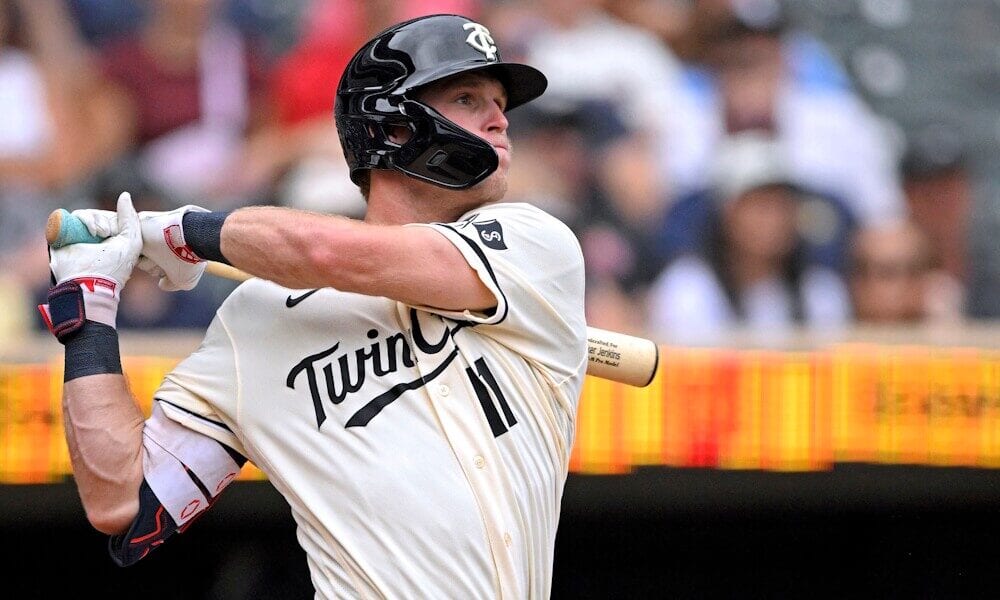
#1 — Walker Jenkins | OF (ETA 2026 – Just got called up!)
The Twins landed Jenkins with the fifth overall pick of the 2023 Draft out of South Brunswick High School in North Carolina, signing him for more than $7.1 million. Three years later, he remains Minnesota’s premier prospect and one of baseball’s most appealing young dynasty assets.
Jenkins has the offensive foundation fantasy baseball managers dream about: an advanced left-handed hit tool, excellent strike-zone control, burgeoning power and enough speed to contribute on the bases. His combination of contact and patience gives him an unusually high floor for a player who still possesses substantial ceiling.
Now at Triple-A, Jenkins is knocking loudly on Minnesota’s door after hitting around .290 with a near-.400 OBP in 2026. The power could continue climbing as he matures, creating the potential for a future fantasy cornerstone capable of helping in average, homers, runs, RBI, and steals. He’s the clear No. 1 dynasty prospect in this Twins system.
Make sure to check out the rest of our 2026 MLB organizational Prospect Rankings!
Final Thoughts
Minnesota’s system offers an appealing blend of near-term opportunity and long-term upside, with Walker Jenkins clearly leading the organization as a potential dynasty cornerstone. Emmanuel Rodriguez and Gabriel Gonzalez provide additional 2026 impact possibilities, while Vahn Lackey, Eduardo Tait, Marek Houston, and several high-upside arms give the farm system considerable depth beyond the immediate wave.
For dynasty managers, the key is balancing proximity against ceiling. Minnesota has several prospects who could contribute soon, but some of the system’s biggest potential risers remain years away and carry meaningful hit-tool, command, or durability risk. Given the Twins’ willingness to create opportunities for homegrown talent, this remains a farm system worth monitoring closely for both immediate contributors and future dynasty breakouts.
Fantrax is one of the fastest-growing fantasy sites in the fantasy sports industry, and we’re not stopping anytime soon. We are the most customizable, easy-to-use, and feature-rich platform in the industry, offering the greatest fantasy experience for your dynasty, keeper, redraft, and best ball leagues. Fantasy sports doesn’t sleep, and neither does Fantrax, with seasons running 365 days a year. Take your fantasy leagues to the next level now at Fantrax.com!