
In evaluating baseball statistics for use in fantasy baseball, we focus on predictability and stickiness. We want to know what data points help us project future performance and filter out the noise, or identify “luck” factors.
These criteria struggle with stats that are at least partly decision-based. These “soft” skills can fluctuate as a player’s approach changes, and they’re not always strictly “bad” or “good” but related to another skill. It’s intuitive that a player with excellent contact and not a lot of power should swing more, while a power hitter should be more patient and take big hacks. So you see all combinations of these metrics that work as a successful MLB hitter. Well, almost all…
Chase Rate and Zone Contact
- The Chase/Contact cliff
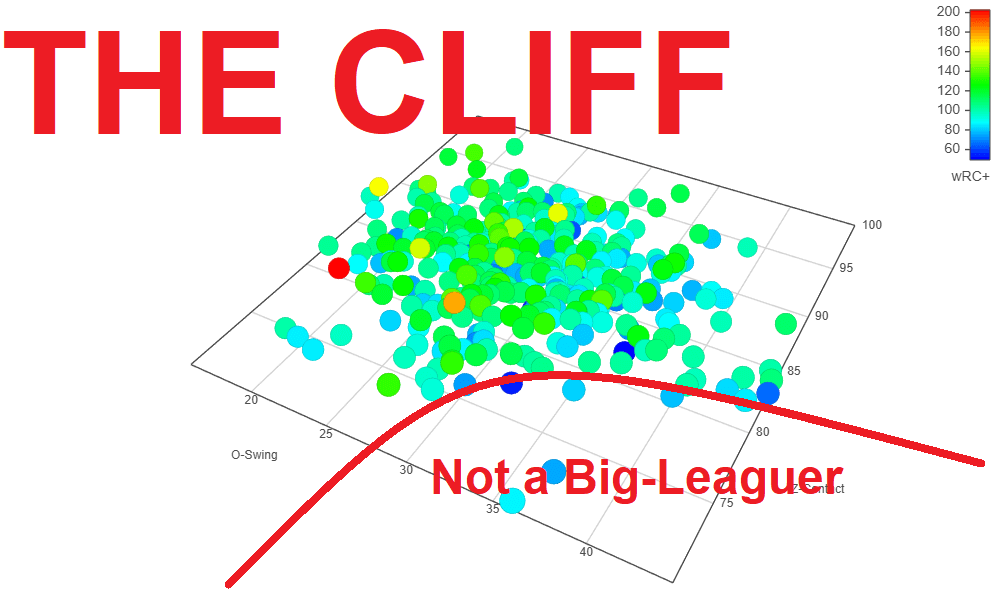
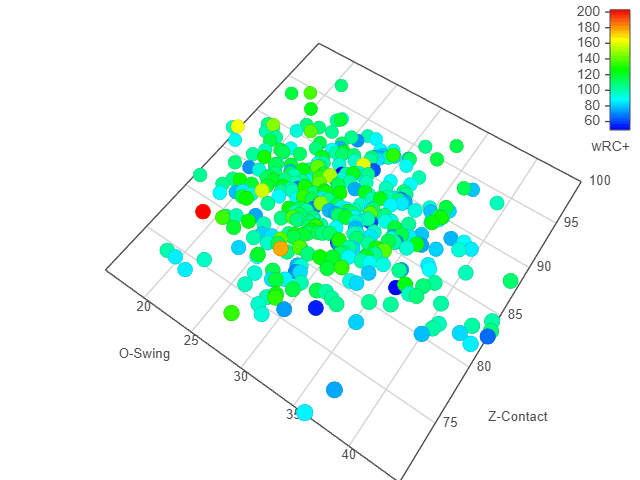
Sometimes you have to chart the data to see a void like this. These are all players with 600+ PA over the past three seasons, charting chase rate, and zone contact per Statcast (there are multiple sources for these stats, so what you see in different places may vary).
What we see in this chart about Z-Contact is that some of the most valuable hitters are below average. Aaron Judge (77.9%), Shohei Ohtani (79%), Kyle Schwarber (78.8%), and Rafael Devers (75.7%) are all under 80%. The third-worst player at this is Matt Wallner (72.8%), and he produced a 133 wRC+. These players have something else in common, though: they don’t chase a lot. Devers is the worst of the bunch at 29.2% over that time.
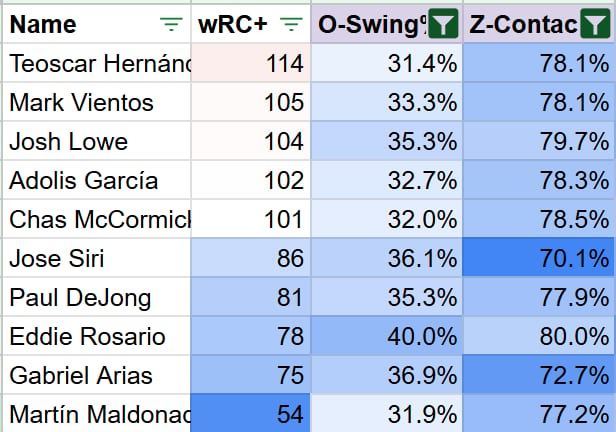
There are also plenty of successful big leaguers who chase over 30% of pitches. Jose Altuve, Josh Naylor, and Bo Bichette all produced above-average chase rates over 35%, but they all made well-above-average contact on strikes. In fact, there are only 10 players out of 365 in the group to combine 30%+ chase with sub-80% z-contact rates.
- OOF
Teoscar is the only player of the 10 to be over 100 wRC+ in each of those three seasons. The other four were buoyed by single strong seasons. When I looked at single seasons, I found that players either improved in one or the other stat or fell off a cliff. My narrative reason for this is that pitchers start feeding these guys a steady diet of junk once the scouting report gets out on them. The other names are defensive specialists and the tail end of Eddie Rosario’s usefulness.
Prospects
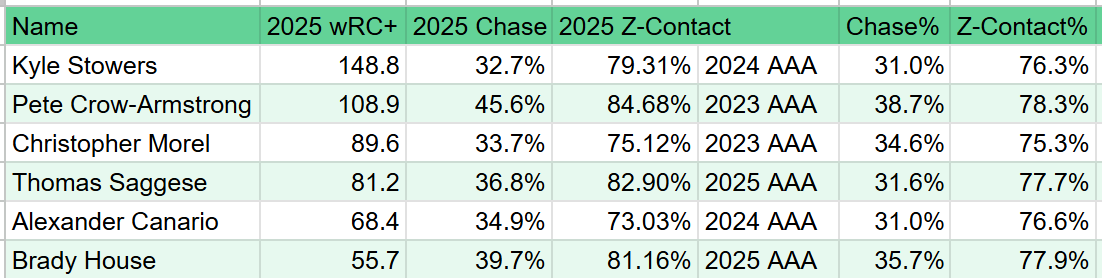
I started this data delve in search of the elusive Pitch Recognition. This is something scouts will talk about – the ability to pick up spin – but it is difficult to tease out of the stats we have. I figured that getting fooled would result in both zone whiffs and chase, but neither worked on its own, or even combined, because there was such strong selection bias against them in the majors. So I took a look at these stats for minor leaguers. Here’s every prospect who had it in a season at AAA over the past three years that recorded at least 200 PAs in 2025:
- It’s a short list
Stowers, Saggese, and PCA made notable improvements on the contact side, and Morel and PCA are the furthest removed from pretty small AAA samples in 2023. They both got thrown into the MLB fire pretty quickly after 60 or fewer games at the level, not even enough time to adjust to the better pitching there. The fact that they stuck at all is impressive, but there’s well-warranted skepticism about both as hitters.
Stowers had more run at AAA and struggled mightily in his debut, but seems to have adjusted well in 2025, and when you also look at his walks, EVs and especially a 19% barrel rate (5th in MLB) he looks more like the premier power hitters than the flame outs, but it really is a knife’s edge.
Looking to the future, notable list prospects who fell on the bad side of the thresholds in AAA in 2025 include Spencer Jones (35.3%, 67.2%), Carson Williams (30.2%, 75.5%), Devyison De Los Santos (35%, 78%) Jhostynxon Garcia (35%, 76%) and Joe Mack (30%, 75.6%). Devy and Williams are right on the edge and could go either way. Mack is a Catcher with plus defense, but there simply are no big leaguers as bad at both as Spencer Jones and The Password. The cautionary tales you might recognize with them in AAA are Khalil Watson, Rece Hinds, MJ Melendez, and Jarred Kelenic.
Conclusion
Too much chase and too much in-zone whiff aren’t strictly bad, but in combination, they are a big red flag. There’s a cliff where they intersect. Devers, Stowers, Brandon Lowe, Oneil Cruz, and Cal Raleigh are all standing right on the edge. I haven’t pushed into adding 3rd and 4th factors – that starts getting into “Build a model” territory – but those guys all hit the ball hard (106+ ev90) and, aside from Cruz, in the air. Devers is the only one with enough track record to truly trust, though. If they struggle in 2026, keep a close eye on these metrics.
For more of the great fantasy baseball rankings and analysis you’ve come to expect from FantraxHQ, check out our full 2026 Fantasy Baseball Draft Kit! We’re here for you all the way up until Opening Day and then on into your championship run.
Fantrax is one of the fastest-growing fantasy sites in the fantasy sports industry, and we’re not stopping anytime soon. We are the most customizable, easy-to-use, and feature-rich platform in the industry, offering the greatest fantasy experience for your dynasty, keeper, redraft, and best ball leagues. Fantasy sports doesn’t sleep, and neither does Fantrax, with seasons running 365 days a year. Take your fantasy leagues to the next level now at Fantrax.com!