
After lots of late-round pitching research over the last couple of months, it’s becoming clear that there will be no shortage of starting pitcher sleepers in 2025 drafts. This week, I wrote about three of them. But honestly, I can probably dig up like 15 players outside the top 200 that I’d really like to keep an eye on. I suspect that Spring Training will help put the landscape into better focus. For example, it will be great to get some clarity on what we might expect from highly-rated rookies who are vying to make their Opening Day rotations.
I’m thinking specifically about Jackson Jobe (ADP 270), Bubba Chandler (ADP 331), and Kumar Rocker (ADP 308). I wrote about each of them earlier this offseason and attached the links above. But for the purpose of this article, I wanted to focus on pitchers who already have a pretty solid handle on their starting jobs. So stay tuned here for updates, get pumped for actual spring training games, and for now take a look at my three favorite starting pitcher sleepers.
One final note: ADPs are from Fantasy Pros which uses a consensus average that covers the five major fantasy baseball platforms.
3 Starting Pitcher Sleepers to Target
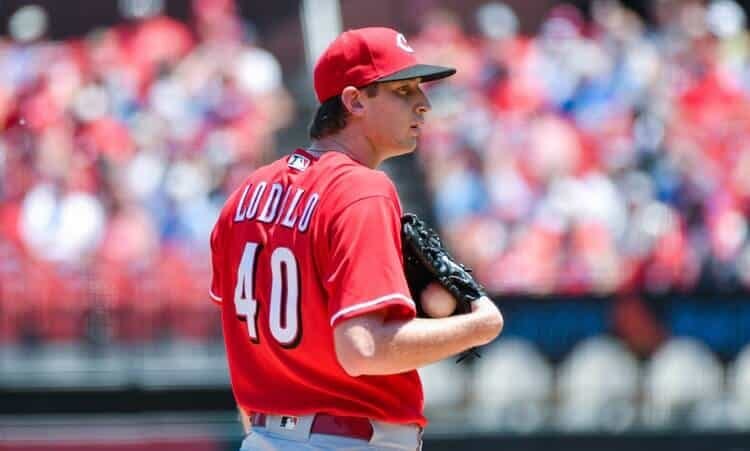
Nick Lodolo SP Reds ADP 249
2024: 115.1IP 9-6 W-L 122K 4.76 ERA/1.20 WHIP
On June 23 of last season, Nick Lodolo developed a blister on a finger of his throwing hand. Despite not being very effective that day, he would leave his 12th start with a very impressive overall slashline: 2.96 ERA/1.07 WHIP/8 Wins/9.4 K/9.
The blister negatively impacted the 27-year-old’s ability to throw his best pitch, a curveball. And the finger was never quite right after returning from the IL. It even progressed into a finger sprain that would end his season a month early. Hence, the 7.54 ERA and 1.39 WHIP over his final nine starts. And hence the final line (above) which is not very impressive.
And the two finger-related IL trips weren’t the only ones. In fact, the lefty had already missed the first two weeks with a calf issue, and another two weeks in May with a groin strain. All this coming after a 2023 season during which he managed only seven starts due to a stress fracture in his leg.
But Lodolo, in his rare times of health, has showcased his ability to miss bats. Even with continued finger complications, his curveball netted a super-impressive 42.9% whiff rate, and his 28.1% overall rate last season put him in the 70th percentile. His mid-90s fastball, too, has elite horizontal break likened to Chris Sale. And at least in his rookie season, it toyed with a 30% rate (29.1% over 103 innings in 2022). This has all led to a career 10.7 strikeouts per nine innings. The upside is pretty clear. 200 strikeouts with great ratios is not out of the question. It’s mostly just a matter of staying on the field.
The good news: fantasy managers are assuming he won’t. That’s why he’s often available in the 21st round of a standard 12-team draft. If you play in a league with IL slots, this will provide late-round upside with pretty much no risk. If not, probably still worth seeing how long he can help you. FWIW, he’s reported healthy to Spring Training and, due to a normal offseason, is in the proverbial “best shape of his life.”
Clay Holmes RP Mets ADP 296
2024: 63IP 30SV 68K 3.14 ERA 1.30 WHIP
We seem to be living in an age where traditional rules just don’t matter anymore. One good example are high-leverage relief pitchers making flawless conversions to the starting rotation. I’m thinking specifically of recent success stories like Seth Lugo, Michael King, and Reynaldo Lopez. This offseason, the Mets signed 31-year-old Clay Holmes hoping he would be the next of that ilk.
Detractors often point to the righty’s league-leading 13 blown saves last year and his limited three-pitch arsenal that might not be suited for multiple turns through the lineup. Or they’ll note his increased HR/9 rate. Or the fact that the veteran hasn’t thrown more than 70 innings in a season. They’ll say that an obvious innings cap, in addition to everything else, will limit his upside. I don’t buy it. Let’s go argument by argument.
First, blown saves aren’t going to mean anything for a starter. These will be low-leverage situations in most cases. The fact is, Holmes only allowed more than one earned run five times in his 67 appearances. He only allowed more than two runs twice. A bad inning might be a disaster for a high-end reliever. For a starter, you suck it up, move on, and adjust.
Additionally, the veteran was most likely the victim of bad luck. His .322 BABIP was by far the worst in his four years with the Yankees. That despite a career-best hard-hit rate (69th percentile) and his best average exit velocity in three seasons. Is it possible that this extreme ground-ball pitcher (100th percentile on Statcast!) just had a bunch squeak through the infield? I think so.
Second, there’s a great chance that the arsenal will expand in 2025. Before last season even ended Holmes worked in a few four-seam fastballs against lefties. And though he didn’t use it in a game, he “tinkered” with a changeup. This might not mean much, except that his pitching coach, Desi Druschel, will also be with the Mets as a coach. This means that he’s had all offseason to refine these pitches (at a pitching lab called Thread Athletics), likely with input from the same person who helped him develop them.
This was evident just this Wednesday during the first BP session of the spring. It was there that Holmes unveiled a “kick-changeup.” Which is essentially a changeup with more late horizontal movement. Both the pitcher and the pitch looked sharp.
Third, his HR/9 rate did go up from the previous two years (0.28/0.29), but it’s still not that bad (0.57). The stat itself doesn’t mean as much in small, 63-inning samples. We’re talking about four home runs versus two. Essentially, he hung four sliders and paid for them. Two, incidentally, were hit by left-handed hitters in Yankee Stadium (which ranks 2nd in home runs by lefties). Which will be a world apart from his future home across town (ranked 23rd in Park Factors overall). And again, over lots of innings as a starter, good chance that number evens out.
And about those innings, fourth, Holmes has stated publicly that he expects to pitch about 160 this season. Considering Lugo went from 65 in his last season as a reliever to 146 the next season. And King from 104 to 173. And Lopez from 66 to 135, this doesn’t sound too far-fetched. It’s certainly enough innings to matter if he can come close.
Bottom line: it feels like the nay-sayers are over-accounting for factors that just won’t be as important this season. If they’re wrong, it can make all the difference in your rotation. If they’re right, I’m sorry, but it only cost you a last-round pick.
Nick Martinez SP/RP Reds ADP 296
2024: 142.1IP 10-7 W-L 116K 3.10 ERA 1.03 WHIP
Since I’m already on the converted reliever train, might as well make another stop for Nick Martinez. Sure, the 34-year-old’s career stats are unlikely to wow you (4.09 ERA/1.32 WHIP/6.4 K/9). His K rate last season was low (20.4%). He plays in a bad environment for pitchers (Great American Ballpark ranks as the 3rd-worst). The radar gun doesn’t light up for him (23rd percentile average fastball velocity). And due to a years-long excursion to the Japan Pacific League, he hadn’t made more than 10 MLB starts since 2017.
But, unlike Clay Holmes above, the righty has had very recent success as an actual starting pitcher. I’m talking about 11 starts down the stretch last year, during which the veteran pitched to a 2.42 ERA/1.09 WHIP, while posting six Quality Starts and five wins.
This doesn’t seem like a fluke either. Martinez really just carried over the same recipe that helped him succeed in the bullpen since his return from Japan (3.31 ERA/1.18 WHIP/2.5 BB/9/8.0 K/9 over the last three seasons). The underlying stats show mastery at limiting hard contact (94th percentile average exit velocity and 96th percentile hard-hit rate in 2024). An elite walk rate (2nd-best overall among qualified starters). And a devastating changeup (producing a 41.6% whiff rate and just an 80.0 MPH average exit velocity last year). He also sports a diverse six-pitch arsenal, well-suited for a starter’s role.
Finally, Martinez seems very optimistic heading into Spring Training. He accepted a qualifying offer due to the Reds being “active in a unique way” this offseason. And specifically for the three-year deal with Terry Francona, the Reds new manager that he’s “very excited to play for.” See also, the signing of Taylor Rogers who will bolster the bullpen and make it even more likely Martinez sticks in the rotation. The $21 Million is a big factor as well. That’s starting rotation sort of money.
This is an ideal points-league grab given the RP eligibility. But really, if someone beat you to Holmes, it also works as a perfect backup plan in just about any league.
For more of the great fantasy baseball rankings and analysis you’ve come to expect from FantraxHQ, check out our full 2025 Fantasy Baseball Draft Kit! We’re here for you all the way up until Opening Day and then on into your championship run.