

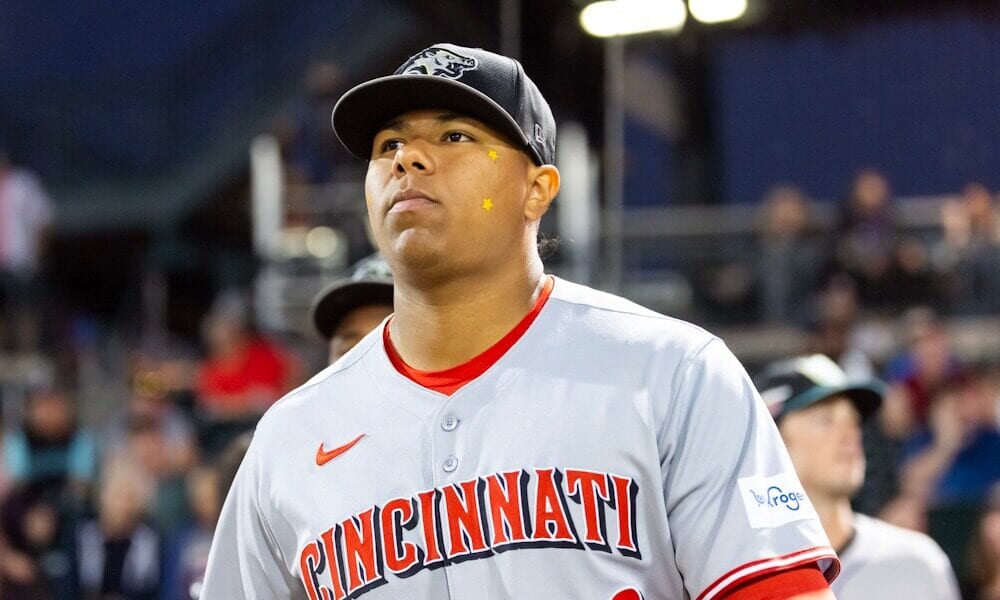
The Cincinnati Reds have built their organization around a philosophy that is particularly important for a smaller-market club: sustainable success has to begin with acquiring and developing young talent.
Dynasty Baseball: 2026 Cincinnati Reds Top 20 Fantasy Baseball Prospects
That direction starts with President of Baseball Operations Nick Krall, whose tenure has increasingly centered on building a roster through scouting, the draft, international acquisition, trades, and player development. Rather than relying on free agency to continually reshape the major-league club, Cincinnati has worked to create a pipeline capable of producing players who can become meaningful contributors in the majors. Krall has described scouting and player development as central to the organization’s approach, and the construction of the current roster reflects that philosophy, as you’ll see in the Reds’ Top 20 fantasy baseball prospects ahead.
The results are becoming increasingly visible throughout the organization.
Cincinnati’s recent major-league teams have featured a substantial collection of players drafted and developed internally, particularly on the pitching side. Hunter Greene, Andrew Abbott, Nick Lodolo and Chase Burns all entered professional baseball through the Reds’ draft pipeline, while the organization has also continued adding position-player upside through both the draft and international market. The 2026 system reflected that balance, with a prospect group featuring significant young hitting talent alongside one of the larger collections of internationally signed players among MLB Pipeline’s organizational Top 30 lists.
That diversity of acquisition is important for dynasty managers.
The Reds aren’t dependent on one avenue for finding talent. High draft selections have brought premium players into the system, international scouting has produced prospects such as Alfredo Duno, and trades have allowed Cincinnati to supplement the pipeline with additional young talent. The organization then has to turn those acquisitions into major-league players—a developmental cycle that has become fundamental to Krall’s vision for building a sustainable winner in Cincinnati.
There is also opportunity here.
Unlike organizations where prospects can find themselves blocked behind expensive veterans for years, Cincinnati’s model requires young players to eventually become part of the major-league solution. Talent still has to earn its way to Great American Ball Park, but when a Reds prospect performs his way through the system, there is a realistic path toward an important role. That combination of organizational necessity and a hitter-friendly major-league environment can make Cincinnati particularly interesting from a dynasty perspective.
For dynasty managers, that means the Reds’ farm system deserves attention beyond simply identifying its biggest names. Cincinnati’s organizational model places real value on developing inexpensive, controllable major-league contributors, and that creates opportunities for prospects whose fantasy value may accelerate quickly as they climb the system. The most interesting targets aren’t necessarily limited to the players already appearing on national Top 100 lists; they’re also the young hitters with impact offensive traits and pitchers whose stuff takes a meaningful step forward after entering professional development.
Under Krall, the larger organizational objective is clear: draft well, scout internationally, develop aggressively, and continually replenish the major-league roster from within. For dynasty managers trying to identify tomorrow’s fantasy contributors before their value fully develops, Cincinnati is an organization worth following closely.
So, let’s begin with our countdown of the Reds’ top 20 prospects.
#20 — Edgar Colon | RHP (ETA 2029)
Colon joined Cincinnati when the Reds selected him out of Felix Varela High School in Miami in the 11th round of the 2024 MLB Draft, signing the Puerto Rican native for $247,500. The 20-year-old has since developed into a legitimate arm to watch, with MLB Pipeline currently ranking him No. 28 in Cincinnati’s system.
Colon has the raw ingredients to become a strikeout-producing starter, beginning with a lively fastball that sits around 96 mph and can reach 98 with excellent carry. His upper-80s changeup gives hitters another bat-missing look, while continued improvement of his slider could eventually give him the three-pitch arsenal necessary to handle a rotation role. The biggest hurdle is command, as inconsistent mechanics can cause his control to disappear for stretches.
For dynasty managers, Colon is an intriguing high-risk, high-reward pitching stash rather than a must-roster prospect in shallow formats. He has already demonstrated encouraging strikeout ability—punching out 60 hitters in his first 47.1 innings of 2026—and a meaningful improvement in walks could send his prospect stock soaring. If the command eventually catches up to the stuff, Colon has the upside of a bat-missing MLB starter rather than simply a future bullpen arm.
#19 — Jose Franco | RHP (ETA 2026)
Franco has taken the long road since Cincinnati signed him out of Venezuela as an international free agent in 2018. Tommy John surgery interrupted his development, but the sturdy right-hander recovered and pitched his way into the upper minors and onto Cincinnati’s radar as a potential major-league arm.
His fastball can climb into the upper 90s, while a hard slider gives him the swing-and-miss weapon fantasy managers want. Franco’s changeup provides another option against left-handed hitters, though inconsistent command continues to cloud whether his future lies in a rotation or bullpen.
Franco’s dynasty attraction is mostly proximity and strikeout potential rather than huge long-term upside. He could become a useful starter or multi-inning weapon, but shallow dynasty managers can afford to be selective given the reliever risk.
#18 — Carlos Jorge | OF (ETA 2027)
Cincinnati landed Jorge for $495,000 out of the Dominican Republic during the 2021 international signing period. Originally developed as an infielder, his athleticism and speed have increasingly made center field an attractive long-term defensive home.
Jorge is at his best when he’s putting the baseball in play, using the entire field and allowing his wheels to create havoc. There is some pop in the bat, but trying to manufacture too much power can lead him away from the contact-and-speed game that makes him intriguing.
The fantasy formula is straightforward: get on base and run. Jorge could provide meaningful stolen-base totals if the hit tool holds up against advanced pitching, making him particularly useful in roto dynasty leagues where speed remains difficult to find.
#17 — Carlos Sanchez | 3B/SS/OF (ETA 2028)
Sanchez has already turned a modest investment into an intriguing prospect after Cincinnati signed him for $70,000 during the 2022 international period. His ability to move around the diamond gives the organization several ways to get his bat into a future lineup.
The left-handed hitter’s calling card is his feel for contact. Added strength has begun creating more impactful contact as well, giving Sanchez a chance to eventually offer respectable power without sacrificing the bat-to-ball skills that started his prospect ascent.
For dynasty purposes, Sanchez is more intriguing than his name recognition suggests. He could eventually provide batting-average help, moderate power and multi-position eligibility—a combination that makes him an excellent deeper-league sleeper.
#16 — Dylan Bowen | SS (ETA 2030)
Bowen entered Cincinnati’s system when the Reds selected the athletic young infielder in the fifth round of the 2026 MLB Draft. Cincinnati’s willingness to invest heavily in signing him adds another interesting upside play to an organization loaded with young middle-infield athletes.
Bowen’s profile is currently more projection than polish. Athleticism gives him a chance to remain at a valuable defensive position, while physical development and professional instruction will determine how much offensive impact ultimately emerges.
That uncertainty is exactly why Bowen fits better in very deep dynasty leagues right now. He’s several years away, but a young shortstop whose offensive tools take an unexpected leap can become a valuable dynasty asset almost overnight.
#15 — Duncan Marsten | RHP (ETA 2029)
Cincinnati selected Marsten in the sixth round of the 2026 Draft, adding another projectable pitcher to an organization with a strong recent track record of developing arms. The Reds are betting that professional development can help his complete arsenal take another step.
Marsten has the ingredients to remain a starter, which is crucial to his fantasy outlook. Improving the consistency and quality of his secondary offerings while maintaining reliable strike-throwing will determine whether he becomes a legitimate rotation prospect.
Pitching prospects this far away always carry substantial volatility, making Marsten more appropriate for leagues with large farm systems. If Cincinnati unlocks additional stuff, though, he could become one of those pitching prospects whose dynasty value rises quickly.
#14 — Ethan Norby | LHP (ETA 2028)
The Reds selected Norby out of East Carolina in the fourth round of the 2026 Draft, adding an accomplished college left-hander who should be more polished than many pitchers entering professional baseball. That background gives him a chance to move faster than Cincinnati’s teenage arms.
Norby isn’t dependent on overpowering hitters with pure velocity. His appeal comes from missing bats, changing looks, and showing enough pitching feel to potentially develop a legitimate starter’s repertoire as he progresses.
There may be less superstar upside here than with some of Cincinnati’s younger lottery tickets, but starting pitchers who generate strikeouts have obvious dynasty value. Norby’s combination of polish and proximity gives him an appealing risk/reward profile.
#13 — Sheng-En Lin | RHP (ETA 2028)
Cincinnati signed Lin out of Taiwan for $1.2 million in 2023, initially allowing the gifted athlete to develop as a two-way player. The Reds eventually shifted his focus exclusively to pitching, where his athleticism gives him an intriguing developmental foundation.
Lin isn’t physically imposing, but his fastball has life, and his changeup has the potential to become an important secondary weapon. Concentrating solely on pitching also leaves open the possibility that his velocity, breaking stuff, and overall command continue improving with additional reps.
He’s a fascinating dynasty stash because the pitching version of Lin may still be taking shape. If another jump in stuff accompanies his natural athleticism and feel, his ceiling could eventually resemble that of a useful mid-rotation fantasy starter.
#12 — Arnaldo Lantigua | OF (ETA 2029)
Lantigua originally signed with the Dodgers during the 2023 international period before Cincinnati acquired him in a trade involving international bonus-pool space. That relatively quiet transaction brought a potentially impactful power bat into the Reds’ system.
The attraction is Lantigua’s strength and ability to drive the baseball. He already possesses the physicality to produce legitimate power, and continued development of his approach will determine how consistently he can reach that pop against better pitching.
Power gives Lantigua an appealing fantasy ceiling even if his defensive profile eventually pushes him toward a corner. If the hit tool develops enough to support the strength, there is a pathway toward a middle-of-the-order hitter capable of 25-plus home runs.
#11 — Angel Nunez | OF (ETA 2031)
Nunez became one of Cincinnati’s newest international investments when the Reds signed the talented young outfielder during the 2026 international period. He’s exceptionally far from the majors, but his athletic foundation immediately makes him interesting in deep dynasty formats.
Speed is the carrying tool at present. Nunez has the wheels to become an impact base stealer, while promising bat-to-ball ability gives Cincinnati something to build around as his body matures and additional power potentially develops.
The risk is enormous because of the distance involved, but so is the potential increase in dynasty value. A teenage center fielder combining contact skills with plus speed can shoot up prospect rankings quickly once game performance begins matching the tools.
#10 — Liberts Aponte | SS (ETA 2030)
Cincinnati made Aponte one of its major international additions in 2025, signing the Venezuelan shortstop for $1.9 million. He entered professional baseball with an advanced defensive reputation, but flashes of offensive impact have made the overall package increasingly interesting.
Aponte has the athleticism and actions to remain in the middle infield while possessing enough speed to contribute on the bases. His offensive profile currently leans more toward contact than huge power, though his slender frame leaves plenty of room for additional strength.
That physical projection is what makes Aponte exciting for dynasty managers. If the power develops without compromising his contact ability or speed, he could eventually offer contributions across several categories from a premium fantasy position.
#9 — Jirvin Morillo | C (ETA 2030)
Morillo joined the organization when Cincinnati signed the switch-hitting catcher out of Venezuela during the 2024 international period. Since then, his offensive development has turned him into one of the more intriguing young catching prospects in the system.
His bat is what separates him. Morillo shows encouraging contact skills from both sides of the plate, understands the strike zone, and possesses enough emerging impact to envision considerably more power as he grows into his frame.
Catchers require patience, but dynasty managers should pay attention when the offensive tools lead the profile. If Morillo remains behind the plate while eventually developing 20-homer power, positional scarcity could make him considerably more valuable than a similarly productive corner player.
#8 — Aaron Watson | RHP (ETA 2029)
Watson joined Cincinnati as a premium young pitching acquisition and has quickly emerged as one of the better arms in the system. At 6-foot-5, he has the type of projectable starter’s frame that gives Cincinnati considerable room to dream on further development.
There is already impressive stuff, and Watson has the ingredients to miss bats as a professional starter. Refining his command and developing enough consistency with his secondary pitches will ultimately determine whether the ceiling becomes that of a mid-rotation arm or something more exciting.
Young pitching carries considerably more dynasty risk than young hitting, but Watson’s upside is difficult to ignore. Managers in deeper formats should view him as one of Cincinnati’s premier pitching investments and a potential future strikeout asset.
#7 — Mulivai Levu | 1B (ETA 2028)
The Reds used the 70th overall selection in the 2026 Draft on Levu after an impressive career at UCLA. Cincinnati was clearly targeting offensive impact, adding a physically strong left-handed hitter whose collegiate performance provides a more advanced starting point than most lower-level prospects.
Levu’s bat speed and raw power immediately stand out. He can drive pitches with authority to different parts of the field, although tightening his strike-zone decisions will be important because his ability to reach pitches can occasionally encourage him to expand too aggressively.
First-base prospects have to mash, but that requirement matters less to fantasy managers when the offensive production arrives. Levu has the potential to become a strong average-and-power contributor, and 25-plus home runs are conceivable if everything clicks.
#6 — Cam Collier | 1B/3B (ETA 2027)
Collier has been on dynasty radars since Cincinnati selected him 18th overall in the first round of the 2022 Draft. He entered professional baseball at only 17 after reclassifying and playing junior-college ball, resulting in the Reds consistently challenging him against older competition.
The left-handed hitter can produce impressive exit velocities and owns the raw power necessary to become a legitimate home-run threat. Contact consistency remains the key developmental question, especially as his defensive future increasingly points toward a corner.
His prospect stock has experienced some turbulence, but Collier is still young enough for another offensive jump. Put 25-plus-homer left-handed power inside Great American Ball Park and fantasy managers can see why he remains worth holding.
#5 — Tyson Lewis | SS/3B (ETA 2029)
Cincinnati selected Lewis 51st overall out of the Nebraska high school ranks in the second round of the 2024 Draft and went above slot to sign him. That investment landed the Reds one of the most exciting power-speed athletes in their lower minors.
Lewis generates impressive exit velocities from the left side and pairs that power potential with plus speed. The swing-and-miss is the obvious concern, as an aggressive approach can leave him vulnerable when pitchers convince him to chase outside the strike zone.
For fantasy baseball, the upside makes the risk worthwhile. Lewis has the tools to eventually challenge for 20-25 homers and 20-plus steals from the infield, a combination that could make him an impact dynasty asset if the hit tool reaches average.
#4 — Justin Lebron | SS (ETA 2029)
Cincinnati selected Lebron with the 18th overall pick in the first round of the 2026 MLB Draft after his standout collegiate career at Alabama. His extensive SEC experience gives him considerably more polish than the typical teenage shortstop and should allow the Reds to challenge him aggressively.
Lebron brings an exciting combination of bat speed, athleticism, and offensive impact. There is enough power to envision meaningful home-run totals and enough athletic ability to contribute stolen bases, giving him considerably more fantasy intrigue than a defense-first shortstop.
That balanced offensive profile is what pushes Lebron this high immediately after being drafted. If his bat translates quickly against professional pitching, he has the ingredients to become an everyday shortstop capable of contributing across all five traditional fantasy categories.
#3 — Steele Hall | SS (ETA 2029)
Cincinnati made a major investment in Hall when it selected the exceptionally young Alabama prep shortstop ninth overall in the 2025 Draft. He signed for $5.75 million, giving the organization a premium athlete with enormous developmental runway.
Hall’s plus-plus speed is his loudest fantasy weapon and gives him legitimate impact potential in stolen bases. He’s hardly a one-tool player, though, as improved strength and offensive development are beginning to create the possibility of meaningful power alongside the wheels.
That’s where the dynasty ceiling becomes exciting. If Hall develops into even a solid hitter capable of producing 15-20 home runs, his speed could turn him into a difference-making fantasy shortstop capable of 30-plus stolen bases.
#2 — Eric Becker | SS (ETA 2028)
Cincinnati selected Becker 58th overall out of Virginia in the second round of the 2026 Draft, adding one of the more accomplished college hitters in the class. His extensive experience against high-end collegiate competition gives him a chance to progress much faster than many of Cincinnati’s teenage prospects.
Becker’s calling card is his polished left-handed bat. He controls the strike zone, makes plenty of contact, and has enough size and strength in his 6-foot-3 frame to envision additional game power emerging once he settles into professional baseball.
For dynasty managers, that combination of hitting ability and proximity is extremely attractive. If Becker reaches the upper end of his power projection while maintaining his contact skills, he could become a high-average infielder with 20-homer potential and strong counting-stat production.
#1 — Alfredo Duno | C (ETA 2028)
Cincinnati made Duno one of the centerpieces of its 2023 international class, signing the Venezuelan catcher for $3.1 million. He has since developed into the premier prospect in the organization, reaching Double-A at age 20 while continuing to produce against increasingly advanced competition.
Duno possesses the offensive package dynasty managers dream about from a catcher: impressive strength, legitimate home-run power and enough hitting ability to avoid becoming a one-dimensional slugger. His strong throwing arm and continued defensive development also give him a legitimate opportunity to remain behind the plate.
That catcher eligibility is the separator at the top of this ranking. A potential middle-of-the-order hitter capable of producing a strong on-base percentage and 25-plus home runs would be valuable anywhere; getting that production from catcher could make Duno a major positional advantage.
Final Thoughts
The Reds’ system offers an intriguing blend of proximity and projection, with Duno leading a group that features several potential impact bats at premium positions. Cincinnati’s emphasis on drafting, international scouting, and internal development gives dynasty managers plenty of reasons to keep monitoring this organization.
The biggest theme is offensive upside, particularly at shortstop and catcher, while the pitching group carries more developmental uncertainty. With several prospects still years away, patience will be required, but the system contains enough power, speed, and positional value to produce multiple significant dynasty risers.
Fantrax is one of the fastest-growing fantasy sites in the fantasy sports industry, and we’re not stopping anytime soon. We are the most customizable, easy-to-use, and feature-rich platform in the industry, offering the greatest fantasy experience for your dynasty, keeper, redraft, and best ball leagues. Fantasy sports doesn’t sleep, and neither does Fantrax, with seasons running 365 days a year. Take your fantasy leagues to the next level now at Fantrax.com!