

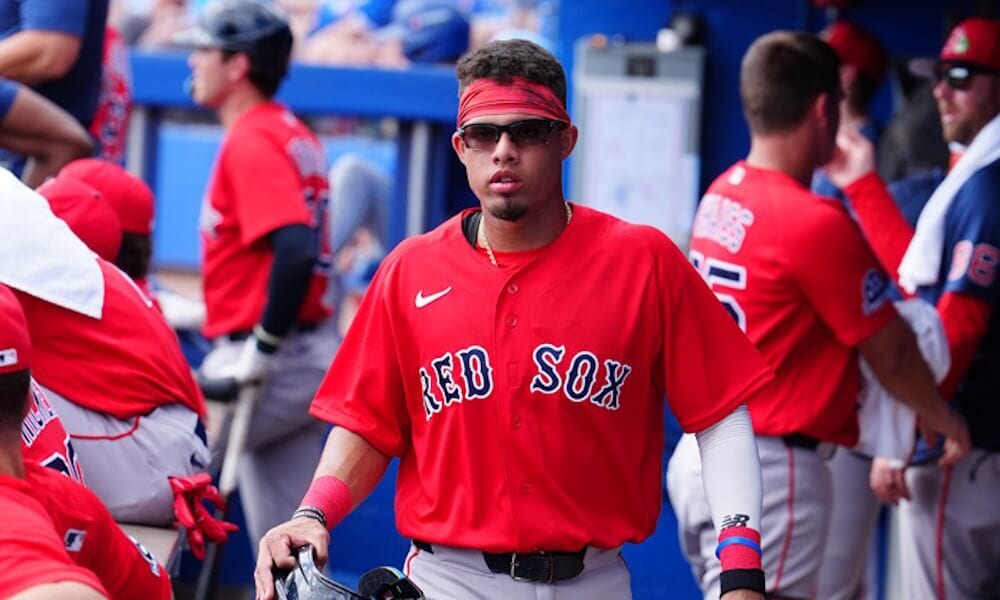
The Boston Red Sox are building an increasingly intriguing player-development operation under Chief Baseball Officer Craig Breslow. Since taking control of baseball operations in October 2023, Breslow has placed a particular emphasis on strengthening the organization’s pitching infrastructure while continuing to develop the position-player talent that has long been one of the system’s greatest strengths.
Dynasty Baseball: 2026 Boston Red Sox Top 20 Fantasy Baseball Prospects
That evolution is beginning to show throughout the farm system, as you’ll see in the Red Sox’ Top 20 fantasy baseball prospects ahead..
For years, Boston’s prospect pipeline was defined primarily by hitters. Under Breslow, the organization has made a concerted effort to build something more balanced, investing heavily in pitching through the draft while attempting to create a development environment capable of turning raw arms into legitimate major-league options. Recent draft classes have added another wave of pitching talent, giving the system considerably more depth on the mound than it possessed only a few years ago.
The international program remains another important part of Boston’s pipeline. The Red Sox have assembled one of baseball’s more internationally influenced farm systems, with young players entering the organization from Latin America and progressing through a development structure designed to maintain a consistent philosophy from the Dominican Summer League through the upper minors.
For dynasty fantasy managers, that combination makes Boston an organization worth following closely. The system no longer revolves around one celebrated group of prospects. Instead, the Red Sox are attempting to create a sustainable pipeline capable of producing talent on both sides of the ball.
Breslow’s influence is especially important when evaluating the organization’s young pitchers. His background in pitching development and Boston’s increased investment in that area mean emerging Red Sox arms deserve attention when their stuff or performance begins to take a meaningful step forward. At the same time, the organization continues to produce position players with intriguing combinations of bat-to-ball ability, athleticism, power, and defensive versatility.
The result is a farm system with multiple avenues for dynasty value. Some prospects are already approaching the majors. Others remain years away and carry considerably more projection. But Boston is increasingly becoming the type of organization where development itself should factor into how dynasty managers evaluate the players coming through the system.
So, let’s begin with our countdown of the Red Sox’s top 20 prospects.
#20 — Jack Winnay | 3B/1B (ETA 2028)
The Red Sox took Winnay in the 13th round of the 2025 MLB Draft out of Wake Forest, adding a physical right-handed hitter whose offensive potential is considerably more interesting than his draft position might indicate. His future will be driven by the bat, with power providing his clearest route up the organizational ladder.
For dynasty managers, Winnay is a deep-league power stash rather than a player who needs to be rostered everywhere. There is enough strength to envision useful home-run production, but playing first and third means he’ll need to hit consistently to earn an everyday major-league opportunity.
He’s the type of prospect worth monitoring closely because a power breakout could change his dynasty value quickly. The ceiling isn’t as broad as the players higher on this list, but there’s enough offensive upside here to keep him on the radar.
#19 — Dylan Brown | LHP (ETA 2029)
Boston selected Brown in the eighth round of the 2025 MLB Draft out of Old Dominion, bringing a large 6-foot-5 left-hander into the organization. His combination of size, strikeouts, and improving pitch mix has made him one of the more interesting lower-profile arms from that draft class.
Brown’s fantasy appeal starts with his ability to miss bats. He has the ingredients to develop as a starter rather than being automatically pushed toward relief, which matters tremendously when evaluating pitching prospects for dynasty leagues.
There’s plenty of developmental distance remaining, and young pitching always carries substantial risk. Still, Brown has enough strikeout upside to warrant attention in leagues that roster well beyond the traditional Top 100 prospects.
#18 — Angel Bastardo | RHP (ETA 2027)
Bastardo has been in the organization for years after Boston signed him out of Venezuela as an international free agent in 2018. Injuries have disrupted what was once a relatively steady climb through the system, making his path much less straightforward than it once appeared.
His changeup has long been an important part of his arsenal, and there’s enough secondary stuff to keep a starting role within reach when he’s healthy. For fantasy purposes, however, durability and command are every bit as important as the raw pitches at this stage.
That leaves Bastardo as a speculative arm rather than a premium dynasty asset. He could still provide useful strikeouts as a starter, while a bullpen transition would significantly reduce his value in most fantasy formats.
#17 — Jace Mataczynski | SS (ETA 2030)
Boston selected Mataczynski in the third round of the 2026 MLB Draft and invested heavily to sign the Wisconsin prep standout away from his commitment to Auburn. He’s a 6-foot-4 athlete with the sort of physical projection that makes him especially intriguing in long-term dynasty formats.
Speed is already a legitimate part of Mataczynski’s game, while his frame offers reason to believe additional power could emerge as he matures. The combination of athleticism, arm strength, and defensive ability should give Boston plenty of patience while his offensive game develops.
He’s years away and therefore carries plenty of risk, but that’s also what makes him an intriguing early dynasty investment. If the hit tool advances while the power arrives, Mataczynski could eventually offer an enticing power-speed package from the infield.
#16 — Martin Shelar | OF (ETA 2030)
Shelar became one of Boston’s most fascinating 2026 draft investments when the club selected him in the ninth round and paid well above the normal bonus for that portion of the draft to sign him away from Mississippi State. The aggressive investment reflects how much Boston liked the high-school outfielder’s upside.
Power is the tool that should grab the attention of dynasty managers. Shelar already possesses impressive physical strength, and there’s enough offensive ceiling to envision a future run-producing outfielder if his bat develops against increasingly advanced pitching.
The gap between present ability and ultimate ceiling remains significant, so patience will be required. In leagues where managers can roster teenage lottery tickets, however, Shelar is exactly the kind of power prospect who can become much more valuable before reaching the upper minors.
#15 — Jedixson Paez | RHP (ETA 2027)
Boston entered the international market to sign Paez out of Venezuela in 2021, and the right-hander has developed into one of the organization’s best strike throwers. He doesn’t overpower hitters in the same manner as some of Boston’s higher-upside arms, but his command gives him an unusually polished foundation.
Paez’s fantasy profile is built around efficiency and control. He can work multiple pitches around the zone and change speeds effectively, potentially allowing him to produce useful WHIP numbers while accumulating enough strikeouts to remain relevant.
The ceiling looks more like a dependable rotation piece than a future fantasy ace, but probability has value too. With Paez already knocking on the major-league door, he’s an attractive option for dynasty managers who need pitching help sooner rather than several years from now.
#14 — Dorian Soto | SS (ETA 2030)
Soto joined Boston as a significant international signing in January 2025, giving the organization another athletic young shortstop from the Dominican Republic. A switch-hitter with a projectable 6-foot-2 frame, Soto is still much more about future possibilities than immediate production.
There’s an intriguing mixture of bat speed, developing strength, and athleticism here. If his offensive approach matures alongside his body, Soto has a chance to grow into considerably more power without sacrificing all of his mobility.
For dynasty purposes, this is a patience-over-production selection. He’s a long way from Fenway Park, but teenage shortstops with legitimate physical projection can become extremely valuable once the offensive tools begin translating into games.
#13 — Marcus Phillips | RHP (ETA 2028)
The Red Sox selected Phillips out of Tennessee with a Competitive Balance selection in the 2025 MLB Draft, targeting one of the more powerful arms available at that point. At 6-foot-4 with a sturdy build, Phillips certainly looks the part of a pitcher capable of handling innings.
His fastball and breaking stuff give him a chance to generate plenty of strikeouts, which immediately makes him interesting for fantasy baseball. The separator will be command: improved strike-throwing could keep him on a starter’s trajectory, while persistent inconsistency could eventually lead to relief.
That uncertainty creates a wide range of dynasty outcomes. Phillips isn’t a safe pitching prospect, but the potential reward is meaningful enough that managers chasing upside should be willing to tolerate the volatility.
#12 — Carlos Gutierrez | OF (ETA 2028)
Gutierrez came to Boston from the Giants organization in the 2026 trade that sent Marcelo Mayer to San Francisco. Originally signed internationally by the Giants, Gutierrez arrived in the Red Sox system with an intriguing combination of contact ability, patience, and athleticism.
Speed may ultimately become his most useful fantasy weapon. Gutierrez can put the ball in play and reach base enough to create stolen-base opportunities, giving him a possible path toward contributing in batting average, runs, and steals.
The missing ingredient is substantial home-run power. If he can develop even average pop while maintaining his contact and speed, the fantasy profile becomes much more complete; without it, he’s more likely to settle into a complementary role.
#11 — Mikey Romero | 3B/2B (ETA 2027)
Boston selected Romero in the first round of the 2022 MLB Draft out of Orange Lutheran High School in California. Injuries complicated the early portion of his professional career, but the left-handed hitter has steadily rebuilt his prospect stock while climbing all the way to Triple-A.
Romero’s fantasy game is more balanced than spectacular. He can make quality contact, provide some power, and handle several infield positions, creating multiple routes to major-league playing time even if he doesn’t develop into a star.
His proximity is an important part of the dynasty equation. While younger prospects below him may eventually possess higher ceilings, Romero has a much clearer opportunity to begin producing major-league statistics in the near future.
#10 — John Holobetz | RHP (ETA 2027)
Holobetz entered professional baseball as Milwaukee’s fifth-round selection in 2024 before Boston acquired him as the player to be named later in the Quinn Priester trade in May 2025. Since changing organizations, he’s developed into one of the steadier starting options in the upper levels of Boston’s system.
Command is his calling card. Holobetz doesn’t need overwhelming velocity to get hitters out because he locates well, creates deception and generally forces opponents to beat him rather than repeatedly giving away bases.
That gives him a higher floor than many pitching prospects, although his fantasy ceiling may be closer to a useful mid-rotation contributor than a frontline starter. Managers in deeper dynasty leagues should appreciate the combination of proximity, control, and opportunity.
#9 — Yoeilin Cespedes | 2B (ETA 2028)
Cespedes became one of Boston’s headline international additions when the organization signed him out of the Dominican Republic in 2023. His compact frame contains surprising strength, and his quick right-handed swing made him an intriguing offensive prospect almost immediately.
The appeal for fantasy managers remains his potential to combine hitting ability with meaningful power from a middle-infield position. He isn’t dependent upon stolen bases to create value, so the development of his approach and consistency at the plate will determine his ultimate ceiling.
His prospect trajectory hasn’t been perfectly smooth, which creates an interesting opportunity in dynasty leagues. Cespedes may no longer carry the same hype he once did, but he’s young enough for another developmental jump to quickly restore his value.
#8 — Jake Schaffner | SS (ETA 2028)
Boston used its first-round selection in the 2026 MLB Draft on Schaffner after his college career at North Carolina. Rather than chasing enormous raw power, the Red Sox invested in an athletic left-handed hitter with contact skills, speed and the ability to remain in the middle of the diamond.
Schaffner has the ingredients to become especially useful in on-base-percentage leagues. He controls at-bats well enough to reach base, can contribute steals, and has already shown an ability to handle professional pitching early in his career.
More power would dramatically raise the fantasy ceiling. Even without becoming a major home-run threat, though, a middle infielder capable of helping in average, OBP, runs, and stolen bases can become an extremely useful dynasty piece.
#7 — Owen Hull | OF (ETA 2028)
Boston selected Hull out of North Carolina with its Competitive Balance Round B pick in the 2026 MLB Draft, bringing him into the organization immediately after taking his college teammate Jake Schaffner. Hull’s first taste of professional baseball only increased the intrigue surrounding his offensive profile.
The 6-foot-4 left-handed hitter combines strike-zone awareness with contact ability and surprising athleticism for his size. There’s also untapped strength in the frame, making the possibility of additional game power particularly enticing for dynasty managers.
Hull could become much more than a high-OBP outfielder if Boston helps him consistently turn his strength into home runs. The combination of approach, physicality, and some speed gives him one of the more balanced offensive ceilings among Boston’s recent draft picks.
#6 — Sadbiel Delzine | RHP (ETA 2029)
Boston signed Delzine out of Venezuela for $500,000 during the 2025 international period, betting on an unusually intriguing combination of size and pitching feel. Still only 18, the 6-foot-5 right-hander has already begun validating that investment against professional hitters.
Delzine offers more than pure velocity. His breaking stuff can miss bats, his changeup provides another developmental weapon and his enormous frame gives scouts plenty to dream on as he becomes stronger and more experienced.
The distance from the majors makes him inherently risky, especially because pitching prospects can change dramatically before reaching Double-A. Still, Delzine has the ceiling dynasty managers should chase: if everything comes together, he could develop into a legitimate impact starter.
#5 — Henry Godbout | 2B/SS (ETA 2028)
Boston selected Godbout out of Virginia during the 2025 MLB Draft, adding another accomplished college hitter to the farm system. He has since done exactly what an advanced collegiate prospect needs to do—hit his way through the lower minors and force the organization to keep moving him forward.
Godbout’s offensive profile has become increasingly interesting for fantasy purposes. There’s contact ability, patience and enough emerging power to envision an everyday infielder rather than simply a versatile bench option.
He may lack the eye-popping single tool of some prospects around him, but dynasty value isn’t created by flash alone. A middle infielder who can reach base, hit for average and threaten 15-to-20-plus homers has a very useful fantasy ceiling.
#4 — Juan Valera | RHP (ETA 2029)
Boston found Valera on the international market in 2023, signing the Dominican right-hander for a relatively modest bonus before watching his velocity take a major leap. He has since developed one of the most electric fastballs anywhere in the Red Sox farm system.
Triple-digit velocity gives Valera obvious strikeout potential, and his breaking ball provides another weapon capable of missing bats. In pure stuff terms, few pitchers in this system offer a more exciting fantasy ceiling.
The major complication is health. Tommy John surgery in May 2026 interrupted his ascent and adds another substantial layer of risk to an already volatile pitching profile. Managers with deep injured-minor-league spots should be patient, because the upside remains significant.
#3 — Franklin Primera | C/1B (ETA 2029)
Primera may be one of Boston’s best recent international scouting finds. The Red Sox signed the Venezuelan catcher for a small bonus in 2024, and he has subsequently turned himself from an under-the-radar addition into one of the most productive young hitters in the organization.
His fantasy appeal is magnified by the position he plays. Primera combines strong contact skills with an advanced approach and developing power, giving him the possibility of becoming an offensive difference-maker at catcher rather than simply a player who qualifies there.
There is always extra developmental risk with young catchers, but Primera’s bat gives him considerable margin for error. If he remains behind the plate while continuing to hit, the positional scarcity could make him one of the most valuable fantasy catchers to emerge from the minors.
#2 — Justin Gonzales | OF/1B (ETA 2028)
Boston signed Gonzales out of the Dominican Republic during the 2024 international period, and he has rapidly developed into one of the most physically imposing hitters in the organization. Standing around 6-foot-5, Gonzales already possesses the kind of strength that can produce serious damage on contact.
Power drives the fantasy dream. Gonzales has the raw ingredients to become a major home-run producer, and the fact that Boston has challenged him aggressively against older competition only adds to the excitement surrounding his development.
There is risk attached to a hitter with long levers, particularly when better pitchers learn how to attack holes in the strike zone. But if Gonzales maintains enough contact to unlock his power consistently, we’re looking at a potential middle-of-the-order fantasy bat with 30-homer upside.
Also, make sure to check out our 2026 MLB organizational Prospect Rankings!
#1 — Franklin Arias | SS (ETA 2027)
Boston signed Arias out of Venezuela during the 2023 international period, and he has evolved from an intriguing young shortstop into the centerpiece of the organization’s next wave of position-player talent. Still only 20, Arias has already climbed to Triple-A while continuing to perform against considerably older competition.
His fantasy appeal comes from having several ways to score points or fill categories. Arias can make frequent contact, control the strike zone, and contribute some speed, while his rapidly developing power has added an entirely new dimension to his offensive ceiling.
That combination separates him from the rest of this group. Arias doesn’t need to become an elite home-run hitter or prolific base stealer to matter because his hit tool gives the entire package such a strong foundation. If the power gains hold as he reaches Boston, he has the ingredients to become an impact dynasty shortstop.
Final Thoughts
Boston’s farm system is becoming deeper and more balanced, with a stronger pitching pipeline now complementing an already intriguing collection of young hitters. The organization offers dynasty managers a useful mix of near-term contributors, high-upside international talent, and longer-term developmental bets.
Franklin Arias headlines the system, but the depth behind him is what makes Boston particularly interesting. From Justin Gonzales’ power upside and Franklin Primera’s potential impact at catcher to a growing collection of high-ceiling arms, there are dynasty targets at nearly every level of the organization.
For dynasty managers, this is a system worth tracking closely. Boston’s increased emphasis on player development—particularly on the pitching side—could create several significant risers over the next few seasons.
Fantrax is one of the fastest-growing fantasy sites in the fantasy sports industry, and we’re not stopping anytime soon. We are the most customizable, easy-to-use, and feature-rich platform in the industry, offering the greatest fantasy experience for your dynasty, keeper, redraft, and best ball leagues. Fantasy sports doesn’t sleep, and neither does Fantrax, with seasons running 365 days a year. Take your fantasy leagues to the next level now at Fantrax.com!