
Aside from what I’ve written here, you don’t know me at all. So let me fill you in on one thing. My most annoying trait – both for myself and others – is that I need to know WHY. Like a child asking every follow-up to “Why is the sky blue?” until you’re explaining electron shells and quantum energy states, I won’t give up until I have an answer.
When someone makes a statement, especially if it’s in an area of interest to me, I keep asking questions, trying to peel away assumptions to get to the heart of the matter. Like I said, annoying, but only someone with a presumption of authority who isn’t used to being questioned at all would take it as disrespectful, right?
More great Fantasy Baseball Analysis: Fantasy Baseball Waiver Wire | Weekly SP Rankings | Pitching Streamers | Two-Start Pitchers | Lineup Analysis | MLB Injury Report | Rookie Report | Advanced Stats | Under the Radar | Overvalued & Undervalued | Bullpen Report
Making Sense of Swing Data
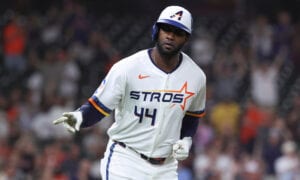
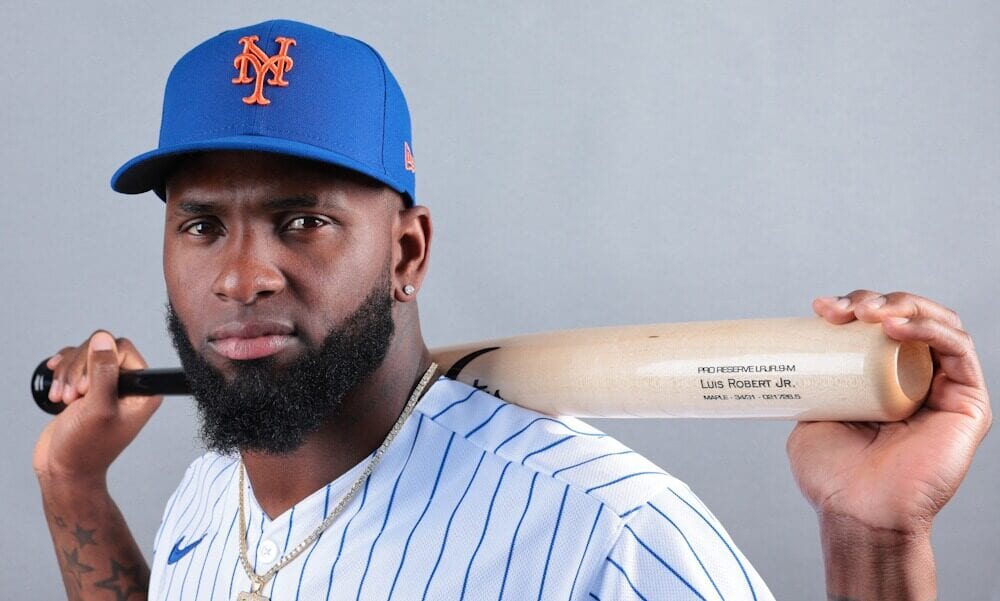
So when someone said that a sudden drop in swing rate, from a previously aggressive swinger, indicated that said player couldn’t see spin, sweet lamb, you know I had questions. They eventually clarified that it was following multiple years of reduced swing rate that they were talking about, not a simple year-over-year look. They said they saw it watching the player in a single game, but were also adamant that they saw it in the data too, and that I just didn’t know what to look for.
Was the Choice ever Mine?
Now, if you’ve read any of my other work this year, you know this is something I have been chasing. It’s one of the last pieces of information still locked within the walled garden of scouting. If it is in the data, I will find it. There are hints of signal in chase and zone swing, but I had to bring in additional data points because a patient, selective hitter can look the same as a passive, lost player with just those numbers.
How useful is something that takes several years to see? Probably not very, but I still need to know if it’s there. I also don’t have any way to verify who can and can’t see spin. So I can’t prove that part either way, but I can look for sharp declines in swing rate and see if that correlates with performance, to see if that change is a good or bad sign.
I should also note that “Can’t see spin” is not something you hang on a player lightly. It’s an accusation that can end a career. I’ve said from day one here that I am not a scout, so I haven’t touched it. I have opinions, but I don’t make a claim without some solid data to back it up. We are data. We are science. So we test that hypothesis.
Devotion to Data
We have swing data back to 2002 – when I was a fan but hadn’t started playing fantasy baseball – so I took every player season since with at least 100 PAs and got their year-over-year change in swing rate and wRC+. It only took me four full listens through KiNG MALA’s 2025 album And You Who Drowned in the Grief of a Golden Thing to compile this data. I really need to learn Python.
- Ode to a black hole
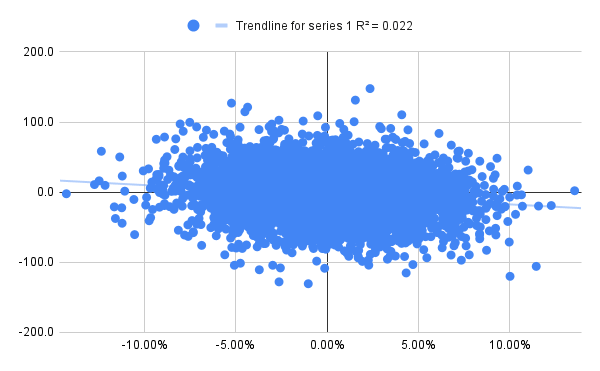
Here’s all 7893 YoY seasons plotted by change in swing rate vs change in wRC+. It’s basically no correlation, but it is tilted slightly towards “Swinging less is better,” so we’ll see if that gets stronger or not.
If you’re wondering, “Who fell off by more than 100 wRC+ in a single year?” Matt Carpenter went from 216 – tops in the league (min 150 PA) to 85 in his penultimate season. Jacob Stallings also dropped from 113 to -7 in 2025, oof.
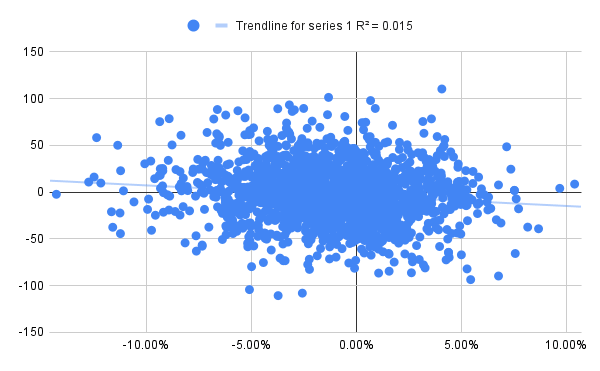
The hypothesis we’re testing is about free swingers, though, so let’s filter on prior year swing rates over 50%
- Ode to a big splat
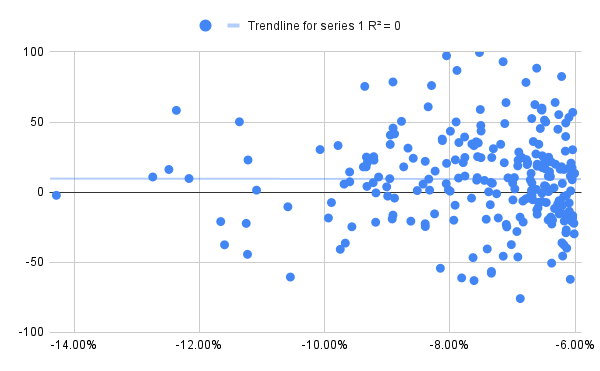
Hmm, that’s even weaker. They did say a big drop in swing rate was what stood out. Let’s look at that
- Ode to the absence of correlation
Limiting it to changes greater than -6%, we get a perfect zero correlation. It’s a beautiful thing, really. Combining both filters only bumps it to 0.001. However, if you ignore degree of change, there are 85 positive vs 51 negative, so I think it’s fair to say that for most free swingers, cutting back is good. On the flip side, among all hitters who swung 6+% more, 159 had worse wRC+ vs. only 84 that got better swinging a lot more.
The last condition we have is a longer trend of swinging less, followed by a cliff. That’s gonna be a bear to pull…
Are You Having Fun?
So, first pass, I cut down to players with 50%+ prior year swing rate that reduced their swing rate at least three times. Then I got a little pickier and dropped guys where the third season was far removed from the others. David Ross, for example, had ‘05 and ’06 but also 2013 and 2016. Or Fernando Tatis 2003, ‘24 and ‘25 – Oh wait, one of those is Fernando Tatis Senior. My bad. That gets us down to 106 players. Correlation is still 0.02 for that subset, in case you were wondering. Next pass, I took out any players who didn’t have a drop of at least 5%, which immediately took out nine seasons of A.J. Pierzynski, eight of Aramis Ramirez, and eight of Yadier Molina.
Get Ready to Remember Some Guys
The last pass is players whose big drop was early in their career. That eliminates Adrian and Alex Gonzalez, Alexei Ramirez, Byron Buxton, Cal Raleigh, Carl Crawford, Delmon and Dimitri Young, Freddie Freeman, Garret Anderson, Gio Urshela, and Greg Dobbs. JD Martinez did also drop 4.5% at the end of his career, but I don’t think we’re worried about his age-36 season. Jacque Jones, James McCann, Jonathan Schoop, Juan Uribe, Rougned Odor, Stephen Piscotty, and Vlad Guerrero (senior) also get cut. Scooter Gennett and Rod Barajas’s big cuts also came in the middle of their careers.
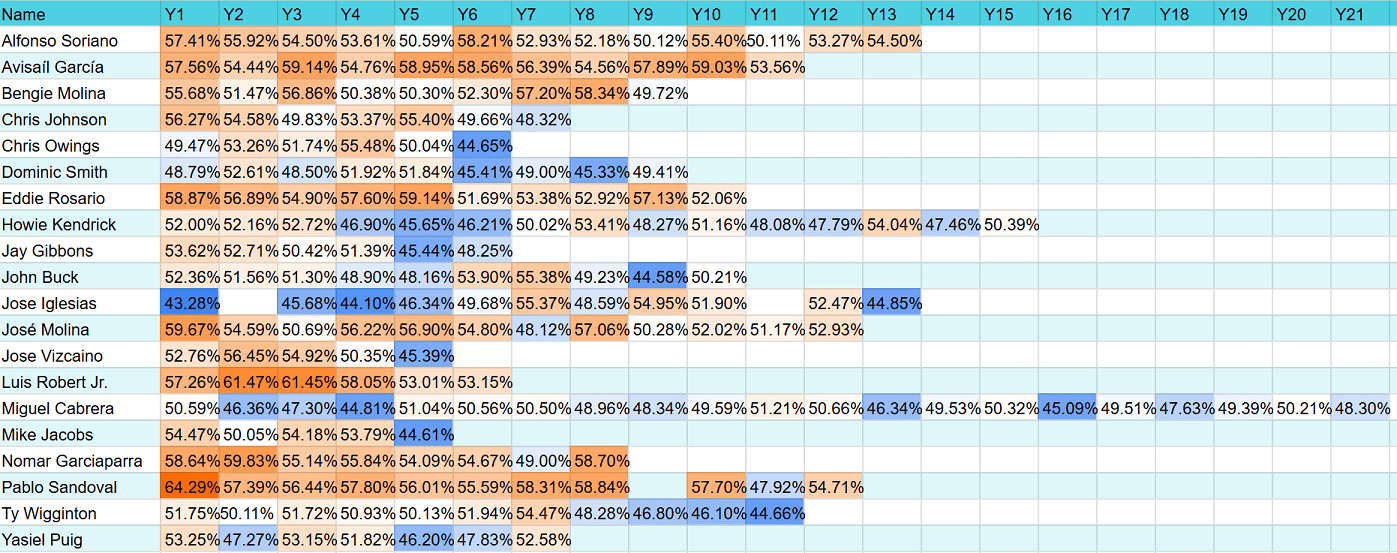
That leaves just 20 players left, and it only took two more times through KiNG MALA. The Swing:wRC+ correlation edges up to 0.029
- You don’t have to read this, just enjoy the pretty colors breaking up my massive paragraphs
I went ahead and aligned these players to year one of their careers. I need 21 columns because of MIGUEL CABRERA, who barely crossed the 50% swing rate threshold, and looking at his whole career, he really isn’t someone we’d call a free swinger. He’s also, y’know, one of the best hitters of all time. Dom Smith, Howie Kendrick, and Jose Iglesias also spent most of their careers under 50% with just a few scattered seasons above, and certainly not a downward trend.
On the flip side, Alfonso Soriano was definitely a free swinger, but he never dipped below 50%, so he was never patient nor passive. That also takes out Avisail Garcia, Eddie Rosario, and the remaining Molina brothers. Nomar Garciaparra had just one 49% in his next-to-last season.
- Exercise and decline
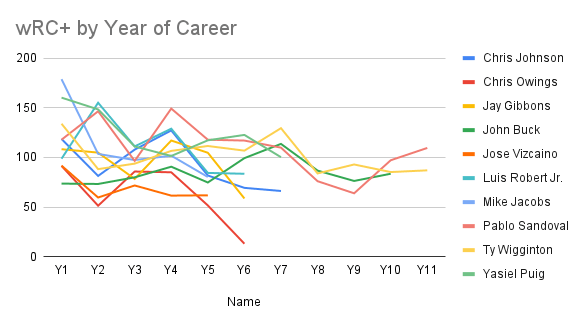
That only leaves 10 players over 24 years of Major League Baseball who meet the criteria of our hypothesis, which isn’t what we’d call a robust sample. They range from -1 to 19.8 career fWAR. Owings and Vizcaino were never employed for their sticks. Puig was never a below-average hitter. Panda only had two seasons, affected by injuries, under a 96 wRC+ before posting a 110 in his final tour. Maybe scouts drew googly eyes on their reports, but without access to those, I can’t say there’s anything you can learn from this group of players. They just couldn’t be more different from each other.
I might question pitch recognition ability of some of the players I eliminated. Flash-in-the-pan hitters who had short peaks and faded fast – but they don’t fit the conditions of the hypothesis. They either didn’t “give up” on swinging, were passive from the start, or wavered back and forth.
What we’re left with instead is 10 names out of 1616 that came this close to including Miguel bat-flipping Cabrera. I don’t think I could pick a more random ten if I tried. I’m not even gonna discuss the player who prompted this because while the data did suggest that swinging less is usually good, and I like to see a player trying something different off a couple of down years, there is no meaningful correlation between swing rate and results.
Still Feel it in Your Bones?
You might be asking, like this person, why I cared so much. Enough to keep pressing. Enough to spend my Easter Sunday doing all this. The answer is simple:
It is important to know what data does and does not tell us.
I could write a whole piece about that, but I’ve rambled on enough. Don’t get me wrong, though, I respect scouts. There are things like body language, projectability, and how comfortable/confident a player looks in the box that just aren’t captured by Hawkeye systems. This guy may very well be right about the player, but you can’t just take that knowledge and experience and turn around and say that it is in the data, actually.
At the end of the day, the only person I know for certain can’t pick up spin is me. Seriously, my eyes are SO bad. So I will stick to my spreadsheets, thanks.
Fantrax is one of the fastest-growing fantasy sites in the fantasy sports industry, and we’re not stopping anytime soon. We are the most customizable, easy-to-use, and feature-rich platform in the industry, offering the greatest fantasy experience for your dynasty, keeper, redraft, and best ball leagues. Fantasy sports doesn’t sleep, and neither does Fantrax, with seasons running 365 days a year. Take your fantasy leagues to the next level now at Fantrax.com!