



As someone who plays in multiple leagues that value quality starts, this is something I look into every year. I want to discover which pitchers will help me most, while also figuring out which ones to avoid. To earn a quality start, pitcher’s must last at least 6 innings, while simultaneously allowing three or fewer earned runs.
Quality starts can tell you a great deal about a pitcher in a way that wins and losses do not. For example, Logan Gilbert earned 22 quality starts last season, tied for the second most in the league. Despite being arguably one of the most dominant pitchers in baseball, Gilbert ended up with a 9-12 record. In one sense, he was one of the best pitchers in the league. Conversely, for someone who rostered him in another league, he may have been just okay.
Quality starts reveal that Gilbert clearly pitched well enough to last deep into games and limited runs in the process; unfortunately, Gilbert’s offense could not support him in many instances. Plus, their bullpen also let him down. The Mariners tallied the third fewest saves and were 21st in runs scored on offense.
Part of your goal in quality starts leagues should be to find pitchers who consistently pitch deep into games, both in drafts and while streaming.
Below, you will find my analysis on quality starts, beginning with some overall information, followed by pitchers to target and avoid in your quality starts leagues.
Quality Starts Primer
Fastball Velocity
Fastball velocity may seem unrelated to quality starts, but the link is essential in understanding the value of quality starts. For the fourth consecutive year, the average fastball velocity has increased:
- 2024: 94.3 MPH
- 2023: 94.1 MPH
- 2022: 93.9 MPH
- 2021: 93.8 MPH
- 2020: 93.5 MPH
- 2019: 93.5 MPH
- 2018: 93.2 MPH
- 2017: 93.5 MPH
- 2016: 93.4 MPH
- 2015: 93.3 MPH
- 2014: 93.1 MPH
- 2013: 92.9 MPH
- 2012: 92.7 MPH
Obviously, pitchers are throwing harder than ever, which is leading to increasing injuries. Because of this, teams have placed innings limits on pitchers, or pitchers simply cannot last long enough into games because of the wear and tear on their bodies.
Pitchers recovering from arm injuries due to throwing hard end up with fewer innings, and therefore, fewer opportunities for quality starts. This makes it essential for those in quality starts leagues to be risk-averse and target pitchers who do not have health concerns.
Because of these issues, quality starts have become relatively difficult to find. Take, for example, the quality start totals since 2012:
- 2024 – 1756
- 2023 – 1673
- 2022 – 1776
- 2021 – 1584
- 2019 – 1794
- 2018 – 1996
- 2017 – 2121
- 2016 – 2262
- 2015 – 2432
- 2014 – 2623
- 2013 – 2556
- 2012 – 2485
From 2012 to 2014, quality starts totals increased, but that was followed by a continual drop from 2015 to 2019. (Thanks to Matt Kirk for mining the data.) After 2020, pitchers saw the lowest quality start total of the last 12 years, partially due to stamina issues following the Covid year. Despite being four seasons removed, pitchers still have not even reached 2019 QS totals.
In 2024, there were 1756 quality starts, which is very likely what we can expect in 2025, if these trends continue.
Overall Quality Starts Trends
In 2023, 11 pitchers reached at least 20 quality starts: Gerrit Cole, Framber Valdez, Logan Webb, Zack Wheeler, Chris Bassitt, Kevin Gausman, Pablo Lopez, George Kirby, Blake Snell, Zac Gallen, and Jordan Montgomery.
In 2024, 10 pitchers reached that threshold, a decrease for the third year in a row. Wheeler, Kirby, and Webb repeated that feat from 2023. The others to reach 20 QS last season were Corbin Burnes, Seth Lugo, Tarik Skubal, Jose Berrios, Cole Ragans, and Aaron Nola. Outside of Berrios and Burnes, none of them had reached 20 quality starts in their career before last season.
The pitchers below registered at least 15 quality starts, but fewer than 20, in 2024:
- Hunter Brown
- Tanner Houck
- Shota Imanaga
- Pablo Lopez
- Luis Castillo
- Bailey Ober
- Bryce Miller
- Chris Sale
- Framber Valdez
- Cristopher Sanchez
- Kevin Gausman
- Dylan Cease
- Nathan Eovaldi
- Jameson Taillon
- Jake Irvin
- Max Fried
- Carlos Rodon
- Mitch Keller
- Mile Mikolas
- Jack Flaherty
- Kutter Crawford
- Sean Manaea
- Paul Skenes
This group is much longer than last year’s list. A number of these pitchers even rank outside of the NFBC top 50 pitchers, meaning there is value in this group. Even though some of these pitchers have their warts, they can carry a ton of value in QS leagues.
Brown, Houck, Sanchez, Gausman, Eovaldi, Taillon, Irvin, Rodon, Keller, Mikolas, Flaherty, Crawford, and Manaea all can be drafted relatively late. Of them, Brown, Houck, Sanchez, Eovaldi, Taillon, Rodon, Mikolas, Flaherty, Crawford, and Manaea all earned more quality starts in 2024 than in 2023, which could be trends that continue in 2025. Many of these pitchers could be hugely valuable late in drafts in QS leagues. One thing that we can do to find value and find pitchers to target is to look at the trends.
Pitchers Whose Quality Starts are Trending Up
Last season, 134 pitchers recorded at least five quality starts. That number is up slightly from 123 pitchers who did it in 2023. Counting pitchers with at least one quality start in 2023 and at least five last season, 63 recorded an increase in their quality start totals (remarkably identical to the 2022-2023 data).
Below are pitchers who had at least one, but fewer than five quality starts in 2023, with their 2024 QS total in parentheses. These are pitchers who are trending upward due to increasing innings, and who could continue to trend upwards this season. Some of the following pitchers are injured or have retired this season, and some may have changed roles this season, something fantasy managers should note.
- Carlos Rodon (16)
- Kutter Crawford (15)
- Michael King, Ronel Blanco (14)
- Ryan Feltner, Nestor Cortes, Brandon Pfaadt (13)
- David Peterson (12)
- Taj Bradley, Matt Waldron, Chris Flexen, Zack Littell, Bryan Woo (10)
- Ryan Pepiot, Kyle Harrison, Ben Lively (9)
- Nick Lodolo, Bailey Falter, Colin Rea (8)
- Ryan Weathers, Luis Ortiz (7)
- Nick Martinez, Javier Assad (6)
- Alec Marsh (5)
Players from this group to target in particular include Lively, Crawford, Marsh, Martinez, Peterson, Waldron, and Littell, all of whom have at least three above-average out pitches, according to Out% data. Though, others with increasing roles, more development, and further distance from injuries like King, Blanco, Pfaadt, Bradley, Woo, Pepiot, and Lodolo are other pitchers to target here as well.
Target 1: Nick Martinez
Nick Martinez possesses some pretty ridiculous stuff. He has four pitches that land above league average in Out%. His only pitch that was below league average at getting batters out was his curveball, which he threw just 12% of the time last year, and probably should throw even less. What makes him a great candidate to accrue quality starts is his ability to get both righties and lefties out, and after being stretched out last season, he should see more innings this year.
Martinez’s bread and butter is a combination of his changeup, cutter, and sinker. His changeup is absolutely filthy. Take a look:
https://x.com/PitchingNinja/status/1833286341724975251
He threw it more to lefties last season, but you can see in the video above that he could still get righty batters out with it. That pitch had a .186 BAA, a 41% whiff rate, and a 22% putaway rate, and despite some below average metrics in velocity and extension, PLV data likes his changeup too:
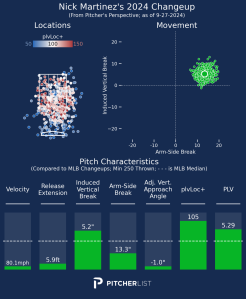
He got above above-average break and located it well, which led to outs. That pitch, combined with a Quality Pitch in his cutter, plus his sinker, which he throws overwhelmingly against righty batters, is going to be why he makes a huge jump in quality starts in 2025. As long as he is given starts in the rotation, he should be an excellent target late in drafts.
Target 2: Ryan Pepiot
Ryan Pepiot should see an increase in quality starts from the nine he had in 2024. In 130 IP across 26 starts for Tampa, Pepiot posted a 3.60 ERA, 9.8 K/9 rate, and a 3.3 BB/9 rate, just over the league average walk rate.
Pepiot projects for more innings this season, which would make sense, after increasing his inning totals each of the last three seasons. With his ability to strike batters out and limit walks (to a certain extent), he should be able to keep runners off the base paths and get out of innings without throwing too many pitches. The Rays have been conservative with young pitchers in the past, so Pepiot may not reach a 20 QS threshold, but 15-17 is in the realm of possibilities.
Pepiot is mostly a fastball/changeup pitcher but also features a decent slider as well. Both his fastball and changeup were above average at getting batters out last season, with his changeup grading as his best pitch.
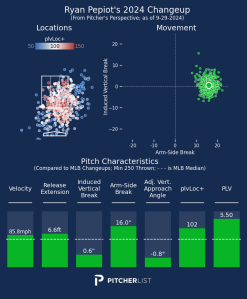
Above average velocity and location, near-elite extension, and excellent break make this a Quality Pitch. His changeup induced a five degree launch angle last season, which surely helped him to a 74% LOB rate. He can get batters out multiple ways, with multiple pitches, has a filthy changeup/fastball combo, is developing an out pitch against righty batters, and should see more innings this season. This all makes Pepiot a must-draft in leagues that feature quality starts.
More Positive Quality Starts Trends
Here are all the other pitchers with at least 5 QS in 2024, who saw an increase in their QS total between 2023 and 2024, including pitchers who had zero QS in 2023. Their 2024 QS totals are in parentheses. I have italicized a few that I expect to increase their quality start totals from last season:
- Zack Wheeler (26)
- Tarik Skubal, Seth Lugo, Logan Gilbert, Corbin Burnes (22)
- Cole Ragans, Jose Berrios (21)
- Aaron Nola (20)
- Tanner Houck, Hunter Brown, Shota Imanaga (19)
- Chris Sale, Bryce Miller, Bailey Ober (18)
- Cristopher Sanchez (17)
- Carlos Rodon, Max Fried, Jameson Taillon, Jake Irvin, Nathan Eovaldi, Dylan Cease (16)
- Sean Manaea, Kutter Crawford, Jack Flaherty, Miles Mikolas, Paul Skenes (15)
- Michael King, Ronel Blanco, Luis Severino, Tyler Glasnow, Michael Wacha, Reynaldo Lopez (14)
- Ryan Feltner, Nestor Cortes, Brandon Pfaadt, Hunter Greene, Brady Singer, JP Sears, Erick Fedde (13)
- David Peterson, Tyler Anderson, Ryne Nelson, Cal Quantrill, Jose Quintana, Yusei Kikuchi, Tanner Bibee, Spencer Schwellenbach (12)
- Nick Pivetta, Grayson Rodriguez, MacKenzie Gore, Garrett Crochet, Mitchell Parker, Jared Jones (11)
- Taj Bradley, Matt Waldron, Chris Flexen, Zack Littell, Bryan Woo, Luis Gil, Garrett Stone, Spencer Arrighetti (10)
- Ryan Pepiot, Kyle Harrison, Ben Lively, Reese Olson, Frankie Montas, Jose Soriano (9)
- Nick Lodolo, Bailey Falter, Colin Rea, Aaron Civale, Shane Baz, Cody Bradford, Jack Kochanowicz, Joey Estes (8)
- Ryan Weathers, Luis Ortiz, Paul Blackburn, Andre Pallante, Tobias Myers, Bowden Francis, Albert Suarez, Yoshinobu Yamamoto, Simeon Woods Richardson, Jonathan Cannon (7)
- Nick Martinez, Javier Assad, Casey Mize, Randy Vasquez (6)
- Alec Marsh, Edward Cabrera, Drew Thorpe (5)
Certain pitchers should be across-the-board draft picks regardless of league and scoring types. There are other players, however, that have some flaws that get outweighed in QS leagues.
Target 3: Spencer Schwellenbach
Spencer Schwellenbach is one of my personal favorite pitchers going into the season, and is a major target for me in all formats, but especially in quality starts leagues.
His splitter, slider, cutter, and fastball all graded out as league average or better in Out% last season, meaning he features four pitches that he can use to get batters out. On top of that, he posted a sub-two BB/9 rate last season in 21 starts and was above league average in LOB%. Schwellenbach has been excellent at inducing ground balls, leading to plenty of outs.
Schwellenbach’s arsenal features three pitches with a BAA below .230, two pitches with a whiff% in the 20s, and two with a whiff% in the 40s, plus four pitches with putaway rates between 19-25%. His splitter was filthy and is a pitch he should toss more, but his slider was incredible. Take a look:
Spencer Schwellenbach, Wicked 90mph Slider. 🤢
4th K pic.twitter.com/1TPP2xW3CL
— Rob Friedman (@PitchingNinja) September 30, 2024

Schwellenbach’s slider features above-average velocity and elite extension, plus elite location. It grades well into what PLV considers a Quality Pitch. Between his slider and splitter, the opposing batter’s handedness does not matter for Schwellenbach. He should be able to get batters out, and then keep runners from scoring when they end up getting on base. This could be a major breakout year for the young starter; hence, he should be a major target, especially in QS leagues.
The low walk rate is important for quality starts because these pitchers waste few pitches and show solid command. On top of that, they are effective at getting outs. And while Skenes and Crochet will be among the first pitchers drafted in many drafts, fantasy managers can find effective arms for quality starts leagues much later, even after pick 250.
More Pitchers To Target
Hunter Brown had an awful March and April but made some adjustments to his pitch mix that righted the course for him. He was a stud from May through the end of the season and should be considered a top option in quality starts leagues after tallying 19 of them last year.
Fantasy managers should reasonably expect a number of pitchers from the above list to continue increasing their quality start totals, some of them significantly in 2025.
Skenes, Glasnow, Lopez, Schwellenbach, Rodriguez, Crochet, Waldron, Woo, Olson, Lodolo, Myers, Francis, Yamamoto, and Martinez, in particular, make for excellent targets in 2025. They each threw fewer than 150 innings in 2024, so they should get a longer leash this season. More innings for these pitchers means there is more of a chance for quality starts, especially for the ones with top-tier stuff. Additionally, all of these pitchers had a BB/9 rate under three last season, and all but Waldron, Woo, Olson, Martinez, and Myers also have high strikeout totals.
Which Pitchers Should I Avoid in Quality Starts Leagues?
Similar to analyzing positive trends, looking at negative trends can tell you which pitchers to avoid in quality starts leagues.
Sometimes a dramatic decrease in quality starts can be due to injury, rather than performance issues. Nonetheless, when a pitcher’s quality start totals decline over multiple seasons, it can be a sign to avoid them. On that note, here are the pitchers who pitched in 2024 and saw their quality start total decline by at least five from 2023, regardless of injury status:
- Gerrit Cole
- Kyle Bradish
- Jordan Montgomery
- Jesus Luzardo
- Merrill Kelly
- Bryce Elder
- Eduardo Rodriguez
- Graham Ashcraft
- Max Scherzer
- Blake Snell
- Shane Bieber
- Dane Dunning
- Clayton Kershaw
- Alex Cobb
- Chris Bassitt
- Taijuan Walker
- Zac Gallen
- Justin Steele
- Justin Verlander
- Cristian Javier
- Braxton Garrett
- Bobby Miller
- Tyler Wells
- Marcus Stroman
- Dean Kremer
- Lance Lynn
- Kyle Hendricks
- Freddy Peralta
- Brayan Bello
- Patrick Corbin
- Jon Gray
- Yu Darvish
- Reid Detmers
- Domingo German
Reasons For Declining Quality Starts
Many of these pitchers experienced injuries last season that cut their year short, which affected their quality start output. Consequently, some of them carry injury risk into 2025 that could also impact their quality start totals. Even though Max Scherzer’s innings may increase, for example, his issues have persisted since after winning the World Series in 2019. Similarly, age and performance problems also seem to be catching up with pitchers like Lynn, Verlander, Darvish, Hendricks, and Kershaw. These pitchers have been markedly less productive in recent seasons, by and large due to aging and not being able to recover as quickly.
Repeated injuries to Shane Bieber have limited his ability to stay on the field, and concerns with his ability to stay healthy persist. This makes him a risky target in quality starts leagues. Additionally, pitchers like Luzardo, Kelly, Cobb, and Rodriguez, who have dealt with consistent and persistent health concerns should be considered risky as well.
Other pitchers may find themselves in danger of losing out on quality starts because of a role change, or being cut from their teams. Dunning became more of a bullpen option in 2024 after picking up 12 quality starts in 2023. Elder may find it hard to make Atlanta’s rotation if he cannot figure out how to limit runs.
The Orioles have a lot of arms in their rotation, including some who will be returning at some point in 2024. That crowded rotation may limit starts for pitchers like Kremer, Wells, and Bradish as the O’s figure out how to structure their rotation when and if it is fully healthy. The Dodgers, Phillies, and Diamondbacks each have similarly crowded rotations and bullpens, which could affect pitchers’ quality start totals.
One Particular Concern
Specifically, I worry about Snell, who has reached over 11 quality starts in a season just twice since 2017 (not counting 2020). This is in part because he has only ever pitched more than 130 innings in a season twice during that same span. Not only is that an issue, but he consistently walks batters, driving his pitch count up and limiting his ability to last long enough into games to earn quality starts, despite his high strikeout totals.
There are plenty of pitchers who produce high walk rates and low strikeout rates that fantasy managers should avoid in quality starts leagues. These high-walk, low-strikeout pitchers risk baserunners. Additionally, pitchers who have low strand rates should be avoided as well. If a pitcher allows base runners, then is unable to keep them from scoring, that pitcher will not last deep into games.
Risky Pitchers in Quality Starts Leagues
Here are few pitchers that THE BAT projects to have a K/9 and BB/9 rate worse than league average, as well as a below league average LOB% in at least 100 innings pitched:
- Frankie Montas
- Chris Bassitt
- Tyler Anderson
- Luis Severino
- Kyle Gibson
- Martin Perez
- Ryan Weathers
- Andrew Abbott
- Kyle Harrison
- Merrill Kelly
- Ryan Feltner
- Jose Soriano
- Andre Pallante
- Luis Ortiz
- David Peterson
- Jose Quintana
- Javier Assad
- Michael Lorenzen
- Simeon Woods Richardson
- Lance Lynn
- Randy Vasquez
- Jordan Hicks
- Cal Quantrill
- Johan Oviedo
- Michael Soroka
- Marcus Stroman
Consistently Low Quality Starts Totals
What about pitchers who never seem to accrue many quality starts? Here is a list of pitchers who have not reached more than 15 quality starts in any of the last three seasons, therefore, are pitchers I would avoid at cost (for this, pitchers need to have pitched in all three season from 2022-2024). You may notice some familiar names:
- Michael Wacha
- Luis Severino
- Brady Singer
- JP Sears
- Hunter Greene
- Nestor Cortes
- Ryan Feltner
- Charlie Morton
- Austin Gomber
- Yusei Kikuchi
- Jose Quintana
- Ryne Nelson
- David Peterson
- Ranger Suarez
- MacKenzie Gore
- Nick Pivetta
- Kyle Freeland
- Chris Flexen
- Patrick Corbin
- Michael Lorenzen
- Ryan Pepiot
- Aaron Civale
- Bailey Falter
- Lance Lynn
- Jon Gray
- Andrew Heaney
- Paul Blackburn
- Javier Assad
- Nick Martinez
- Kyle Hendricks
- Reid Detmers
- Patrick Sandoval
- Dakota Hudson
- Carlos Carrasco
- Cristian Javier
- Hayden Wesneski
- Jose Urena
- Trevor Rogers
- Dane Dunning
- Taijuan Walker
- Braxton Garrett
- Ross Stripling
- Eduardo Rodriguez
Hopefully this guides you and helps you make some tough decisions in your Quality Starts leagues. Comment with any questions, since this can be something difficult to predict, or reach me on Twitter/X @TaylorTarter.
For more of the great fantasy baseball rankings and analysis you’ve come to expect from FantraxHQ, check out our full 2025 Fantasy Baseball Draft Kit! We’re here for you all the way up until Opening Day and then on into your championship run.
Ryan Pepiot do I target him or not?
Yes