

The concept of position scarcity is one that has been debated for quite some time. It’s the idea that different positions are deeper in talent than others, meaning that later in drafts, there could be a drop in talent for the positions whose depth is sparse. After all, there’s no worse feeling in drafts than seeing good players worth drafting at a position where your lineup is already filled.
How Important is Position Scarcity in Fantasy Baseball?
That being said, this is also a concept that should be fluid from year to year. The idea that “I will never draft a catcher early” (as an example) may work now, but years ago, when the talent level was porous, reaching a little bit on a catcher may not have been such a bad idea. It all depends on the player pool, the talent level at each position, draft trends, and more.
Here are some positional trends that are taking place in drafts. The positions examined will be the positions of catcher, first base, second base, shortstop, and third base. While position scarcity applies to the outfield and all pitching spots, it doesn’t have the same exceptionalities, given that the player pool is so much bigger.
It’s also worth noting that all ADP numbers will be taken from the NFBC website and extracted from drafts since January 1 in all DC formats. When looking at each position to determine scarcity, the question should be, “Would I be happy with this player as a starter for me at that position?” If the answer is no, then you should not be looking this deep into the player pool.
Catcher
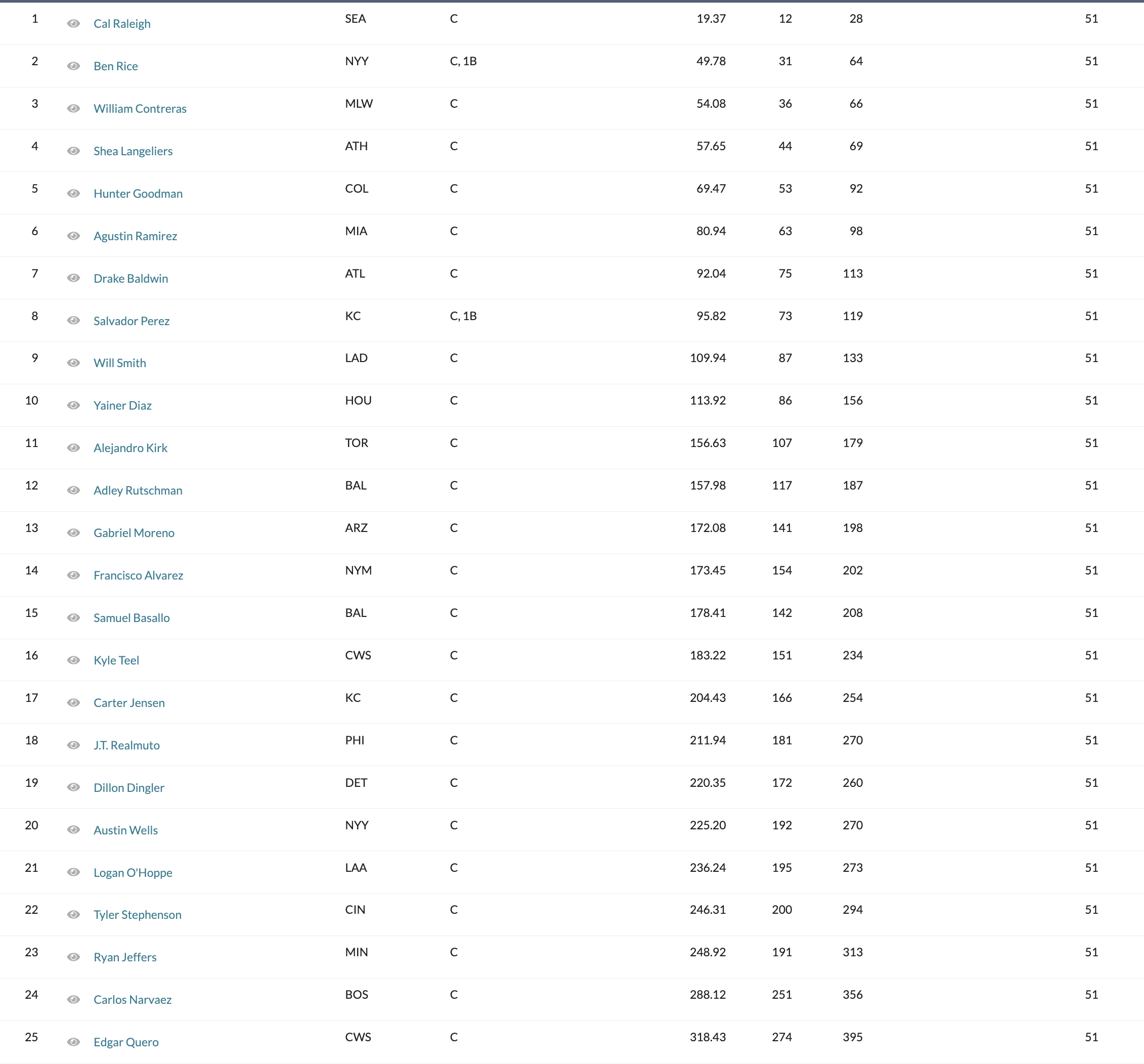
The catcher position may be deeper than it’s ever been, but just how many players are confident options to start on your teams?
- Cal Raleigh (1) led all of baseball with 60 home runs hit and almost won the AL MVP trophy. Even if he lowers his production by a third, he still hits 40 home runs and likely remains as baseball’s best catcher.
- Ben Rice (2) is gaining a lot of hype this offseason, and as such, his draft price is going to continue to rise. That said, he should still see plenty of opportunities to hit and produce like he did last year. He is a stronger player here at catcher, instead of at first base.
- William Contreras (3) played through an injury last year, hurting his final stat line. He should be 100% healthy in 2026, and could skyrocket up catcher rankings.
- Shea Langeliers (4) gets another chance to play in the hitter-friendly Sutter Health Park with an up-and-coming team. He is a worthy C1 in all formats.
- Hunter Goodman (5), Agustin Ramirez (6), and Drake Baldwin (7) all broke out last year and are young enough to take another step forward. They will get playing time and should be rostered.
- Salvador Perez (8), despite being a year closer to retirement, should benefit from the new dimensions at Kauffman Stadium and is definitely worth rostering.
- Will Smith (9) and Yainer Diaz (10) are both big-name players who have provided more fantasy value than they did in 2025. While a bounce-back for both isn’t necessarily a given, they’re both great C1 options.
Here’s where it begins to get tricky. If you’ve waited this long in a single-catcher league, then chances are that you’re willing to wait some more. In doing so, Adley Rutschman should bounce back this year, but if he doesn’t, then the Orioles have Samuel Basallo to pick up the pieces. Francisco Alvarez has a powerful bat, but his body doesn’t seem to be able to withstand the injuries. Gabriel Moreno and Alejandro Kirk offer batting average boosts, but other than that, it’s a pretty empty stat line. All of the above-mentioned here would be fine C1 in two catcher leagues, and finding catchers later who will play is key.
* Ivan Herrera and Willson Contreras may gain catcher eligibility at some point this season, and both are excellent options.
Conclusion: The catcher position is as strong as ever. For one-catcher leagues, it seems best to wait and take what falls to you later in drafts. In two-catcher leagues, while drafting a catcher early isn’t out of the question, it’s no longer a must either. Waiting in all situations feels feasible and could lead to success.
First Base
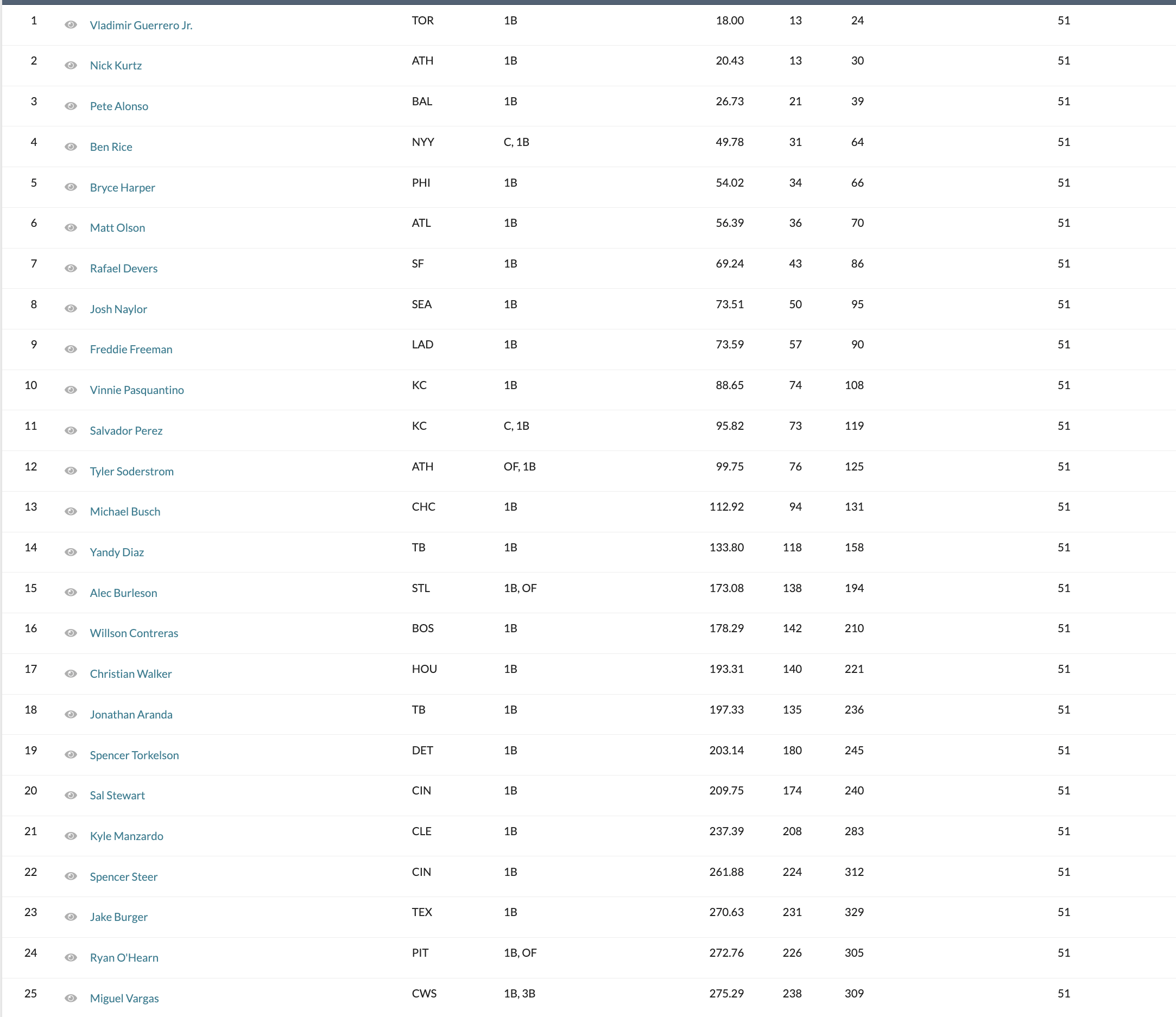
Up and down the board here, first base looks like a solid position. How many players make you feel good and confident in rostering as your starting first baseman?
- Vladimir Guerrero Jr (1), Nick Kurtz (2), and Pete Alonso (3) are in a tier all by themselves. All have tremendous power abilities, with Guerrero offering high batting average upside. You should feel confident with any of them as your starter.
- Bryce Harper (4) has seen his power output dissipate over the years, but some of that could have been due to injuries. He’s by no means washed up and is still a tremendous option.
- Matt Olson (5) and Rafael Devers (6) are both power-first everyday players, making them an attractive fit for most roster builds. There’s a potential for a low batting average, but don’t let that stop you from drafting them.
- Josh Naylor (7) had himself a career-best season in 2025, stealing 30 bases. It’s unclear if that was an anomaly, but he’s a solid option.
- Freddie Freeman (8) is getting older, but he’s still one of the best in the game.
- Vinnie Pasquantino (9) should also benefit from the new dimensions at Kauffman Stadium.
- Tyler Soderstrom (10) broke out in a big way last year and is still just 24 years old. He has a chance to take a step forward in 2026.
- Michael Busch (11) is proving to be a solid ball player who will get everyday at-bats for a great Cubs lineup.
After that, we get to some players who SHOULD produce, but it’s unclear if they will. Yandy Diaz had a breakout season in 2026, but a move back to Tropicana Field could signal the end of his offensive brigade. Alec Burleson is a very good hitter, but he’s in a poor lineup and may not reach his full potential. Jonathan Aranda was a popular breakout pick last year, and he still might do it, but he feels more like a corner infield option. Kyle Manzardo had himself a tremendous second half of the season, but how confident are you in making him your starter all year?
Conclusion: The first base position has some of the best offensive weapons in baseball. Some might even be worth reaching for early on in drafts. In the deepest of leagues, if you miss out on those opportunities, it feels like waiting would be a better option, and then reaching for potential instead of known value. That said, it doesn’t feel like you need to be overly aggressive when drafting.
Second Base
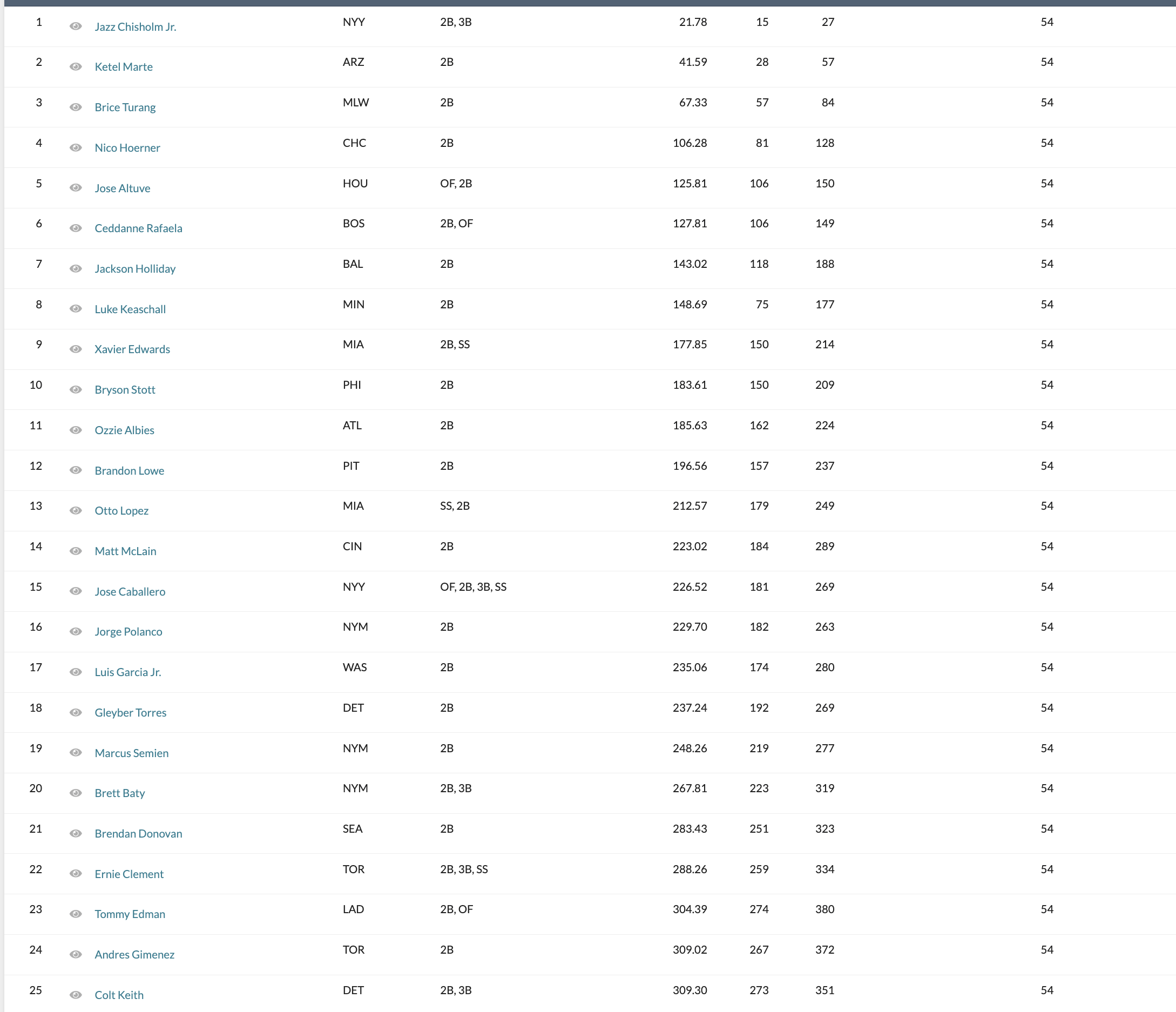
There is a case where this is the shallowest position in all of baseball, leading to the question of which players are fine enough options to be your starting second baseman?
- Jazz Chisholm Jr. (1) and Ketel Marte (2) lead the way as the clear favorites at this position. Both have safe floors with potentially rocky ceilings due to injury risk and age, but neither is worth passing over for the right price.
- Brice Turang (3) broke out in 2025 with an uptick in bat speed and some mechanical tweaks. While it’s reasonable to doubt that he repeats last year’s success, he should at least come close enough to it to warrant a pick and some positional safety.
- Nico Hoerner (4) and Xavier Edwards (5) offer batting average help and stolen base upside, two offensive categories that are difficult to manage.
- Jackson Holliday (6) continues to improve, and he’s young enough to see a big step forward this season. He continues to position himself closer to the player we all expected him to be when he was one of the game’s top prospects.
- Luke Keaschall (7) has fought through injuries to become one of the most promising players on this list, and he’ll be getting reps everywhere on the field. While he doesn’t have a proven track record, he still feels like a safe bet for success.
- Ozzie Albies (8) and Brandon Lowe (9) have proven that they can be viable second basemen with health, and while neither is a guarantee to stay healthy, they’re worth rostering with the hopes of at least 600 plate appearances.
After that, it gets dicey. Ceddanne Rafaela broke out last year, albeit in a small way, and the underlying metrics don’t back up a repeat performance. Bryson Stott always feels like a lunchbag letdown, in the sense that his final numbers underwhelm. He is projected to do well this year, if you want to take a chance. Matt McLain has had a productive offseason and could produce in an improved Reds’ lineup, but he’s nowhere close to a guarantee to live up to his potential. Marcus Semien gets a new chance for success, and a case could be made that it could happen because of his new stadium and lineup around him.
Conclusion: There are some nice options at the top of the second base list, but as the ADP rises, so does the risk, almost exponentially. It feels like picking an earlier second baseman is the better way to draft, but even those options carry risk. The entire position is almost like a landmine. That said, position scarcity here might provoke someone drafting to set it and forget it at second base.
Third Base
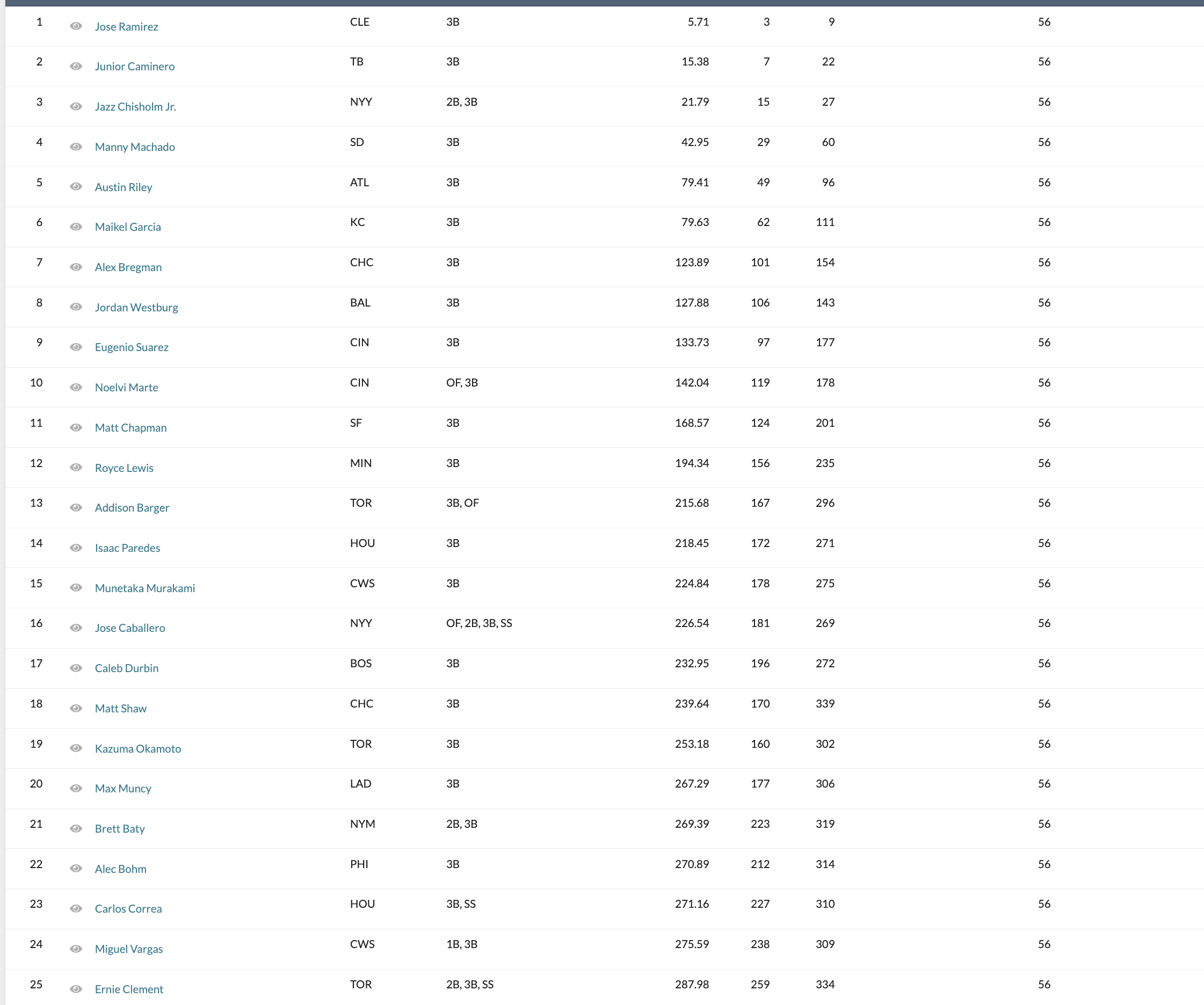
The hot corner position was once considered deep and full of power. Now, let’s see how deep this position really is:
- Jose Ramirez (1) is one of baseball’s best players and is worth his weight in gold. Draft him.
- Junior Caminero (2) broke out in a major way last year. However, this season his home games will be indoors at Tropicana Field, and he didn’t fare so well outside of George Steinbrenner Field. Still, he’s good enough to warrant a roster spot and be a starting third baseman.
- Manny Machado (3) and Austin Riley (4) have frequently ranked at the top of the third-base rankings for years. Don’t let age or past injuries sway you away from rostering them.
- It’s hard to project one way or another if the new dimensions at Kauffman Stadium will help or hurt the value of Maikel Garcia (5). That said, he’s been playing at an elite level when healthy.
- Alex Bregman (6) might see a dip in production due to his new ballpark, as it’s the first time that his home stadium won’t favor his bat and profile. He is still someone to feel comfortable rostering as your third baseman.
- When healthy, Jordan Westburg (7) plays at a near elite level. It’s a big if, but he’s by no means someone to fear drafting.
- Eugenio Saurez (8) back in Cincinnati: yes, please!
- Matt Chapman (9) has this year to prove that 2025 isn’t a sign of things to come. He gets the nod with the benefit of the doubt.
After that, some questions need answering. Can Noelvi Marte sustain last season’s overall success, despite some very concerning metrics under the hood? Can Royce Lewis stay healthy for more than 106 games and become the player we hoped he could be? Will Addison Barger sustain last year’s breakout and prove it wasn’t a fluke? Can Isaac Paredes* play every day and live up to his potential?
* full context, if Isaac Paredes gets traded or gets everyday playing time in Houston, he makes the list of confidence here.
Conclusion: Third base feels like a case can be made for position scarcity. Other than the elite of the elite, there are no options here without question marks. It feels like this is a position worth reaching for, as after the top ten players, the talent level falls off a cliff.
Shortstop
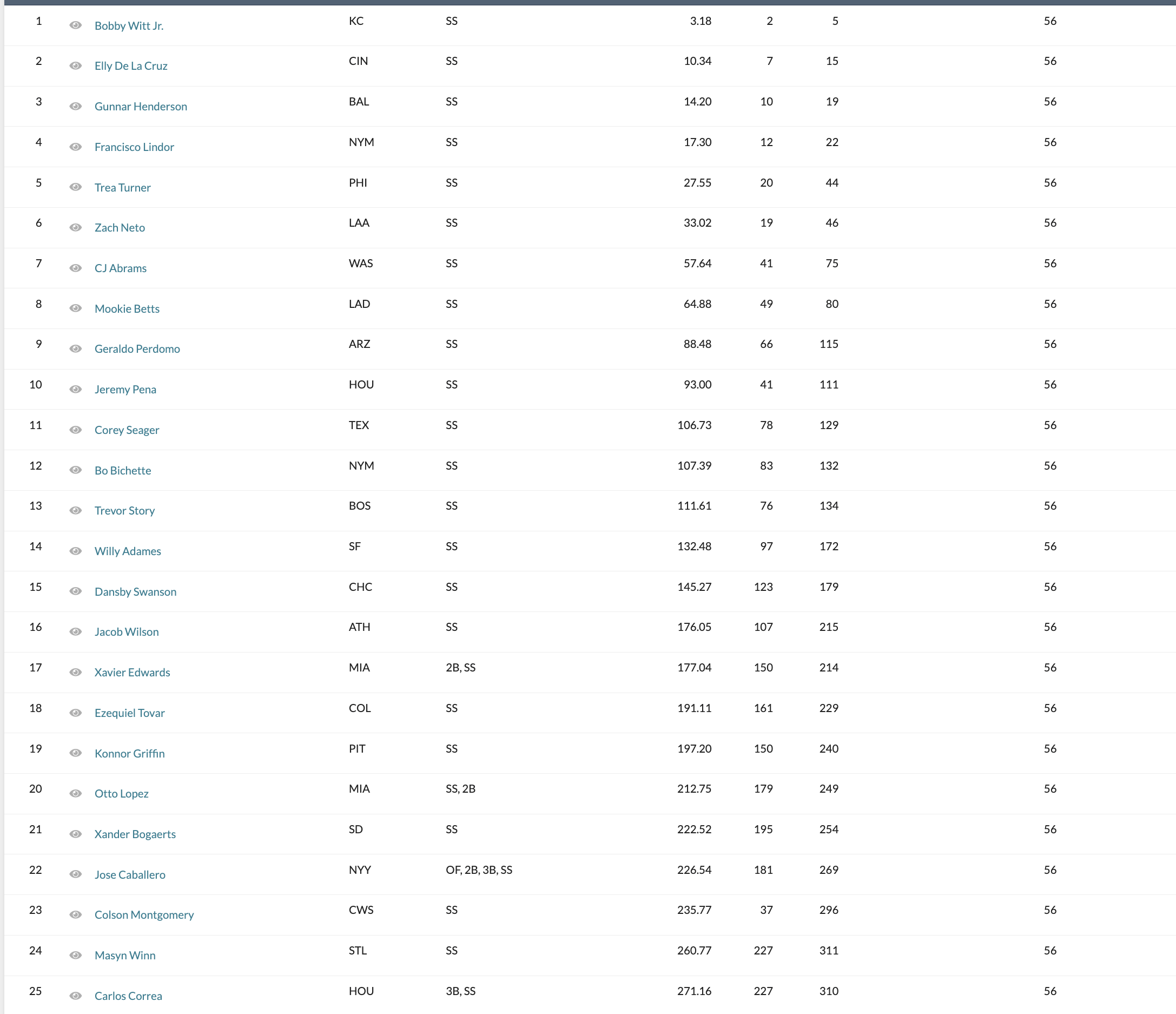
Considered the best position in baseball, here’s where the stars really shine. That said, how many players would you feel safe with as your starting shortstop?
- Bobby Witt Jr. (1) is a stud. Don’t overthink this.
- Elly De La Cruz (2) has some red flags attached to his profile, but he was also hurt last year. Draft with confidence.
- Gunnar Henderson (3) was also playing hurt for most of the 2025 season. Buy the dip, if there is any, by the time you draft.
- Francisco Lindor (4) is getting up there in age, but he’s still one of the best in baseball.
- Trea Turner (5) continues to shine and be one of the best at stealing bases.
- Zach Neto (6) looked better than ever despite coming back from major offseason surgery. A healthy offseason could provide even better results.
- CJ Abrams (7) has seemingly underperformed his entire career, and yet he remains a player with good upside. He may get traded, and his stock would rise wherever he goes.
- Mookie Betts (8) looked better as the season wore on, and as such, looked more and more like his former self.
- Geraldo Perdormo (9) is someone that I don’t necessarily believe in, but he may be a late breakout. Take a chance on him, but have a backup ready.
- Jeremy Pena (10) broke out last season and looks ready to roll.
- Bo Bichette (11) and Carlos Correa (12) will both gain third base eligibility this season and should be used at the hot corner. They just won’t be able to do it until some point during the season.
- Corey Seager (13) is one of the best in baseball when healthy, but it’s never a given that he will actually stay on the field.
- Will Adames (14) took a while to get started, but his 2025 season finished with a bang. If he can figure out how to raise his batting average, he should move up the rankings.
After that, the options get a bit dicey, but they do have some potential. Dansby Swanson and Xander Bogaerts are underrated in that they have consistently produced power and speed numbers for quite some time. They’re borderline shortstop worthy, but a beautiful middle infield pairing with one of the aforementioned players. Ezequiel Tovar just needs to stay healthy to provide some prominence at the position, though that is sometimes easier said than done. Konnor Griffin is one of baseball’s most exciting prospects, but there’s a world where the Pirates are going to pirate, and don’t call him up until they gain more years of team control from him. Jacob Wilson provides batting average stability, but not much more than that.
Conclusion: Shortstop is full of potential, and drafting at least one of the stable players listed is a worthwhile strategy in drafts. Even if, for some reason, you decide against these options, the ones with questions offer enough upside where you can see them succeeding with things falling their way. The good news is that if you choose to avoid this position, chances are you’re able to bolster the rest of your lineup without sacrificing too much in terms of production until you do pick a shortstop. It’s the one position in baseball where the makeup of your team is determined by how you decide to build a roster. Pick wisely.
Fantrax is one of the fastest-growing fantasy sites in the fantasy sports industry, and we’re not stopping anytime soon. We are the most customizable, easy-to-use, and feature-rich platform in the industry, offering the greatest fantasy experience for your dynasty, keeper, redraft, and best ball leagues. Fantasy sports doesn’t sleep, and neither does Fantrax, with seasons running 365 days a year. Take your fantasy leagues to the next level now at Fantrax.com!