
Dynasty leagues get to have drafts too; they’re usually limited to First Year Players – new draftees and international free agents (IFAs) since you’re keeping almost your entire roster. Some leagues may include available free agents in these drafts, but those are more like waiver pick-ups.
Prospecting for Dynasty: Mastering FYP Drafts
FYPs are more volatile and have less information available than drafting established prospects. Many haven’t played in affiliated ball yet, let alone at a level that has statcast data available. Ranking lists also vary even more on these players. Sometimes there’s a consensus #1, but we don’t really have that this year. In this article, I’ll help you navigate your first FYP draft (or 3rd or 10th).
International Free Agents
When I say IFA, I’m referring to players signing out of other professional leagues like NPB and the KBO, like Tatsuya Imai and Munetaka Murakami. This may also include returning MLB’ers like Cody Ponce, depending on your league rules. Some ranking lists don’t even include these players. Top IFAs are often the best picks because they have the equivalent of AA or AAA experience overseas, while even the best college competition is more like A-ball. If you’re contending, you definitely want to move these guys up your list. Even if you’re deep in a rebuild, their trade value could be higher than any available draftee.
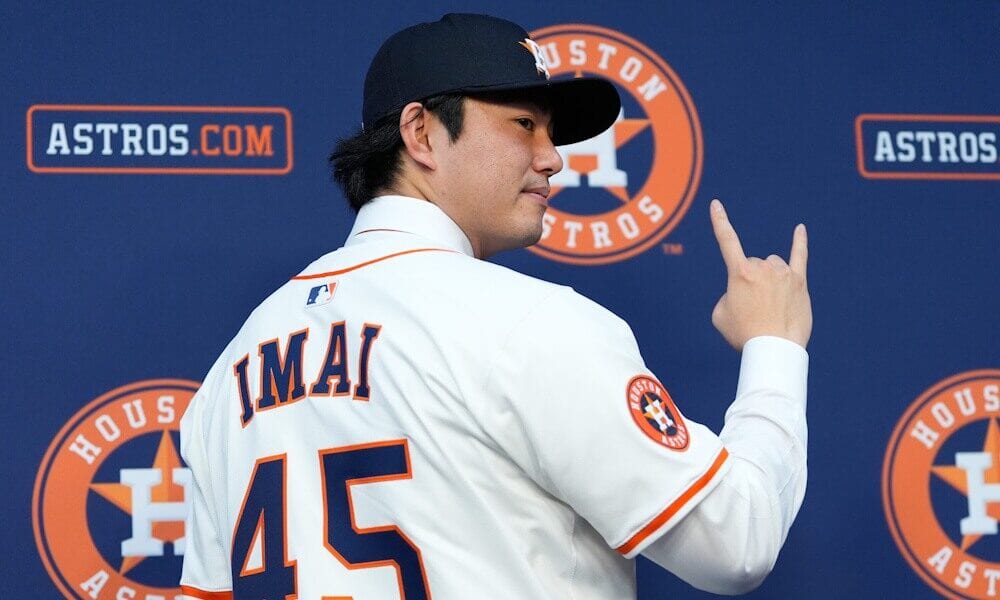
Tatsuya Imai
Pitchers tend to fare better in MLB than hitters, partly because pitch shape and velocity are easier to judge regardless of competition. Not that there aren’t pitfalls here – Roki Sasaki was able to blow away NPB hitters with pure velocity, but we’ve seen that without shape and command, most MLB hitters can tee off on 99. Imai has both shape and command, and his stuff looks even better in early spring than it did in Japan. I’m buying in dynasty and redraft.
Munetaka Murakami
On the flipside, power rarely translates to MLB, and that was Murakami’s calling card. Since an MVP season in 2022, though, his strikeout rate jumped from low-20s to high-20s, and his contact rate dropped from a not great 70% give-or-take to low 60s – something only Joey Gallo did over a sustained period in the majors – and that’s before adjusting for MLB pitching. While FanGraphs does rate his raw power as 80 grade, I don’t think he’s got Gallo-power. He’s a huge gamble and one I’m not taking in dynasty.
Kazuma Okamoto
Okamoto, on the other hand, hit 30-40 dingers in Japan while maintaining a 75-80% contact rate and striking out less than 20% of the time. Projections put him more in the low-mid 20s, but I think he’s more likely to get there than Murakami – and do it with a more palatable batting average.
J15 Signess – International Teens
J15 refers to the January 15th signing period for international amateurs. These are 16-17-year-olds who have been scouted since they were 10 and often have had handshake agreements with MLB clubs since they were 12 or 13, despite such deals being forbidden by the CBA. You occasionally see U.S. players re-classify as international to get better bonuses or avoid the draft, but that’s less common with recent CBA changes to limit international spending.
There’s always a couple of J15 players in every class that jump into top 100 lists after signing, but it’s not always the top bonus-getters (see Jesus Made), so drafting them is fraught. Despite their age, they do play as much or more baseball than the most committed U.S. high schoolers and train often exclusively in the sport, so it’s not unusual for them to be advanced for their age. We’ve seen this with aggressive minor league assignments of Ethan Salas and Leo De Vries in recent years, which contributed to equally aggressive rankings, but Salas is a cautionary tale as his development stalled after initially holding his own.
Because we have so little information, I avoid taking them in the top 25 FYPs and treat them more like lottery tickets likely to be dropped when another one pops. We do have Dominican Summer League (DSL) data on FanGraphs now, so we do have some insights before they get Stateside. Just understand that it is an extremely hitter-friendly environment. Speaking of, just don’t draft J15 pitchers. You’ll hear about them if they reach A-ball and will be free for the taking outside the deepest leagues.
Oddly enough, I do like stashing one in shallower leagues where a 1% chance at a star is better than a 30% chance at someone becoming the kind of major leaguer you can always pick up. They can also be a good target for contending teams who have traded away or graduated most of their prospects and have the minor league slots for such gambles and flipping them if they pop. The top names worth a flyer this year are Luis Hernandez (SF), Francisco Renteria (PHI), Johenssy Colome (ATH), Angeibel Gomez (KC) and Wandy Asigen (NYM) – in no particular order.
For more of the great fantasy baseball rankings and analysis you’ve come to expect from FantraxHQ, check out our full 2026 Fantasy Baseball Draft Kit! We’re here for you all the way up until Opening Day and then on into your championship run.
Draftees
By far the most ink is spilled on high school (AKA “prep”) and college draft classes, and they will be the majority of players picked in FYP Drafts. You’ll find better consensus on the order of these players, but there can still be differences of 8-12 spots between players ranked in the top 15 by most sources.
I compiled several FYP lists, and three players ranked #1 (Imai, Eli Willits, and Kade Anderson) and 15 within at least one top-10. The big difference I find in lists is how close they hew to pre-draft rankings vs new data. Take Dax Kilby as an example. FanTrax ranked him 26, which tracks with him being the 39th pick in the draft, but lists published in 2026 rank him 4th or 5th based on his low-A debut, where he struck out just 13.6% of the time and swiped 16 bags in 18 games while posting impressive exit velocities (according to unnamed sources with access to non-public data). Conversely, Ethan Holliday had nearly a 40% strikeout rate in his 18 games, reinforcing pre-draft contact concerns.
Besides Kilby and Holliday, players with the biggest disagreement in FYP ranks include Aiva Arquette (3 to 20), Gage Wood (11 to 28) due to electric stuff and no track record starting, Andrew Fischer (16 to 40) and Billy Carlson (12 to 38) who I like as this year’s big “Two-way player focusing on hitting” player. Last year’s was Konnor Griffin, who you may have heard of. Griffin has two inches and 40 pounds on Carlson, but it’s not unusual for players who are gifted enough athletes to be two-way players to see rapid development when they dedicate their attention to the dish.
Impact from Any Slot
While Nick Kurtz was ranked 4th on average last year, Konnor Griffin had an average rank of 10th and was widely available as a mid-to-late first-round pick in FYPDs. Ryan Waldschmidt and Trey Yesavage were ranked in the teens, and Kaelen Culpepper was ranked 30+. Caleb Bonemer ranged from 34-53 in FYP ranks and can be found in that range on the top 100s now. Payton Tolle was ranked in the 50-70 range, if at all, and is among the top pitching prospects today. So don’t assume those 4th round picks are worthless. If you do some research, you can find guys with real top 100 potential, no matter where you finished last year.